Step 1. The big picture
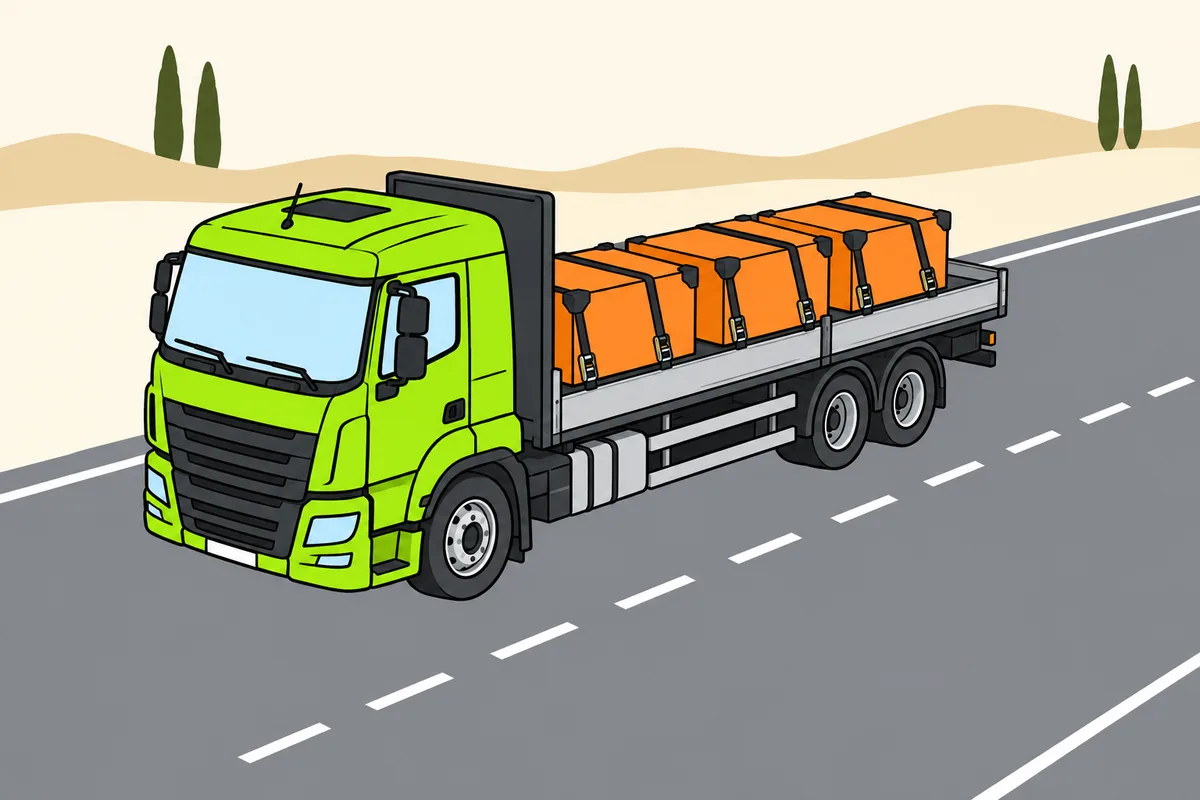
In one sentence…
Safe loading isn't just a logistics matter: incorrect stowage shifts the centre of gravity, lengthens braking distance and can cause a rollover or objects to fall onto the road. In the C licence - Truck, study it as a matter of safety, responsibility and anticipation.
Step 2. The syllabus
2.1Principles of stowage
The load must be immobilised so it doesn't shift, fall, drag or compromise the vehicle's stability, visibility or the effectiveness of its devices while driving.
- The weight distribution must respect the vehicle's capabilities; place the heaviest items low and centred whenever the load and the space allow it.
- Stowage begins before you start the engine: check the support base, securing, catches, tarpaulins, panels and any element that prevents falling or shifting.
- Don't study loading as an isolated formality; in the exam it's linked to braking, bends, gradients, visibility, signalling and driver responsibility.
2.2Distribution and centre of gravity
A high or lateral load shifts the centre of gravity and reduces the margin in bends, swerves or crosswind, even if the vehicle doesn't exceed its authorisation.
- Badly distributed weight can load wheels, suspension and brakes unevenly, which is why the correct answer doesn't always speak only of maximum mass.
- If the load changes during the service, through partial unloading or internal movement, you must rethink stability before carrying on as if nothing had changed.
- Practise imagining where the load would push in a braking manoeuvre, a bend and a gradient; that mental image helps you answer without memorising loose phrases.
2.3Lashings and checks
Doors, tarpaulins, panels, lashings and catches are checked before setting off and during the service if the journey, vibration or the load require it.
- A lashing that's valid at the start can lose effectiveness through harsh driving, an irregular surface or the goods resettling, so vigilance doesn't end once you set off.
- If you notice shifting, loss or risk of items coming loose, you must stop in a safe place and fix it before rejoining traffic.
- In multiple-choice questions, be wary of answers that postpone the fix until arrival when there's already a risk to the road or to other users.
2.4Driving with a load
The greater the mass and the worse the distribution, the longer the braking distance and the worse the response in a bend, swerve or slow manoeuvre, even with a technically correct vehicle.
- Smooth driving preserves the stowage: accelerate, brake and turn progressively so as not to turn a well-secured load into a dynamic risk.
- In rain, on a gradient, on an irregular surface or in crosswind, increase your safety margin because the load amplifies any late correction or sudden manoeuvre.
- The exam tends to reward anticipation: if the situation seems doubtful, the safe answer is usually to reduce demand, observe more and avoid abruptness.
2.5Responsibility on the road
A vehicle whose load stains, drags or falls onto the road must not be driven, because the risk no longer affects only the truck driver.
- Responsibility includes checking that the load doesn't limit visibility, lighting, optical signalling or any visible devices needed to warn of manoeuvres.
- Signs restricting mass, height, width, length or goods can determine the route even if the stowage seems correct.
- When a question mixes route and load, first confirm the vehicle can use that section and then analyse securing and distribution.
2.6Exam practice
In the C-specific test you have 20 questions, a maximum of 2 errors and 20 minutes; answer quickly, but always from the rule and the case described.
- Turn each case into four questions: what can move, what can fall, what can block visibility, and what can change the vehicle's stability.
- Don't answer purely on common sense; look for the option that requires preventing the risk before the load affects braking, visibility or the road.
- Review loading, mechanics and truck techniques together, because the DGT combines these topics to check whether you understand the vehicle's real behaviour.
Step 3. Key points
If you only have a minute before the exam, revise this.
- 1.Immobilise the load before starting to drive.
- 2.Distribute the weight with stability in mind.
- 3.Place the heaviest items low and centred where possible.
- 4.Check doors, tarpaulins, panels, lashings and catches.
- 5.Increase your margin in rain, on a gradient, in wind or on an irregular surface.
- 6.Stop safely if you detect shifting or loss of load.
- 7.Check the load doesn't block visibility or signalling.
- 8.Relate each case to braking, bends and responsibility on the road.
Step 4. Exam traps
Mistakes the DGT uses again and again on this topic.
- Thinking it's enough not to exceed the maximum authorised mass.
- Forgetting that harsh driving can ruin an initially correct stowage.
- Confusing an immobilised load with a load that's simply placed on board.
- Ignoring that the load can affect visibility, lights and optical signalling.
- Waiting until arrival even though there's a risk of items coming loose.
- Answering about total weight without assessing distribution, centre of gravity and route.
Step 5. Quick check
Four real exam questions on what you have just read.
If you are driving a lorry, must you know how to position and secure the load?
Step 6. Frequently asked questions about safe loading
- At an unsigned narrow passage, with no steep gradient or instructions from officers or authorised personnel, two vehicles of the same type must decide which reverses. Neither has priority from entering first and both would reverse the same distance. Which dimensions or mass are considered for priority?
- Greater width, length or maximum authorised mass. For that tie, greater width, length or maximum authorised mass are considered. Before this tie-break, the vehicle that would reverse farther has priority; different vehicle types follow Article 62’s hierarchy. This is not a general junction-priority rule or a rule based on actual load. Signs, authorised instructions, prior entry and steep-gradient rules must be resolved before this tie situation.See full question
- Under Spain’s vehicle-use classification, a vehicle carries goods in a fully enclosed compartment, with no padding or special interior adaptation and no bulk-material tank. Which designation applies?
- Box body. Caja cerrada (closed box body), use-classification code 20. A capitoné also has an enclosed compartment, but with padding or special interior adaptation; this question excludes that feature. A silo is specially designed for powdered or granular solids in a closed tank. Enclosure alone does not distinguish all these uses; the additional features must also be considered.See full question
- A lorry used exclusively for goods transport is exactly 5 metres long. It carries indivisible-length posts with proper stowage and securing, without a special-transport authorisation. What is the maximum longitudinal overhang?
- One third of the vehicle's length at the front and one third of the vehicle's length at the rear. One third of the vehicle’s length at the front and one third at the rear: approximately 1.67 metres at each end of a 5-metre vehicle. This rule concerns indivisible-length loads in vehicles used exclusively for goods. The 2-metre front and 3-metre rear limits apply to vehicles longer than 5 metres, not exactly 5 metres. Other limits still apply; protect protruding ends and use required markings, including V-20 for rear overhang and additional lighting under the applicable conditions.See full question
- You park a 6,000 kg MAM lorry with a manual gearbox on an 8% uphill slope and will leave the driving position. The parking brake is applied and proper wheel chocks are available, but there is no usable kerb. What else must you do?
- Engage first gear and properly chock the vehicle. Leave first gear engaged and properly chock the vehicle using purpose-made wheel chocks. Stones and other improvised objects must not be used as chocks. On a downhill slope engage reverse; use the parking position where the gearbox provides one and it applies. For vehicles over 3,500 kg on a significant slope, the rule permits proper chocks or the prescribed support of a steering wheel against a kerb: these are alternatives, rather than both being compulsory. With no usable kerb here, use the chocks and remove them from the road when moving off. Also stop the engine and disconnect the starting system when leaving the driving position.See full question
- To drive with correct tyre inflation pressure, you must ...
- Check and adjust pressure when the tyres are cold. Check and adjust cold tyre pressure to the recommended value for the load and operating conditions. Pressure normally rises while driving: do not release air from a warm tyre to bring it down to the specified cold value. A warm measurement can help detect a problem but must not be interpreted as a cold reading. After driving, allow the tyres to cool under the applicable instructions. Do not arbitrarily reduce pressure by 10% because of load or higher speed.See full question