Step 1. The big picture
In one sentence…
Preventive maintenance of trucks and goods vehicles is part of road safety: it avoids breakdowns, reduces braking distance, improves stability and cuts down on errors in the exam and in real driving. In the C licence - Truck, basic checks are part of driving with anticipation.
Step 2. The syllabus
2.1Checks before setting off
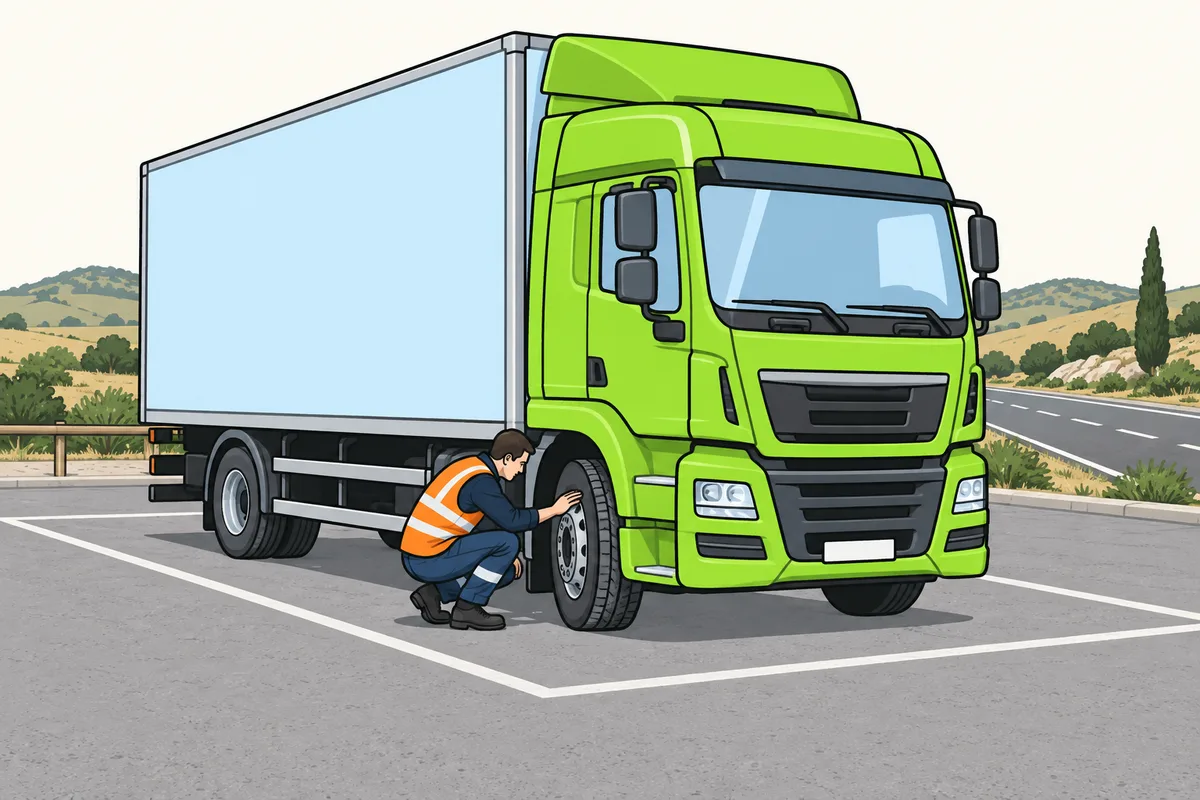
Check tyres, pressure, tread, uneven wear, lights, optical signalling and brake condition before a demanding use or a long journey.
- Check essential levels when the vehicle requires it: oil, coolant, brake fluid and windscreen washer fluid, without waiting for a breakdown to appear.
- If the vehicle is towing a trailer or carrying a load, check fastenings, catches, electrical connections and balanced distribution before moving off safely.
- Preparation also includes the seat, mirrors, seatbelt, doors and reading the surroundings, because a basic fault complicates any manoeuvre afterwards.
2.2Tyres and contact with the road
Tyres are the point of contact with the road surface; incorrect pressure, poor tread or uneven wear worsen braking, steering and stability.
- A reasonable, well-distributed load helps the wheels and suspension work predictably, especially in a bend, on a gradient or on an irregular surface.
- The exam may present a wheel defect as a minor matter; remember that on a heavy vehicle it directly affects safety and control.
- Practise linking each visible symptom, such as uneven wear or incorrect pressure, to a consequence: longer distance, worse grip or an imprecise response.
2.3Brakes, steering and suspension
On heavy vehicles it's essential to keep an eye on brakes, suspension, steering and possible leaks, because the mass amplifies the effect of any defect.
- A poorly maintained vehicle can alter the response under braking, in a bend or in a slow manoeuvre, and ruin a driver's correct technique.
- Don't rely on skill to make up for a mechanical defect; if it affects essential elements, the safe option is not to drive until it's fixed.
- Questions mix maintenance and technique: on a downhill stretch, with a load or on a slippery surface, a brake defect narrows the available margin even further.
2.4Lights, doors and signalling
Lighting and optical signalling allow you to see and be seen; if they fail, other road users may not understand your position, braking or manoeuvre.
- Doors, catches and elements that contain the load are part of safety, because an accidental opening can create an immediate danger.
- Electrical connections matter when there's a trailer or auxiliary elements; it's not enough for the tractor vehicle alone to look in good condition.
- In the exam, separate the cosmetic from the functional: lights, signalling and catches are functional because they affect warning, visibility and the load.
2.5Efficient, legal maintenance
Correct pressure, alignment, filters in good condition and a reasonable load reduce consumption, wear and mechanical demand.
- Driving with a known defect isn't just unsafe; it can also be reportable if it affects essential elements of the vehicle.
- A prior check doesn't replace periodic maintenance, but it helps catch obvious faults before they turn into a risky situation.
- Study efficiency as a consequence of good condition and smooth driving, not as an excuse to ignore brakes, wheels or lights.
2.6ITV by category and age
For an N1 goods vehicle with a maximum authorised mass up to 3,500 kg, Royal Decree 920/2017 sets this schedule: exempt up to 2 years; every two years from over 2 to 6 years; annually from over 6 to 10 years; and every six months after 10 years.
- Therefore, a 2,500 kg goods vehicle at 7 years falls into the annual N1 frequency; do not turn the example into a general rule for every truck or use.
- N2 and N3 goods vehicles over 3,500 kg have a different table: annually up to 10 years and every six months afterwards. Identify the category and first-registration date first.
- Periodic inspection does not replace pre-drive checks: study ITV frequency, mechanical condition and load safety separately.
2.7Spare wheel and alternatives: check the scope
For goods vehicles up to 3,500 kg (apart from three-wheelers and quadricycles), current Vehicle Regulations Annex XII section 1(c) allow a complete spare wheel, a temporary wheel with the tools needed, or an alternative system that guarantees sufficient mobility, subject to that system's limits.
- Vehicles over 3,500 kg, buses and combinations fall under the different equipment table in Annex XII section 2. Do not transfer the light-goods-vehicle rule to them, and do not treat a repair kit as universal.
- Before driving, check that the available equipment can deal with a puncture without creating a hazard and does not conflict with the vehicle record, type approval or current regulations.
2.8Exam practice
In the C-specific test you have 20 questions, a maximum of 2 errors and 20 minutes; answer quickly, but always from the rule and the case described.
- Faced with a mechanics question, first identify whether the defect affects braking, steering, seeing, being seen, securing the load or maintaining stability.
- Memorise short lists, but train cause-and-effect links: pressure, brakes, lights, fastenings and levels each have different practical consequences for real driving.
- If two answers seem possible, choose the one that prevents the risk before starting or continuing the journey with a relevant defect.
Step 3. Key points
If you only have a minute before the exam, revise this.
- 1.Check wheels, brakes, lights and optical signalling.
- 2.Check essential levels when appropriate.
- 3.Adjust seat, mirrors, seatbelt and doors before setting off.
- 4.Check fastenings, catches and connections if there's a load or trailer.
- 5.Relate each defect to braking, stability or visibility.
- 6.Don't drive with defects affecting essential elements.
- 7.Tell apart preventive maintenance from a late repair.
- 8.Practise questions by cause, effect and safe decision.
Step 4. Exam traps
Mistakes the DGT uses again and again on this topic.
- Thinking maintenance is only a workshop matter and not one of road safety.
- Focusing on the engine and forgetting wheels, brakes, lights or fastenings.
- Believing the driver's skill makes up for an essential defect.
- Forgetting electrical connections and catches when there's a trailer or load.
- Applying the N1 table without checking an N2/N3 vehicle, or treating the 2,500 kg and 7-year example as universal.
- Claiming a spare-wheel alternative for every truck without identifying the category and current rule.
- Confusing efficient driving with driving despite poor mechanical condition.
- Treating a visible defect as irrelevant because the vehicle still moves.
Step 5. Quick check
Four real exam questions on what you have just read.
What does adjusting the headlights of your lorry's lighting system involve?
Step 6. Frequently asked questions about mechanics and maintenance
- A lorry has an expansion tank marked MIN and MAX. When checking coolant with a cold engine according to the manufacturer’s instructions, must you inspect the level?
- Yes, and it must be between the maximum and minimum marks. Yes; it should be between MIN and MAX under the manufacturer’s specified checking conditions. Check it periodically rather than waiting for abnormal temperature, and do not fill the tank to overflowing. Do not open a hot, pressurised cooling-system cap because of the burn risk. Use the specified coolant and have leaks or repeated drops investigated; topping up does not necessarily resolve a fault.See full question
- In a combustion engine with a turbocharger and intercooler, where is the intake air filter located?
- Before the turbocharger compressor. Before the turbocharger compressor, so incoming air is filtered and particles that could damage the compressor and engine are kept out. The intercooler cools already compressed air downstream of the compressor and upstream of the engine intake. The filter is not placed between those components. The question explicitly specifies a turbocharged engine; turbocharging is one form of forced induction.See full question
- On a road surface in good condition, the steering wheel vibrates particularly at certain speeds. Which of these mechanical causes may produce this?
- Unbalanced wheels. Unbalanced wheels may transmit vibrations to the steering wheel, particularly at certain speeds. Balancing corrects mass distribution in the wheel-and-tyre assembly; alignment corrects steering and suspension geometry. Persistent vibration requires professional inspection to identify its cause, rather than continuing to increase speed.See full question
- On ice, up to what multiple of the normal braking distance on a dry road may a vehicle need?
- Ten times the normal distance on a dry road. Grip on ice can be extremely low and braking distance may reach ten times the normal distance on a dry road. This is a risk reference rather than a guaranteed distance: speed, ice conditions, tyres and the vehicle all matter. Reduce speed and greatly increase your following distance.See full question
- A lorry travels at night, between sunset and sunrise, on an insufficiently lit road through a built-up area. Which lights must it use?
- Position lights and dipped headlights. Position lights and dipped headlights. In a built-up area use dipped headlights rather than main beam, even when road lighting is insufficient. Position lights alone are insufficient for driving at night in this situation. Poor lighting does not make a through-road outside a built-up area or authorise main beam. The question explicitly states the night-time period covered by the obligation.See full question