Step 1. The big picture
In one sentence…
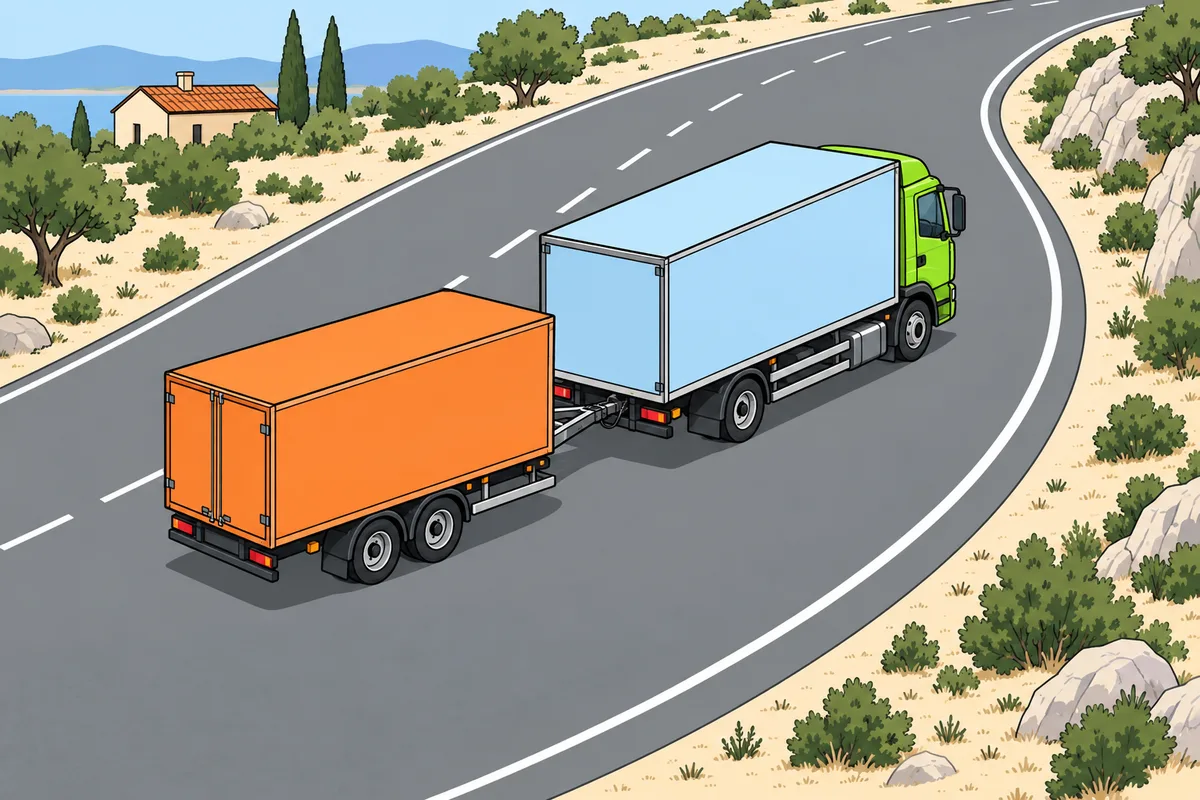
C1+E technique demands controlling mirrors, angle, inertia and lateral and rear space in category C1 vehicles with a trailer or semi-trailer, and combinations up to 12,000 kg. Smoothness is a safety condition, because the towed unit responds with a delay and can amplify an abrupt correction.
Step 2. The syllabus
2.1Preparation and starting off
Before moving the combination, check the coupling lock, lines, support legs and lighting, and the load's overall stability.
- Moving off must be progressive so as not to strain the coupling, cause jerks or destabilise the load in the first few metres.
- Adjust seat, mirrors and seatbelt before setting off, because you will need constant lateral and rear references during precise manoeuvres.
- In the exam, an orderly preparation shows you don't rely on improvisation once the combination starts moving in a manoeuvre.
2.2Using mirrors and references
Mirrors are your main reading of the towed unit; you must check their position before setting off and use them before, during and after every turn.
- Don't look only at the point closest to the towing vehicle: watch where the towed unit's wheels are going and what space remains against kerbs, road users and obstacles.
- References must be clear and unhurried; if you lose a reference, stop and regain your position before continuing to close the angle.
- The exam question may mention limited visibility to tempt you into rushing the manoeuvre; the safe answer is to increase control.
2.3Bends, roundabouts and turns
Open up the turn and watch the trailer's or semi-trailer's tracking in the mirrors so as not to encroach on obstacles or vulnerable road users.
- Never sacrifice control to save metres; on a heavy combination, a safe trajectory takes priority over haste or manoeuvring comfort.
- At roundabouts and junctions, the towing vehicle and the towed unit don't follow exactly the same path, so anticipate the lateral sweep.
- If the space doesn't allow you to turn safely, don't force the manoeuvre; find more room, stop or reposition before creating a conflict.
2.4Reversing
Reversing must be done at minimum speed, with clear references and small corrections, because the angle changes fast and takes time to recover.
- If the combination's angle closes too much, stop and reposition the manoeuvre before completely losing the towed unit's alignment.
- A helper or an external reference point can be useful when visibility doesn't let you control the rear area well, but it doesn't replace your responsibility.
- In the exam, sudden steering corrections made too late are usually the wrong option; the safe technique is to stop, straighten up and continue smoothly.
2.5Braking, inertia and descents
The combination's mass and inertia require you to anticipate braking, keep a margin and avoid abrupt reductions that could unsettle the towed unit.
- On descents, driving must be especially progressive; if you wait until the last moment, the combination needs more space to regain control.
- Swaying or oscillation gets worse with violent manoeuvres, so the reaction must be smooth and aimed at stabilising the combination.
- The theoretical trap is thinking harder pedal pressure always corrects things sooner; with combinations, abruptness can create a bigger problem.
2.6Load and stability
How the load is distributed influences grip, steerability and braking, so you cannot treat it as a detail unrelated to driving.
- A poorly fastened or shifted load can change the towed unit's behaviour in a bend, while reversing or under braking, even if the coupling is correct.
- Before a demanding manoeuvre, think about whether the combination is loaded, empty or has a delicate distribution, because the answer can vary.
- In technique questions, load, stability and smoothness tend to go together; don't choose answers that ignore the towed unit's dynamic effect.
2.7Mistakes and exam strategy
In C1+E, the specific test has 20 questions, a maximum of 2 errors and 20 minutes, so every doubt must be resolved on basic safety grounds.
- Classify the question: preparation, mirrors, turning, reversing, braking, load or stability; that classification usually reveals the most prudent answer.
- Be wary of answers involving haste, sudden steering, violent braking or excessive confidence in power, because they contradict smooth, safe driving.
- Practise describing each manoeuvre quietly to yourself: I look, I anticipate, I turn smoothly, I watch the towed unit, I correct little, and I stop if I lose a reference.
Step 3. Key points
If you only have a minute before the exam, revise this.
- 1.Check the coupling, lines, support legs, lights and load before moving off.
- 2.Adjust mirrors and use lateral and rear references throughout every manoeuvre.
- 3.Open up turns and track the towed unit through junctions and roundabouts.
- 4.Reverse at minimum speed with small corrections.
- 5.Stop and reposition if the angle closes too much.
- 6.Anticipate braking, descents and joining traffic because of the combination's inertia.
- 7.Link load and stability before choosing a technique answer.
Step 4. Exam traps
Mistakes the DGT uses again and again on this topic.
- Trying to correct poor alignment with sudden steering.
- Forgetting to track the towed unit at roundabouts and tight turns.
- Rushing a manoeuvre because it looks like the towing vehicle has already cleared the obstacle.
- Relying on the vehicle's power instead of anticipating space.
- Separating load and technique as if distribution didn't change stability.
- Continuing to reverse without clear references when the angle is closing.
Step 5. Quick check
Four real exam questions on what you have just read.
When overtaking with a C+E combination you must allow for:
Step 6. Frequently asked questions about vehicle combination driving techniques
- In a heavy combination, mirrors should be used especially to:
- Monitor trailer position and surroundings. They help monitor trailer position and road users around the combination, especially before lane changes, turns or manoeuvres. They do not replace looking ahead or maintaining a safe path. Blind spots may remain even with correct adjustment; check the surroundings using appropriate means without becoming distracted.See full question
- When joining traffic from the edge of the road with a C1+E or C+E combination, the correct action is to:
- Check that it can be done safely, give way and signal when joining traffic. Before joining, check that it can be done safely, give way to traffic already on the road and give the prescribed signal. Check mirrors and blind areas, and seek assistance if needed. Wait if there is no safe gap. Other drivers’ duty to facilitate joining where possible does not permit forcing them to brake or give the combination priority.See full question
- When turning forwards at low speed with a C+E combination, what precaution must you take concerning the space occupied by the trailer?
- Allow for its path and body swing, checking space on both the inside and outside. Allow for the swept space of the entire combination and monitor it in the mirrors. Trailer wheels may cut in on the inside of the turn, while the body overhang may swing outwards. Behaviour depends on the trailer geometry and steering axles. Plan the turn at low speed, respecting lanes, signs and other road users; taking a wider line does not authorise crossing their path or occupying space without checking that it is safe.See full question
- An overtake with a C1+E or C+E combination should only be started when:
- It can be completed safely and with enough margin. An overtake requires enough space, visibility, and margin to complete it safely.See full question