Step 1. The big picture
In one sentence…
In C1+E, the combination's safety devices aren't checked as a formality: they support braking, lighting, signalling, stability and control of the towed unit. Study every check by thinking about how a faulty connection, a support leg or a wheel can turn a normal manoeuvre into an unsafe situation.
Step 2. The syllabus
2.1Overview of the combination
The C1+E licence covers category C1 vehicles with a trailer or semi-trailer, and combinations up to 12,000 kg, so you must always think of two parts travelling as a single unit that share the same risks.
- Before moving off, confirm that the devices on the towing vehicle and on the towed unit work together: one part being correct doesn't make up for a fault in the other.
- In the exam, questions tend to present an apparently minor fault and ask you for its real consequence for braking, lights, stability or signalling.
- The check is preventive because many defects in the towed unit go unnoticed until late, when the combination is already turning, braking or driving with poor visibility.
2.2Coupling and locking
The coupling must be locked, properly seated and free of abnormal play, because it is the point that transmits forces between the towing vehicle and the towed unit.
- Looking from a distance isn't enough: you must check that the locking mechanism is working correctly and that there is no intermediate position that could release under vibration.
- If the coupling isn't secure, any braking, tight turn or change in road camber can multiply the risk of losing control of the combination.
- A common trap is confusing 'coupled' with 'visually hitched'; in exam study, the key word is effective locking, not simple contact.
2.3Electrical and service connections
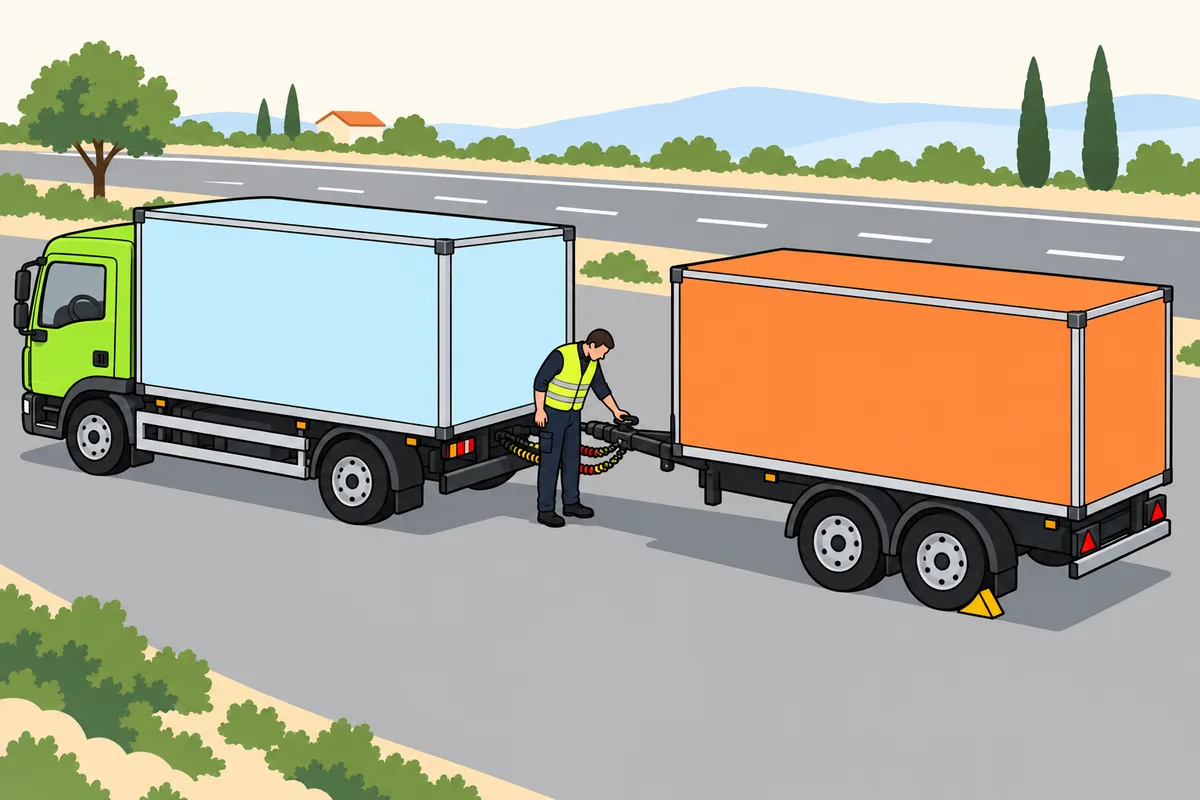
Mechanical, electrical and service connections must be fastened, protected and free of tension, so they don't disconnect when turning or manoeuvring.
- A faulty electrical connection can leave the rear of the combination without tail lights, active reflectors or the warnings other road users need to see you.
- A badly made service connection can affect braking or the towed unit's response, so the fault isn't merely administrative.
- In multiple-choice questions, be wary of answers that allow you to drive when only one connection has failed; if it affects safety, it must be fixed first.
2.4Brakes and the towed unit's response
The braking system must be understood as a single unit: if the towed part doesn't match the braking, the towing vehicle can lose stability or take longer to stop.
- Check the behaviour before a demanding journey, especially when loaded, because mass and inertia make any defect more noticeable.
- An unbalanced brake can show up in the exam as swaying, drifting, jerking or a sensation of being pushed from behind when slowing down.
- The correct response isn't to compensate by driving harder, but to avoid driving with a defect that compromises the combination's basic safety.
2.5Wheels, tyres and support legs
The towed unit's tyres also bear load, indirect steering and lateral forces, so their wear or pressure cannot be ignored.
- A fault in a towed wheel can start without clear symptoms and become critical in a bend, under braking or in a slow manoeuvre with a sharp angle.
- Support legs and immobilising elements must be retracted or positioned as required, because they affect stability and safety while stopped or moving off.
- In the exam, avoid answering as if only the towing vehicle's front wheels mattered; every axle of the combination plays a part in safety.
2.6Lighting, plates and reflectors
Clean, visible and working tail lights, reflectors and plates let other road users judge the combination's length, width, position and manoeuvre.
- Signalling must stay legible in rain, dirt or poor lighting; a long, poorly visible vehicle increases the risk during joining manoeuvres and overtaking.
- Check that the rear signalling isn't hidden by the load, mud, accessories or poor positioning, because the road user behind you depends on it.
- Questions tend to penalise the idea of driving in daylight without correct rear lights; the obligation to signal doesn't disappear just because ambient light is good.
2.7Study method and practice
Practise the inspection in the same order every time: coupling, connections, brakes, wheels, support legs, lighting and signalling, so you don't rely on improvised memory.
- When you read a question, first identify which device is failing, then ask what function the combination loses: braking, being seen, staying joined or staying supported.
- Link every device to a specific manoeuvre; for example, connections in turns, brakes on descents, wheels in bends and lights in night driving.
- Remember the C1+E specific format: 20 questions, a maximum of 2 errors and 20 minutes, so it's best to answer by function, not by intuition.
Step 3. Key points
If you only have a minute before the exam, revise this.
- 1.Check the coupling is effectively locked before moving the combination.
- 2.Check the electrical and service connections are firm and free of tension.
- 3.Check the brakes of the towing vehicle and the towed unit as a single system.
- 4.Look at the towed unit's wheels, wear, pressure and support legs before driving.
- 5.Confirm that tail lights, reflectors, plates and rear signalling are visible.
- 6.Link every fault to the safety function it stops fulfilling.
- 7.Stop for any defect that affects braking, lights, the coupling or stability.
Step 4. Exam traps
Mistakes the DGT uses again and again on this topic.
- Relying on a superficial visual check of the coupling without thinking about the locking mechanism.
- Forgetting that an electrical fault leaves the combination without part of its required signalling.
- Answering as if the towed unit were passive and didn't affect braking or stability.
- Believing good daytime visibility allows driving with faulty tail lights or reflectors.
- Focusing on the towing vehicle and skipping the towed unit's wheels, support legs or connections.
- Confusing a workshop inspection with a basic check before setting off.
Step 5. Quick check
Four real exam questions on what you have just read.
Before setting off with a C+E combination, which check specifically concerns the connection between the towing vehicle and its trailer or semi-trailer?
Step 6. Frequently asked questions about safety devices
- A lorry tows a non-agricultural semi-trailer that is 7 metres long. Must that semi-trailer be equipped with side position lights?
- Yes, because its length exceeds 6 metres. Yes, because the semi-trailer is longer than 6 metres. Article 16.5 of the General Vehicle Regulations requires side position lights on non-agricultural trailers and semi-trailers exceeding that threshold. This does not mean they are mandatory on every semi-trailer regardless of length.See full question
- Before setting off with a semi-trailer, you must check that:
- The semi-trailer's landing legs are raised and secured. Among the basic coupling checks is verifying that the semi-trailer's landing legs are raised and secured.See full question
- A trailer has safety chains forming a secondary coupling beside the main coupling. What do they do if the main coupling separates?
- To prevent the coupling bar from touching the ground if it becomes detached, and to allow a certain degree of control over the trailer to be retained. They keep the coupling drawbar off the ground and allow some residual control of the trailer. They are not an electrical earth connection or an anti-theft system. Distinguish them from a device that automatically applies the trailer brake on separation. The General Vehicle Regulations require a secondary coupling on trailers with a maximum authorised mass of no more than 1,500 kg that lack a system ensuring braking if the coupling breaks. This does not permit driving with a faulty main coupling.See full question
- Before leaving with a C+E combination, an essential check is that the combination's connections:
- Are correctly connected and secured. Electrical connections and, where fitted, brake connections must be properly connected and secured so the combination operates safely from the moment it sets off.See full question