Step 1. The big picture
In one sentence…
Preventive maintenance for C1+E is directly part of road safety: it avoids breakdowns, improves braking, preserves stability and reduces errors when preparing the vehicle. Study the whole combination, because it covers category C1 vehicles with a trailer or semi-trailer, and combinations up to 12,000 kg, and no defect in the towed unit is offset by a towing vehicle in good condition.
Step 2. The syllabus
2.1Check before setting off
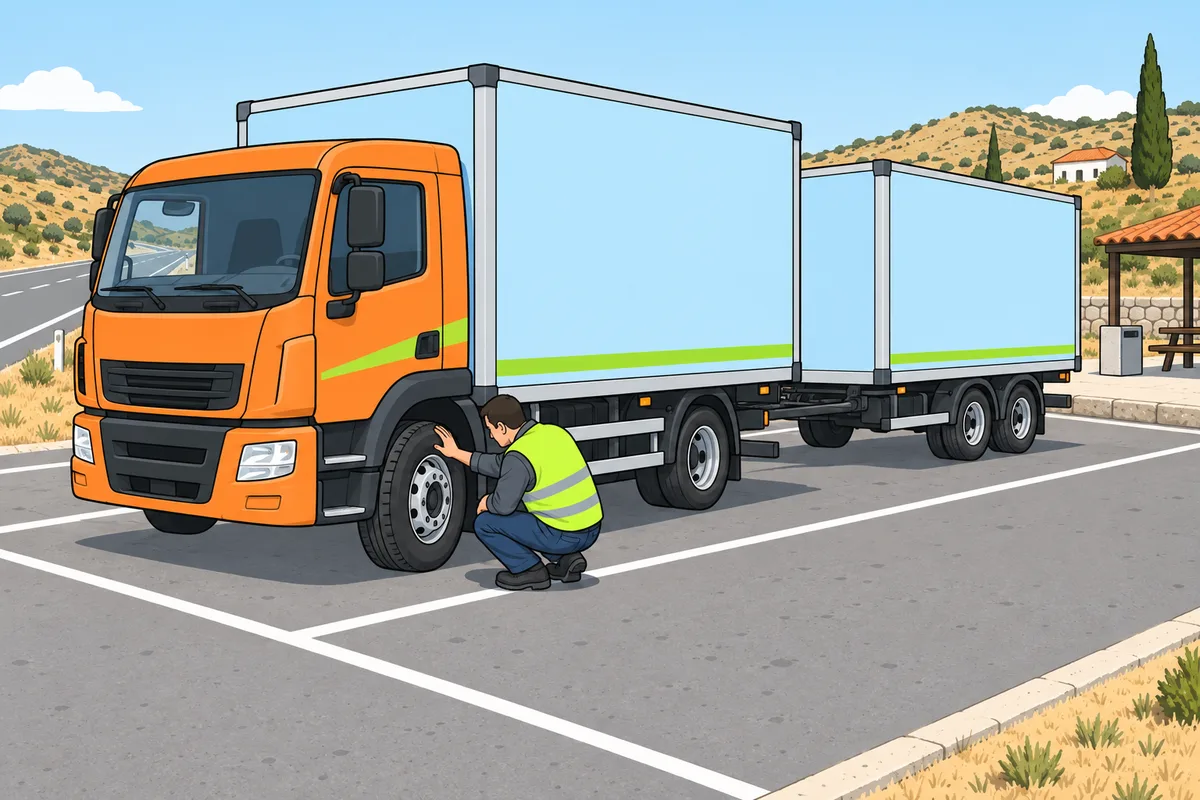
Start with a calm exterior check: tyres, visible pressure, tread, uneven wear, lighting, optical signalling and the general condition of the brakes.
- Check essential levels when the vehicle requires it, such as oil, coolant, brake fluid and windscreen washer fluid, without turning it into a meaningless mechanical checklist.
- If you're towing a trailer or carrying a load, add fastenings, fasteners, electrical connections and balanced distribution, because these points change how the combination responds.
- In the exam, the key idea is to prepare the vehicle to drive safely before demanding manoeuvres, braking or joining traffic with a reduced margin.
2.2Tyres and contact with the road
Tyres support steering, braking and stability; that's why pressure, tread and uneven wear have a safety reading, not just a cost one.
- A tyre in poor condition can increase braking distance, reduce grip and worsen control in a bend or in the rain, even if the engine is running perfectly.
- In combinations, also check the towed axle, because a defect at the back can appear late and alter the trajectory when you are already manoeuvring.
- The usual trap is looking only at the towing vehicle's wheels; for C1+E, every contact point of the combination matters.
2.3Brakes and stability
The brakes must respond predictably, without jerking, drifting or a sensation of being pushed from the towed unit, especially with a load or on demanding routes.
- A braking defect can turn otherwise correct driving into an unsafe situation, because it increases the margin required and reduces your ability to correct an unforeseen situation.
- When studying, link brakes with stability: they aren't separate topics when a long vehicle turns, descends or needs to stop with precision.
- If the question mentions a known brake fault, don't choose answers that normalise driving on; the defect affects an essential element.
2.4Lights, signs and visibility
Lighting and optical signalling let other road users understand your width, length, intended manoeuvre and presence in poor conditions.
- Check tail lights, indicators, reflectors and plates before setting off, because the rear of the combination is far from the driver and can go unnoticed.
- A failed light isn't a minor detail if it stops you signalling braking, a change of direction or the towed unit's real position.
- The exam may present good weather or daytime driving to distract you; the obligation to keep lights and signals working remains basic.
2.5Load, fastenings and restraints
The load must be distributed and secured, because it influences grip, steerability, braking and the risk of the towed unit swaying.
- Check fastenings, doors, tarpaulins, anchor points and restraints when relevant, since a load that shifts changes the vehicle's expected behaviour.
- Don't treat loading as a separate matter from maintenance: a faulty restraint can produce a dynamic reaction just as dangerous as a breakdown.
- When a question mentions goods, think about load safety and how it affects the combination, not just about paperwork.
2.6Efficient driving and wear
Correct pressure, correct alignment, filters in good condition and a reasonable load reduce fuel consumption and wear without replacing any safety obligation.
- Poor maintenance forces you to correct more with the wheel, brake or accelerator, and those corrections worsen the smoothness a heavy combination needs.
- Driving with a known defect can be unsafe and reportable if it affects essential elements of the vehicle or the safety of other road users.
- Efficiency isn't studied as isolated saving: in the exam it is linked to preventing breakdowns, maintaining control and not forcing the vehicle.
2.7Preparing for the exam
In C1+E, the specific test values knowing how to apply pre-drive checks to a combination, not just naming parts from memory.
- Before answering, decide whether the question affects tyres, brakes, lights, coupling, restraints or the load, and reason through the safety consequence.
- Practise with a fixed sequence: exterior, wheels, lights, coupling, connections, brakes, load and driving position, to reduce important omissions.
- Remember the specific test has 20 questions, a maximum of 2 errors and 20 minutes; every answer must be direct and safe.
Step 3. Key points
If you only have a minute before the exam, revise this.
- 1.Check tyres, pressure, tread and wear before demanding use.
- 2.Check brakes and stability, thinking about both towing vehicle and towed unit.
- 3.Check lights, tail lights, reflectors and full optical signalling.
- 4.Check restraints, fastenings, connections and balanced load distribution.
- 5.Link every mechanical defect to its effect on driving.
- 6.Don't drive with faults that affect essential safety elements.
- 7.Practise a fixed check sequence for the exam.
Step 4. Exam traps
Mistakes the DGT uses again and again on this topic.
- Thinking maintenance is only a workshop matter and not a road-safety one.
- Focusing on the engine and forgetting tyres, brakes, lighting or fastenings.
- Assuming a towing vehicle in good condition offsets a defect in the towed unit.
- Treating the load as paperwork rather than a stability factor.
- Choosing to drive with a known fault because the journey looks short or easy.
- Confusing efficient driving with accepting incorrect pressures, filters or wear.
Step 5. Quick check
Four real exam questions on what you have just read.
A steering fault in a C1+E or C+E combination:
Step 6. Frequently asked questions about mechanics and maintenance
- In an articulated or heavy trailer combination, you should pay special attention to:
- The trailer tires and brakes. The condition of the trailer tires and brakes is essential for the safety of the combination.See full question
- In the pre-trip inspection of a C+E combination, it is advisable to check especially:
- The condition of the trailer or semi-trailer's brakes. The condition of the brakes on the towed unit is essential to the safety of the whole combination.See full question
- You park a vehicle combination on a 10% downhill gradient and will leave the driving position. In addition to applying the parking brake and selecting the appropriate gear or position, must you secure it against movement using suitable chocks or support against the kerb?
- Yes, using suitable chocks or supporting a steered wheel against the kerb in the specified position. Yes. Article 92.3.d of the General Traffic Regulations requires this additional protection for a vehicle combination parked on a significant gradient. Use purpose-made chocks, or support a steered wheel against the kerb with the wheels turned away from the centre of the carriageway on a downhill slope. Do not use stones or improvised objects as chocks; remove the chocks from the road before moving off. These measures are additional to the parking brake and the applicable reverse gear or parking position.See full question