Step 1. The big picture
In one sentence…
A C1 licence - Light truck driver must master the goods transport framework: the authorised category, visibility, the vehicle's masses and dimensions, stowage, route and the prudence obligations of a heavy vehicle. This topic ties together the licence, the load, signs and everyday responsibility.
Step 2. The syllabus
2.1Category and authorisation
The C1 licence - Light truck authorises goods vehicles between 3,500 kg and 7,500 kg. You must know this class, its minimum age of 18 and the conditions currently in force before driving.
- The DGT requires both the common and goods-specific tests, unless you are exempt from the common theory test, so studying general car-licence rules alone isn't enough.
- When a question compares licences, pay attention to the authorised category, the type of vehicle and whether a trailer or a combination not included appears.
- A heavy vehicle needs more distance, anticipation and control of its surroundings; the rules weigh up the potential risk of its mass and dimensions.
2.2Goods-specific test
In the C1 specific test you get 20 questions, a maximum of 2 errors and 20 minutes; answer quickly, but always from the rule and the case described.
- The specific content focuses on goods vehicles, loading, driving times, the tachograph, responsibility and reading restrictions for heavy vehicles.
- Don't work through the test as if it were an extended B licence; the key usually lies in mass, dimensions, stowage, blind spots or professional documentation.
- The margin for error is limited, so turn every rule into a practical decision: can I drive, must I stop, or must I adapt the manoeuvre.
2.3Masses, dimensions and route
Signs limiting mass, height, width, length or prohibiting heavy goods vehicles constrain the route even when the map looks favourable.
- It isn't enough for the vehicle to be allowed to drive by category; you must also check whether the stretch of road allows for its dimensions, load and specific conditions.
- If a specific sign or limit has changed through a later reform, the official rule in force cited in the syllabus references must prevail.
- In the exam, when tunnels, bridges, narrow streets or service accesses appear, think about restrictions first, not the comfort of the route.
2.4Stowage and distribution
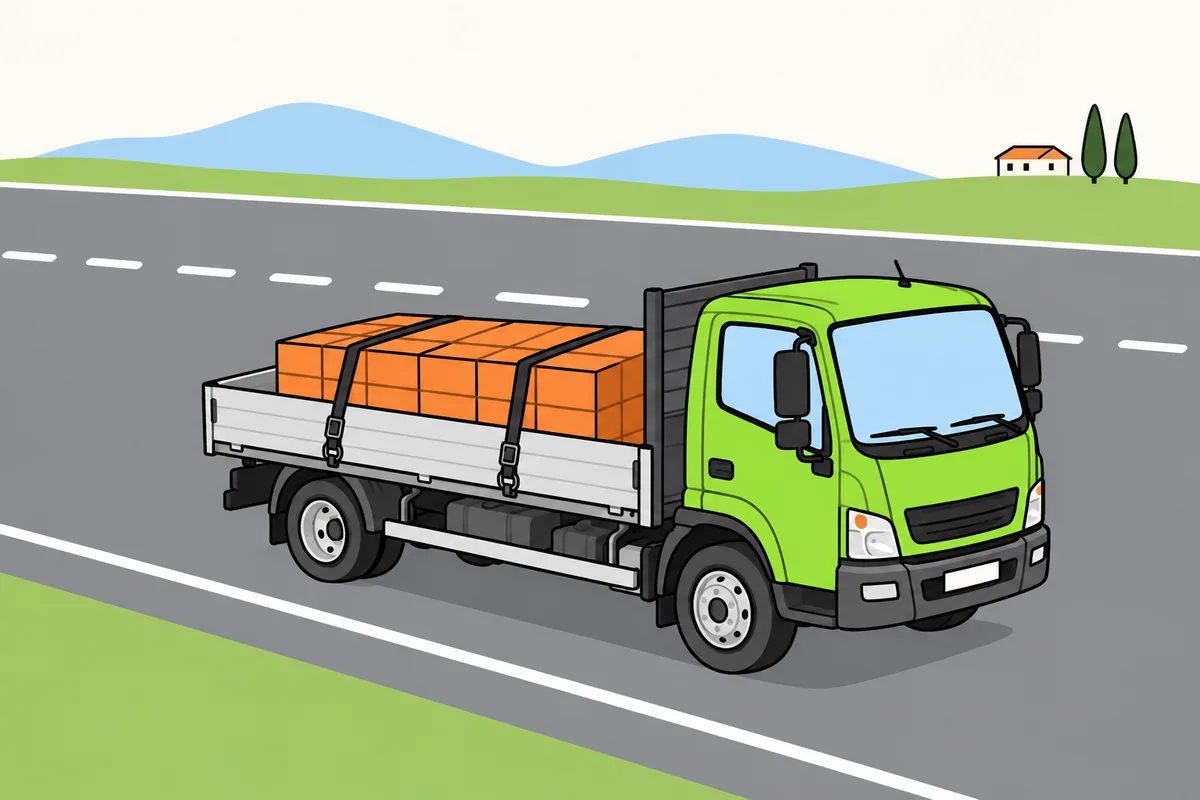
The load must be placed and secured so it cannot fall, drag, shift or compromise the vehicle's stability, visibility or the effectiveness of its devices.
- It isn't enough not to exceed a theoretical maximum mass: weight distribution across axles and correct fastening matter for both safety and legality.
- Faulty stowage multiplies braking distance and can cause a rollover, jack-knifing or loss of control in bends, on gradients and in evasive manoeuvres.
- Link goods regulations with safe loading: the correct answer usually requires preventing movement before the danger appears on the road.
2.5Driving and manoeuvres
You must adapt speed and distance to the mass, the braking time and the blind spot; the correct manoeuvre starts much earlier than in a car.
- In town, roundabouts, tight turns and service accesses require you to open up your trajectory with constant watch for pedestrians, cyclists and lateral obstacles.
- On the road, a small lapse in observation can turn into an impossible manoeuvre because of length, inertia and the need for return space.
- The exam exploits late decisions: if you are already on top of the obstacle, the correct answer was probably to anticipate, slow down and observe earlier.
2.6Professional responsibility
The goods vehicle driver is responsible for driving with the appropriate authorisation, a vehicle in proper condition, a secure load and respect for the applicable signage.
- If driving times, rest or the tachograph come into it, remember these are road-safety and labour rules, not simple administrative checks.
- The prudence expected of a heavy vehicle requires more distance, more observation and less improvised decisions, because the potential risk to other road users increases.
- Practise crossing topics: licence, signs, mechanics and loading appear together because in real driving they don't show up as separate blocks.
Step 3. Key points
If you only have a minute before the exam, revise this.
- 1.Identify exactly what C1 authorises.
- 2.Distinguish the authorised vehicle, trailer and combinations not included.
- 3.Check restrictions by mass, height, width and length.
- 4.Apply stowage, load distribution and correct fastening.
- 5.Increase distance, observation and manoeuvring margin.
- 6.Link driving times, the tachograph and professional responsibility.
- 7.Read every sign for heavy vehicles before choosing your route.
- 8.Work through the test as a goods vehicle driver, not as a car driver.
Step 4. Exam traps
Mistakes the DGT uses again and again on this topic.
- Answering as if stability depended only on total weight and not on how it is distributed.
- Forgetting blind spots and turning radius in an urban environment.
- Confusing the licence's authorisation with permission to use any route.
- Ignoring mass or dimension signs because the sat nav suggests the route.
- Treating driving times and the tachograph as unrelated to road safety.
- Answering with general rules when the question involves a goods vehicle.
Step 5. Quick check
Four real exam questions on what you have just read.
A lorry has aerodynamic air deflectors designed for its configuration and correctly adjusted. Can they help reduce fuel consumption?
Step 6. Frequently asked questions about goods transport rules
- When replacing this halogen bulb, which precaution prevents grease deposits that could damage it when heated?
- avoid touching the bulb glass with bare fingers. Avoid touching the glass with bare fingers. Grease left on it can heat up and damage a halogen bulb; this specific precaution does not concern its metal terminals. Work with the lights off and the bulb cool, following the manufacturer’s instructions and using suitable clean gloves. Not every replacement legally requires a workshop; seek professional help if you cannot do it safely.See full question
- Under the wording of Annex VI.A.2 of the General Driver Regulations, after two unsuccessful attempts, what minimum interval is specified between the second and third, except for a justified exceptional reduction?
- 10 days. Annex VI. A.2 specifies a minimum of ten days between the second and third attempts when both previous attempts were unsuccessful. Between successive attempts after the third, it specifies fifteen days. The intervals run from the date of the unsuccessful test and may exceptionally be reduced for justified urgency. This question concerns the interval expressed in the regulation; the traffic authority determines the actual test date.See full question
- What is blood alcohol concentration?
- The concentration of alcohol in the blood. Blood alcohol concentration is the concentration of alcohol in the blood, commonly expressed in grams per litre of blood. It is not the total amount of alcohol in the whole body or an amount located in the head. Breath alcohol concentration is expressed in milligrams per litre of air and is a different measurement used in alcohol testing.See full question
- May an ordinary lorry driver hold a telephone conversation while driving without using their hands, audio headsets or earphones?
- Yes, hands-free, without earphones and while maintaining attention. Yes, through a hands-free system without headsets, earphones or similar devices, while maintaining attention to driving. The driver may not handle the phone while driving. There is no general statutory one-minute call limit; even hands-free conversations can distract. To deal with a call requiring handling, park safely and legally.See full question
- Between the two attempts of the same the C1 and C licences application there should normally be no more than:
- Six months. As a general rule, there should be no more than six months between the two attempts of the same application.See full question