Step 1. The big picture
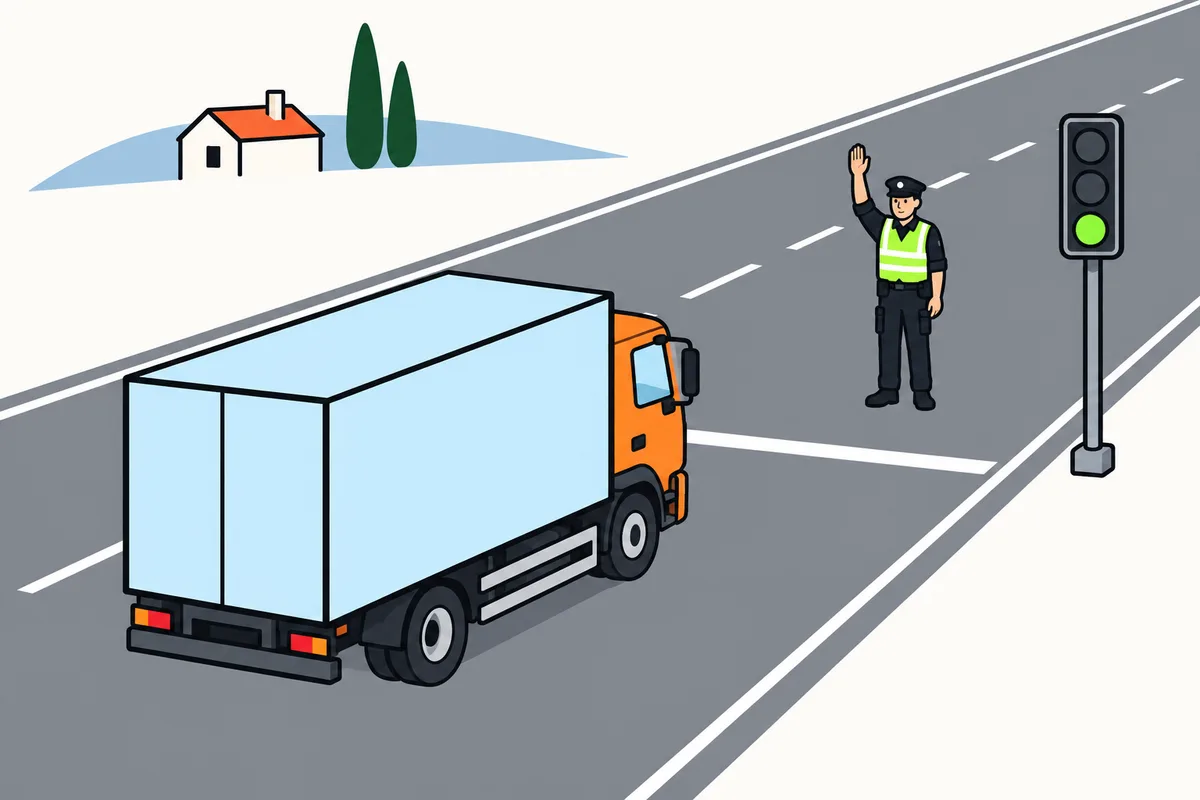
In one sentence…
Master the hierarchy between officers, circumstantial signalling, traffic lights, vertical signs and road markings, and study the official catalogue in force, paying attention to the most recent updates. For the C1 licence - Light truck, always add the restrictions specific to goods vehicles and heavy vehicles.
Step 2. The syllabus
2.1Signalling hierarchy
The priority between signs isn't arbitrary: first you obey officers, then circumstantial signalling, traffic lights, vertical signs, and lastly road markings.
- If two signs seem to contradict each other, the higher-ranking one prevails; many questions are solved by applying the hierarchy before looking at shape or colour.
- Signs are binding from the place where they are positioned, unless they indicate a distance, the length of a stretch of road or the end of a prohibition.
- In roadworks, diversions or incidents, temporary signage can change the usual regime; don't answer out of habit if the scenario has changed.
2.2Families of signs
Danger warning signs warn of a risk; regulatory signs impose prohibitions or obligations; information signs guide or inform.
- Traffic lights regulate right of way with priority over an incompatible vertical sign, and can apply to all users, to specific lanes or to particular manoeuvres.
- Road markings delimit lanes, excluded zones, pedestrian crossings, continuous or broken lines, and rules for stopping, parking and priority.
- Don't memorise isolated pictures: link each family to the required behaviour, the affected stretch of road and the user it addresses.
2.3Priority and conflicts
At a junction, a priority sign outweighs the general right-hand rule; apply the specific sign first and then the general rule.
- A single road marking may not be enough if there is a traffic light, an officer or a temporary sign that changes the required behaviour at that point.
- When the question mentions a reversible lane, an extra lane or a provisional diversion, look at road delineation devices, arrows and variable message panels.
- If a sign only applies to one lane, vehicle or manoeuvre, avoid automatically extending it to the whole direction of travel without checking the wording.
2.4Signs for goods vehicles
For heavy goods vehicles, restrictions on mass, length, height, width, gradient, overtaking and access to certain routes take on special importance.
- A restriction sign can force you to change route even if the vehicle is properly loaded and even if the road looks wide enough.
- In C1, you must read every sign thinking about the real vehicle: inertia, turning radius, load, dimensions and the need for anticipation.
- The exam may show a common sign, but the key is that you are driving a goods vehicle; check whether it specifically affects heavy vehicles or the load.
2.5Official catalogue and updates
The official sign catalogue was updated in 2025, with new representations and pictograms and panels adapted to current mobility.
- To study rigorously, use up-to-date material and be wary of old diagrams that still show obsolete signs or incomplete explanations.
- If a question puts a new sign against a classic one, identify whether it signals danger, prohibition, obligation or information and apply the correct behaviour.
- When a sign or its meaning has been reformed, the official catalogue in force cited in the references prevails, not an old study sheet.
2.6Exam practice
In the C1 specific test you get 20 questions, a maximum of 2 errors and 20 minutes; answer quickly, but always from the rule and the case described.
- Before answering, mentally order the scene: who is in command, which sign applies, from where it takes effect, and which user it affects.
- Train with images by asking yourself what you must do, not just what the sign is called; the exam assesses behaviour, not decorative recognition.
- If you're unsure between two answers, look for the one that respects the hierarchy, the stretch of application and the specific restrictions on goods vehicles.
Step 3. Key points
If you only have a minute before the exam, revise this.
- 1.Memorise the full signalling hierarchy.
- 2.Distinguish danger, regulatory, information, road delineation devices and road markings.
- 3.Link every sign to the behaviour and stretch of road affected.
- 4.Apply sign priority before general rules.
- 5.Check restrictions by mass, dimensions and goods vehicles.
- 6.Study the updated catalogue, not just old diagrams.
- 7.Read whether a sign affects a lane, a user or a specific manoeuvre.
- 8.Practise with images until you can decide which action applies.
Step 4. Exam traps
Mistakes the DGT uses again and again on this topic.
- Confusing the general priority rule with an operating vertical sign or traffic light.
- Forgetting that temporary roadworks signage can change the usual regime.
- Reading a single road marking without linking it to the rest of the signalling.
- Applying a lane sign to the whole road without checking the wording.
- Ignoring mass or dimension restrictions in goods-vehicle questions.
- Studying old signs without checking the official catalogue in force.
Step 5. Quick check
Four real exam questions on what you have just read.
On a narrow, steep section, with no signs or officer regulating priority, a truck and a car cannot pass each other. The uphill vehicle cannot reach a passing place first. Which vehicle has priority?
Step 6. Frequently asked questions about traffic signs
- Inside a tunnel with several lanes of traffic in your direction, you are driving your lorry behind another vehicle which you intend to overtake. What separation must you maintain between both vehicles before starting the move?
- Enough to stop without colliding if the vehicle ahead brakes suddenly. Maintain sufficient separation to stop without colliding if the vehicle ahead brakes suddenly. Because you intend to overtake, the specific 100 metres or 4 seconds rule for vehicles not intending to overtake is not the answer here; for vehicles over 3,500 kg MAM with no overtaking intention it would be 150 metres or 6 seconds. No fixed distance replaces adaptation to speed, grip and visibility. Multiple lanes in your direction do not permit overtaking where other prohibitions or danger exist.See full question
- If you are driving an unladen lorry with a maximum authorised mass of 5 tonnes, may you enter a road at whose entrance this sign is displayed?
- No, because it prohibits entry to lorries and vans even when they are travelling empty. Vertical sign R-107 prohibits entry to the road where it is displayed by vehicles intended for the carriage of goods whose maximum authorised mass is greater than that indicated on the sign. The prohibition also applies to this type of vehicle when it is travelling empty and unladen.See full question
- On a road, may a lorry reverse as a manoeuvre complementary to a U-turn?
- No. The reversing manoeuvre carried out by a lorry on a road must be performed slowly, after having signalled the intention using the required signals, and under no circumstances may this manoeuvre be complementary to a U-turn carried out before or after it.See full question
- As a general rule, above what width must a lorry be fitted with end-outline marker lights?
- When its width exceeds 2.10 metres. On a lorry, end-outline marker lights are compulsory when width exceeds 2.10 metres; fitting is optional between 1.80 and 2.10 metres. They are white at the front and red at the rear. Fitting requirements are separate from use: switch them on at night, in substantially reduced visibility and in tunnels or underpasses.See full question
- At the entrance to a carriageway, what does this sign indicate?
- Mandatory circulation for vehicles transporting more than 1,000 litres of water-polluting products. The mandatory vertical sign R-415 in the image indicates that from this point onwards, you must use a carriageway that is mandatory for vehicles transporting water pollutants. Specifically, it indicates to those drivers transporting more than 1000 litres of products that may pollute the water that this is the route they must take and obliges them to use it.See full question
Official sources
Signs catalogue
All Spanish traffic signs and their meanings
The full DGT catalogue — warning (P-), regulatory (R-) and information (S-) — with the official image and meaning of every sign.