Step 1. The big picture
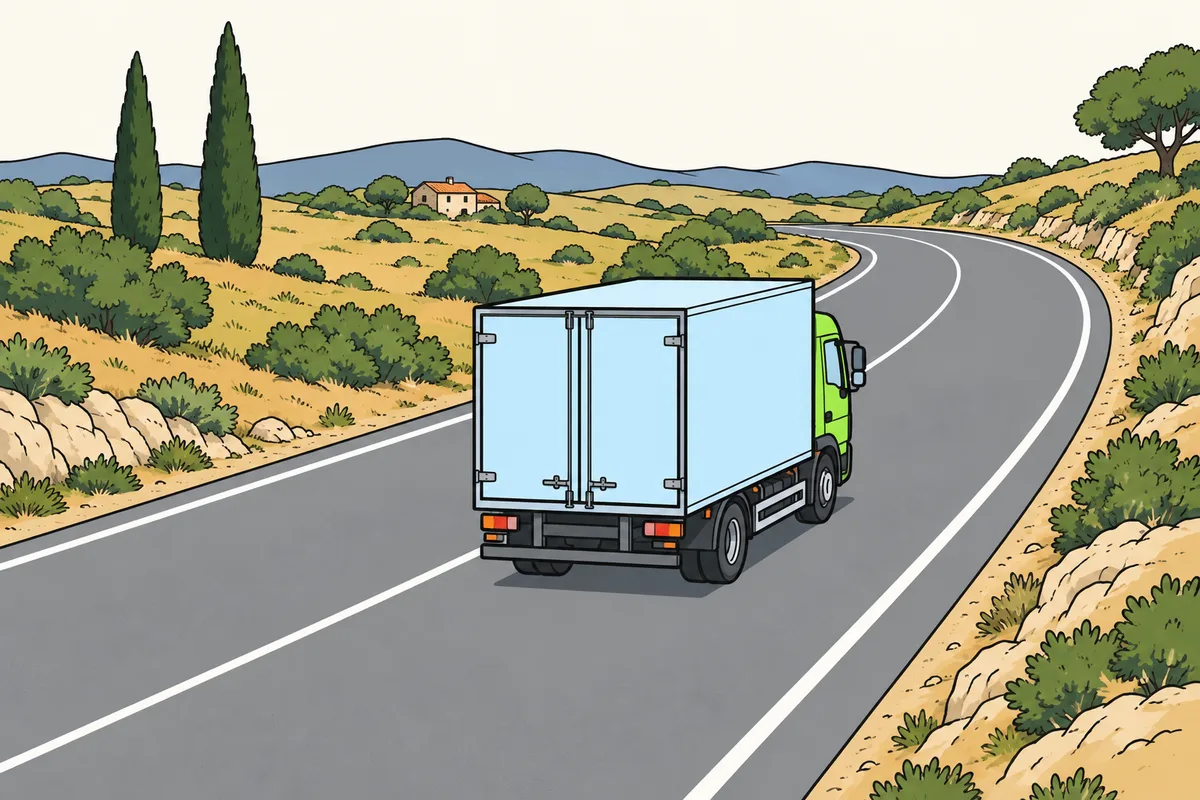
In one sentence…
Truck technique demands observing far ahead, managing the blind spot, using the brakes smoothly and changing pace well in advance. The heavier the vehicle, the less room there is to improvise, especially with a load or in tight environments.
Step 2. The syllabus
2.1Observation and position
Adjust the mirrors and seating position to control the front, the sides and the area close to the vehicle before starting any demanding drive.
- The blind spot is a structural feature of a truck; that's why it isn't enough to look just once before turning or changing lanes.
- Your lane position must anticipate turning radius, lateral obstacles and the possible presence of pedestrians, cyclists or other vulnerable road users.
- Look far ahead to prepare the manoeuvre with time; if you spot the problem late, the mass and length reduce your options for correction.
2.2Blind spots and vulnerable road users
Before turning, changing lanes or approaching a roundabout, check several times because a road user may enter an area you cannot see.
- In an urban setting, the sides of the truck are especially sensitive; an open trajectory must be paired with constant watch of the space inside and outside the vehicle.
- If you cannot see the risk area clearly, stop and check again; forcing a manoeuvre without visibility is a serious mistake.
- The exam may present an apparently slow situation; even so, the correct answer requires control of blind spots and lateral space.
2.3Braking and use of inertia
Stopping distance is longer because of mass and inertia; if you anticipate late, the margin for correction disappears sooner than in a car.
- Efficient professional driving uses progressive braking, appropriate engine braking and early reading of traffic to avoid abrupt, unstable interventions.
- On descents, bends and slippery surfaces you must multiply your caution and not rely solely on the service brake to correct things late.
- With a load, braking also depends on distribution and fastening; an abrupt manoeuvre can affect stability and stowage at the same time.
2.4Turns, roundabouts and lateral space
Turns and roundabouts require you to calculate turning radius, vehicle length and possible lateral sweep before starting the trajectory.
- Don't enter a space without having checked that other road users understand your manoeuvre and that no one is trapped next to the vehicle.
- On narrow streets or service accesses, slow down and use visual references; haste tends to turn a simple manoeuvre into a hazard.
- If the question mentions lateral obstacles, loading bays or parked vehicles, think about real space, not just right of way.
2.5Slow manoeuvres and reversing
Loading bays, parking and reversing manoeuvres require visual references, minimum speed and control of lateral and rear space throughout the movement.
- A slow manoeuvre isn't automatically safe; the risk appears when you lose visibility, references or control of the blind spots.
- Stopping to observe again is the correct technical decision when the rear or lateral area isn't clearly under control.
- Practise answering what you must check before moving, during the manoeuvre and before correcting your trajectory, not only at the end.
2.6Exam practice
In the C1 specific test you get 20 questions, a maximum of 2 errors and 20 minutes; answer quickly, but always from the rule and the case described.
- For each question, first identify the factor that differs from a car: mass, length, blind spot, load, braking or turning radius.
- Be wary of answers that propose deciding at the last second; truck technique is based on preparing early and executing smoothly.
- Link this lesson to signs, loading and mechanics, because a correct manoeuvre depends on the vehicle, the road and the condition of its components.
Step 3. Key points
If you only have a minute before the exam, revise this.
- 1.Adjust mirrors, seat and seatbelt before setting off.
- 2.Check blind spots several times before manoeuvring.
- 3.Anticipate braking, engine braking and changes of pace.
- 4.Increase your margin on descents, bends and slippery surfaces.
- 5.Calculate turning radius and lateral sweep.
- 6.Don't force manoeuvres without sufficient visibility.
- 7.Use visual references when reversing and at loading bays.
- 8.Link technique with loading, signs and maintenance.
Step 4. Exam traps
Mistakes the DGT uses again and again on this topic.
- Relying on experience and leaving the final check to the last second.
- Treating a truck's braking as if it were that of a loaded car.
- Checking a mirror only once before turning or changing lanes.
- Forgetting the lateral sweep at roundabouts, turns and narrow streets.
- Thinking a slow manoeuvre can't be dangerous.
- Separating truck technique from loading, mechanics and signalling.
Step 5. Quick check
Four real exam questions on what you have just read.
Before changing lane or starting a maneuver with a truck, it is advisable to:
Step 6. Frequently asked questions about truck driving techniques
- On a long downhill section in a truck, it is advisable to:
- Select a suitable gear and control speed. On long descents you should choose a suitable gear and control speed to avoid overheating the brakes.See full question
- What are the basic principles on which the driving technique is based?
- Vision, anticipation and space. Preventive driving techniques are based on 3 principles. Vision: looking far ahead, to the sides and in the mirrors. Anticipation: getting ahead of hazards and reacting to them. Space: maintaining distances ahead and to the sides and managing the space behind.See full question
- While driving a C1 or C truck, continuous observation of the surroundings:
- Helps detect risks in advance. Continuous observation helps detect risks early and adapt speed, following distance and manoeuvres. Observe ahead and use mirrors, checking areas of limited visibility as appropriate. Driving faster does not replace observation and reduces the time available to respond.See full question