Step 1. The big picture
In one sentence…
On the D licence you must master passenger-transport regulations: the scope of the licence, passenger safety, stops, doors, luggage and the extra margin of caution required by the vehicle's size and responsibility. The exam does not separate the regulation from conduct: it asks you to decide how to protect passengers in specific situations.
Step 2. The syllabus
2.1Category and authorised passengers
The D licence authorises buses and coaches for more than 8 passengers. You must distinguish this class from category D1 and from its combinations with a trailer.
- An exam question may mix the number of passengers, length, type of service or trailer; always start by identifying the licence and the vehicle described.
- A passenger-transport driver has an enhanced responsibility because they are carrying people and must guarantee stability, comfort and safety throughout the service.
- Do not study the category as an administrative label: the scope of the licence determines which vehicle you may drive and what technique is expected of you.
2.2Passenger safety and accessibility
Passenger-transport study must cover dimensions and swept path, but also safety inside the vehicle: doors, emergency exits, extinguishers, seatbelts where fitted and first-aid equipment.
- Order FOM/1230/2013 requires minimum passenger information about relevant travel arrangements and safety features; connect each measure to a concrete driver decision.
- Accessibility and care for people with reduced mobility are learning outcomes too: do not reduce the topic to manoeuvring a large vehicle.
2.3Driver responsibility
With passengers on board, every driving decision affects people who have no control over the vehicle, which is why caution must be greater than in private driving.
- Safety includes driving, stopping, opening doors, informing passengers and resuming the journey without creating avoidable risks inside or outside the vehicle.
- If a situation is not clear, the prudent response is to wait, check and act only once boarding, alighting or moving off is safe.
- The exam usually penalises answers that put the speed of the service ahead of the safety of passengers or other road users.
2.4Stops, boarding and alighting
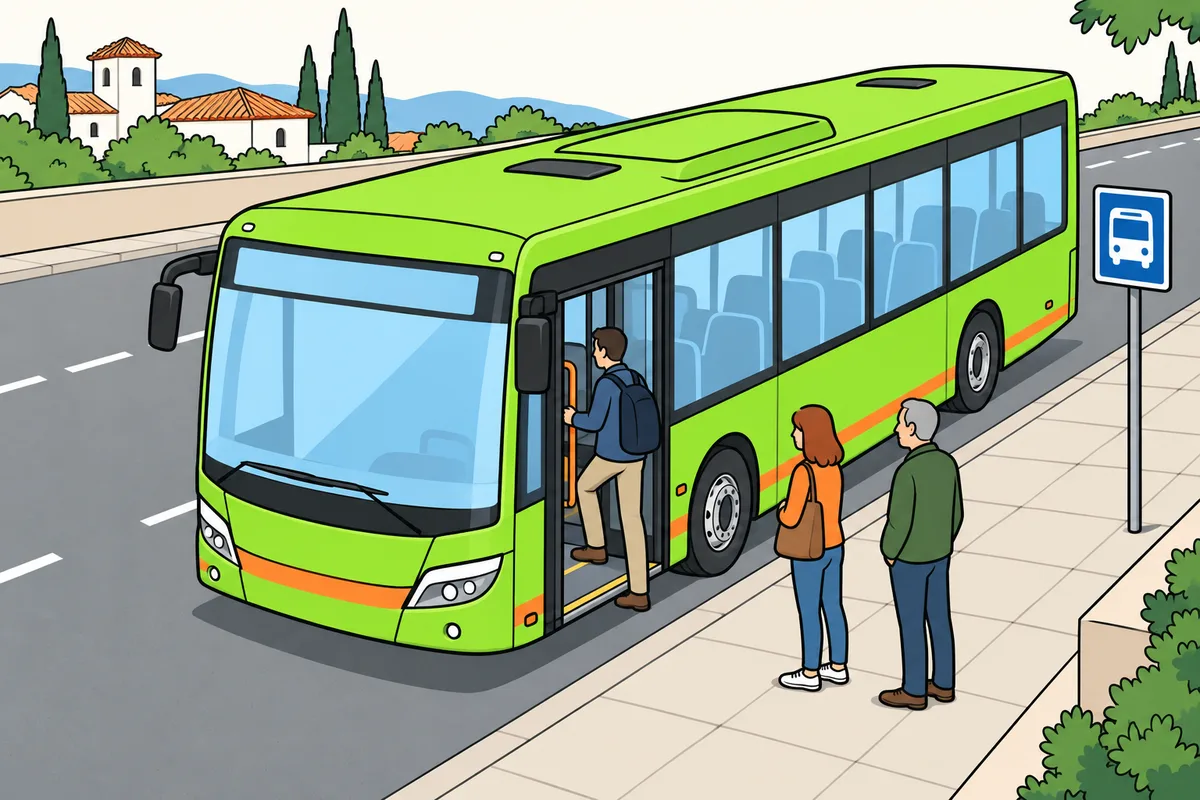
Opening the doors, stopping at a stop and moving off again must only be done when it is safe for passengers and nearby road users.
- Take extra care with children, older people, people with reduced mobility and users who might cross in front of or behind the bus.
- Before closing the doors and pulling away, confirm that boarding and alighting have genuinely finished and that no passenger is left in a compromised position.
- Having priority as a service vehicle does not remove the obligation to stop, give way or wait when safety requires it in the specific situation.
2.5Doors and interior safety
Doors are not just an access feature: opening, closing or checking them incorrectly can create a direct risk to passengers.
- The driver must make sure the vehicle does not move off while passengers are still boarding, alighting, looking for support or moving through sensitive areas.
- Harsh driving is felt more by passengers standing or seated without optimal restraint; smoothness is a safety requirement.
- When a question mentions doors, do not answer thinking only about the mechanism; also consider the passenger's position, visibility and the stopping environment.
2.6Luggage and objects
Luggage and objects must be placed so they do not interfere with exits, aisles, stability or passenger safety throughout the passenger service.
- A badly placed item can become an obstacle during braking, an evacuation or an incident, even on a short journey.
- Securing luggage safely is part of preparing the service and must not be left until the vehicle is already moving.
- In the exam, be wary of answers that allow exits or functional areas to be blocked for convenience, speed or a temporary lack of space.
2.7Seatbelts and safety systems
If the vehicle is fitted with seatbelts or other required safety systems, using them correctly is part of protecting the passenger.
- The driver must understand that interior systems complement smooth driving but do not replace anticipation or caution.
- When there are vulnerable passengers, the margin for observation and smoothness must increase to prevent falls, knocks or unsafe reactions throughout the passenger service.
- Questions may present the seatbelt as a secondary detail; remember that any fitted protection system serves a safety function.
2.8How to answer regulation questions
First read which licence appears, which vehicle is described and which phase of the service is raised: driving, stopping, access, luggage or an incident.
- Rule out answers that reduce passenger transport to simply moving the vehicle from one point to another.
- When a specific detail is missing, apply the safe rule: do not open, close, pull away or continue until you have checked that the manoeuvre creates no risk.
- Practise linking each regulation to its purpose: protecting passengers, keeping exits clear, avoiding sudden movements and accommodating vulnerable users.
Step 3. Key points
If you only have a minute before the exam, revise this.
- 1.Distinguish the scope of the D licence from the D1 licence.
- 2.Identify whether the question concerns category, stops, doors, luggage or interior safety.
- 3.Control boarding, alighting and safe door closing before pulling away.
- 4.Secure luggage and objects so exits and functional areas stay clear.
- 5.Apply extra caution with children, older people and people with reduced mobility.
- 6.Link fitted seatbelts and safety systems to effective passenger protection.
- 7.Rule out answers that prioritise service speed over safety.
- 8.Always check the situation is safe before resuming the journey.
Step 4. Exam traps
Mistakes the DGT uses again and again on this topic.
- Thinking only about the outside of the bus and forgetting the risk inside the passenger compartment.
- Moving off without checking that boarding and alighting have genuinely finished.
- Confusing the D licence with the D1 licence when the scope of the vehicle changes.
- Allowing luggage that blocks exits, aisles or functional areas because it is a short journey.
- Believing that service priority removes the obligation to give way or wait for safety.
- Treating the use of safety systems as a recommendation unrelated to the driver's responsibility.
Step 5. Quick check
Four real exam questions on what you have just read.
A bus’s windscreen wipers have hardened rubber and leave streaks that impair vision even with a clean windscreen. What should you do?
Step 6. Frequently asked questions about passenger transport rules
- Taking into account the volume of a bus, when is the wind most dangerous?
- When it blows from the side. Driving in wind is dangerous because it destabilises the vehicle and increases the risk of an accident. When the wind blows from the front, this affects acceleration and therefore increases fuel consumption. But without a doubt, the wind is most dangerous when it blows from the side, especially if it is gusty or blows in gusts.See full question
- If you are driving a bus and a traffic officer is directing traffic, you must:
- Obey the officer's instructions. The signals and orders of an officer directing traffic take precedence over traffic lights, road signs and road markings. The driver must obey those instructions even if they conflict with a fixed sign.See full question
- The ordinary validity period of D1 and D licences is:
- Five years before age 65 and three years from age 65. Five years while the holder is under 65, and three years from that age, under Article 12.1 of the General Driver Regulations. Health circumstances may shorten the period. Turning 65 does not automatically invalidate the licence: check its expiry date and maintain required qualifications. An expired licence does not permit driving. The image illustrates a medical assessment without specifying ages or validity periods.See full question
- As a general rule, the bus you are driving will have a maximum width of:
- 2.55 metres. 2.55 metres as the general rule. Annex IX provides exceptions: for example, buses specially equipped to transport prisoners may reach 2.60 metres. Carrying prisoners in an ordinary bus is not sufficient to invoke that exception. The general limit does not mean every vehicle has the same maximum without exceptions.See full question
- To drive a trolleybus without a trailer designed to carry 40 passengers in addition to the driver, which is the minimum licence category required among those listed?
- The D class. The minimum category is D. A trolleybus is included in the definition of a bus, and D covers vehicles designed to carry more than eight passengers in addition to the driver. D1 limits passenger capacity to 16 and length to eight metres. D+E includes D and covers certain trailer combinations, but that extended licence is not required for this trolleybus without a trailer.See full question
Official sources
- BOE - General Traffic Regulations (Reglamento General de Circulación) (RD 1428/2003)
- BOE - General Driver Regulations (Reglamento General de Conductores) (RD 818/2009)
- BOE - General Vehicle Regulations (Reglamento General de Vehículos) (RD 2822/1998)
- BOE - Passenger transport information and safety (Order FOM/1230/2013)