Step 1. The big picture
In one sentence…
Master the hierarchy between officers, temporary signalling, traffic lights, vertical signs and road markings, and study the current official catalogue with attention to the most recent updates. On passenger-transport licences, reading a sign late can compromise turns, stops, reserved lanes and access restrictions.
Step 2. The syllabus
2.1Hierarchy of signalling
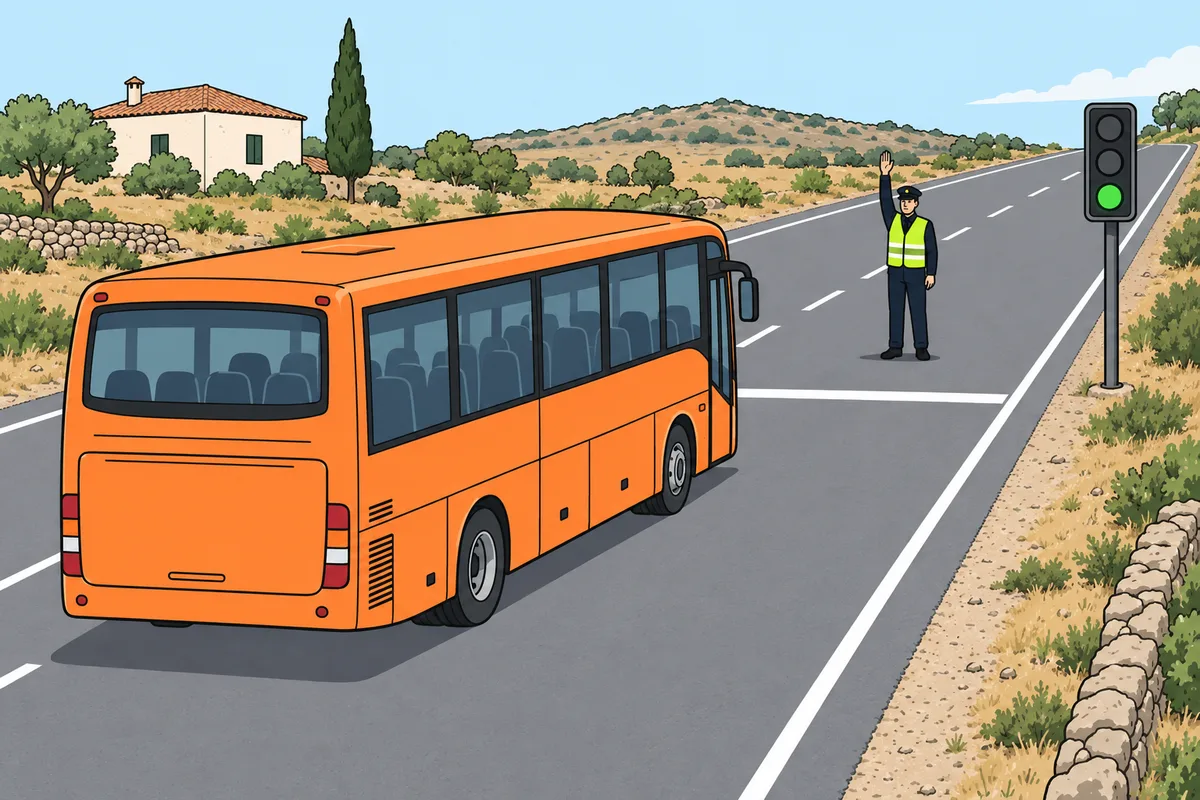
The priority between signs is not arbitrary: first you obey officers' orders, then temporary signalling, then traffic lights, then vertical signs, and finally road markings.
- If two signs appear to contradict each other, the higher-ranking one prevails. In the exam, many questions are solved by applying this hierarchy before looking at colours.
- Signs apply from the point where they are placed, unless they indicate a distance, the length of a stretch of road or the end of a restriction.
- In a passenger service, applying a sign late may force abrupt manoeuvres; that is why you must read it with enough anticipation.
2.2Families of signs
Warning signs alert you to a hazard; regulatory signs impose prohibitions or obligations; information signs give directions or information.
- Traffic lights regulate right of way with priority over an incompatible vertical sign. Their lights may apply to all road users or to a specific lane.
- Road markings delimit lanes, excluded areas, pedestrian crossings, continuous or broken lines and rules on stopping, parking and priority.
- Temporary road works signs and panels help you interpret roadworks, diversions or affected lanes; do not study them as mere decoration on the road.
2.3Priority at junctions and conflicts
At a junction, a priority sign takes precedence over the general priority-to-the-right rule, provided it applies to your route.
- If there is an operating traffic light and an incompatible vertical sign, resolve first by the traffic light, unless an officer's order or higher-ranking temporary signalling says otherwise.
- When a road marking appears to allow a manoeuvre but a higher-ranking sign restricts it, you must obey the higher-ranking restriction.
- The exam exploits junctions loaded with information; separate the officer's order, the traffic light, the vertical sign and the road marking before choosing an answer.
2.4Road markings and lanes
Road markings do not just paint boundaries: they show where to stop, which lane to follow and when a manoeuvre is prohibited or conditional.
- In reversible, additional or diverted lanes, pay attention to arrows, temporary signage and variable message panels before deciding your position.
- A continuous line or an excluded area must be interpreted as part of the whole set of signs for the lane, not as an isolated mark.
- For buses, choosing the lane late increases risk due to length, width, turning radius and the presence of passengers before choosing your answer in the exam.
2.5Roadworks, diversions and temporary signalling
At roadworks, temporary signalling can override the permanent signalling for as long as the situation it regulates lasts, before choosing your answer in the exam.
- Questions about roadworks usually combine hazard, lane reduction, road delineation devices and provisional markings; look for which element governs the specific conduct required.
- Do not assume the road keeps its usual regime if panels, cones, temporary traffic lights or specific instructions for a stretch appear.
- In passenger transport it is worth increasing your observation margin around diversions, because a sudden correction can affect passengers and vulnerable road users.
2.6Official catalogue and the 2025 update
The official catalogue of signs was updated in 2025. The reform introduces new representations and adapts pictograms and panels to current mobility.
- To study rigorously, use up-to-date material and be wary of old diagrams that keep discontinued signs or incomplete meanings, before choosing your answer in the exam.
- If a question sets a new sign against a classic one, the key is still to identify hazard, prohibition, obligation or information and act correctly.
- On buses and minibuses you must read well in advance any restrictions on length, height, traffic-light priority, reserved lanes and access restrictions.
2.7Study method for signs
Do not study signs as loose pictures: link each one to the required conduct, the vehicle's position and the anticipation needed, before choosing your answer in the exam.
- When doing practice tests, say under your breath the sign's family, its rank and the specific action it requires or prohibits.
- Pay special attention to questions with several signs, because they usually test hierarchy and context rather than visual memory, before choosing your answer in the exam.
- If you are unsure between two answers, choose the one that best respects the sign's rank and avoids an unsafe or late manoeuvre.
Step 3. Key points
If you only have a minute before the exam, revise this.
- 1.Recognise the full hierarchy of signalling before interpreting details.
- 2.Distinguish hazard, regulatory, information, traffic lights, markings and temporary signage.
- 3.Link each sign to the required conduct and the affected stretch of road.
- 4.Apply priority signs before the general priority-to-the-right rule.
- 5.Study the updated catalogue and not just old images.
- 6.Interpret roadworks and diversions as situations governed by temporary signalling.
- 7.Practise reversible, additional and reserved lanes paying attention to arrows.
- 8.Read in advance the restrictions that affect buses.
Step 4. Exam traps
Mistakes the DGT uses again and again on this topic.
- Confusing the general priority rule with a vertical sign or an operating traffic light.
- Forgetting that temporary roadworks signalling can change the usual regime.
- Reading a road marking in isolation without linking it to the rest of the signalling.
- Deciding by shape or colour without first applying the hierarchy between signs.
- Using old material and not recognising the official catalogue updated in 2025.
- Not distinguishing whether a light or arrow applies to all road users or only to one lane.
Step 5. Quick check
Four real exam questions on what you have just read.
A bus without a trailer, equipped with seat belts and carrying no standing passengers, is not performing school or children’s transport. It legally overtakes a motorcycle on a dual carriageway outside a built-up area, with no lower specific limit. What is its general maximum speed while overtaking?
Step 6. Frequently asked questions about traffic signs
- An identified driver personally disobeys a traffic sign while driving. With no special liability provision applying, who is responsible for that infringement?
- The driver. The driver, as the person who committed the act. Article 82’s general rule assigns liability to the offender, subject to statutory exceptions. A company instruction does not automatically make the company solely liable or remove the driver’s liability for that act. Other infringements, such as vehicle documents, inspections or maintenance affecting safety, may have different liability rules; this answer must not be applied to every infringement.See full question
- In 2026, which combination of accessories does Annex XII of Spain’s General Vehicle Regulations require on a bus registered in Spain?
- Connected certified V-16, regulation-compliant reflective vest and appropriate approved fire-extinguishing equipment. A connected, certified V-16 beacon, a high-visibility reflective vest meeting the regulatory requirements, and an approved fire-extinguishing unit appropriate for the vehicle and in working order. Since 1 January 2026, triangles or an unconnected beacon do not replace the required connected V-16. This question concerns that Annex XII equipment and does not exclude other equipment required for a particular vehicle or service.See full question
- May a bus authorised to use the road travel in a lane opened against its usual direction because of roadworks?
- Yes, unless expressly prohibited. Yes, unless expressly prohibited. A lane opened for roadworks may be used by vehicle types authorised to travel on that road, subject to the lane’s conditions. Use at least dipped headlights by day and night and comply with the regime’s speed limits, including any lower established or posted limits. A lane opened for traffic flow is restricted to cars without trailers and motorcycles; a bus may not use it.See full question
- A bus authorised to carry standing passengers travels on an urban road with two or more ordinary lanes in each direction, without a shared carriageway-and-pavement platform or a specific posted limit. What is the general speed limit?
- 50 km/h. 50 km/h in the stated case. Lanes reserved for particular users or exclusively for public transport do not count toward that lane total. An urban road with one lane per direction generally has a 30 km/h limit, and a shared carriageway-and-pavement platform has a 20 km/h limit. Thus 50 km/h is not the limit for every urban street. Outside built-up areas, a bus carrying authorised standing passengers has an 80 km/h maximum, subject to applicable lower limits.See full question
- A bus without a trailer and a car without a trailer meet head-on in a level narrowing wide enough for only one vehicle. No officer or signs regulate passage, and it is unclear who entered first. If one must reverse to let the other pass, which one is it?
- The car. The car must give way to the bus. Where entry order is uncertain, Article 62 ranks collective passenger vehicles ahead of cars without trailers. If the first entrant is known, Article 60 gives that vehicle priority. Steep sections have the specific rule in Article 63. Not all special vehicles rank first: that position applies to those exceeding the regulatory masses or dimensions.See full question
Official sources
Signs catalogue
All Spanish traffic signs and their meanings
The full DGT catalogue — warning (P-), regulatory (R-) and information (S-) — with the official image and meaning of every sign.