Step 1. The big picture
In one sentence…
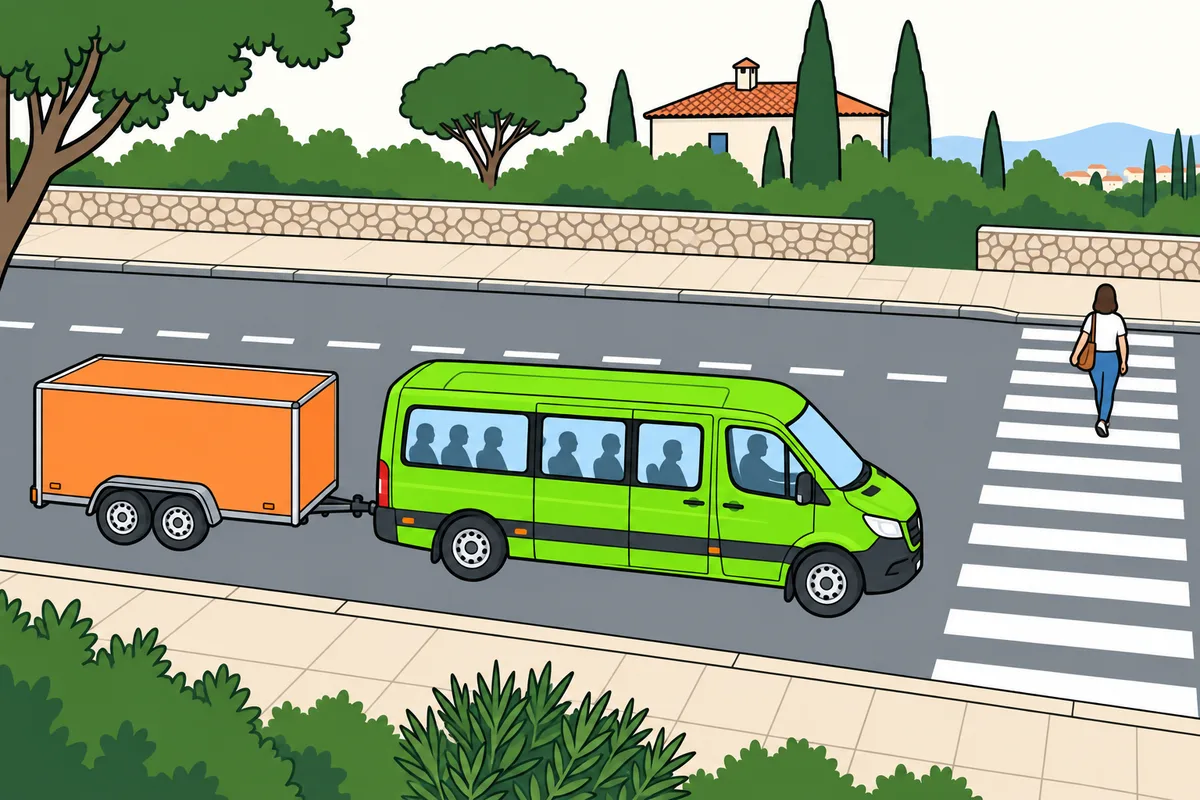
D1+E passenger combinations combine the transport of people with the dynamic complexity of a heavy trailer. You must master the scope of the licence, the specific exam and the practical consequences of driving a D1 minibus with a trailer of over 750 kg.
Step 2. The syllabus
2.1Scope of the licence
The D1+E licence authorises a D1 minibus with a trailer of over 750 kg. The authorisation covers the combination formed by the passenger vehicle and its trailer.
- To obtain it you must hold a valid D1 licence, meet the minimum age of 21, and pass the specific theory test and the practical test with the combination.
- The specific theory test has 20 specific questions, a maximum of 2 errors and 20 minutes. The margin for error is small, so it is worth studying situations, not just definitions.
- Distinguish the base minibus, the authorised trailer and the obligations of the combination. Mixing up a single vehicle and a combination is a common source of mistakes.
2.2Base vehicle and trailer
The base vehicle belongs to the D1 licence, but hitching a trailer of more than 750 kg MAM puts you into D1+E territory.
- The trailer changes length, tracking on bends, space needed and stability. That is why there is specific preparation and a practical test with the combination.
- Remember that the trailer cannot be used to carry passengers. This rule rules out answers that treat the trailer as an extension of the passenger cabin.
- Documentation, coupling, connections and the applicable limits must be checked before the service. Knowing the licence's authorisation is not enough on its own.
2.3Passenger safety
Carrying passengers turns smoothness into a safety requirement. Harsh acceleration, braking and turning affect comfort and stability.
- The margin must be greater than in a single vehicle because every manoeuvre affects two connected masses and people inside them.
- If a situation forces you to improvise, you probably reacted too late. Correct driving is based on anticipation, space and early decisions.
- In theory questions, look for the option that protects passengers and other road users without forcing the manoeuvre or reducing the margin.
2.4Manoeuvrability and space
The trailer changes turns, roundabouts, joining traffic and reversing. You need more space and less improvisation than with a single vehicle.
- Do not start a manoeuvre if you cannot complete it without encroaching on or unsafely blocking a space. Just enough room is usually a trap.
- In turns, watch how the trailer tracks and protect areas with pedestrians or cyclists. The risk is not only in front.
- When reversing, use clear reference points and small corrections. If you lose sight of the critical area, stop before continuing.
2.5Checks beforehand
Before the service, check the coupling, electrical connections, wheels, brakes, lights, signalling and fastenings. These are applied safety, not paperwork.
- Do not wait to notice a fault while driving. Spotting an anomaly too late reduces your margin to stop and protect passengers.
- Checking the trailer is as practically important as checking the main vehicle. A fault at the back affects the entire trajectory.
- When a question talks about starting the service, read that phrase as a cue about preparation and prior checks.
2.6How it appears in the exam
The D1+E specific exam covers the service, coupling, manoeuvring and passenger safety. Study each rule with a practical consequence.
- If an answer plays down the trailer, be suspicious. The central idea is that it changes driving, stability and trip preparation.
- If an answer forgets about the passengers, also be suspicious. Smooth, foresighted driving is part of safety.
- Practise separating three levels: what the licence authorises, what you check before setting off, and how you manoeuvre with margin.
Step 3. Key points
If you only have a minute before the exam, revise this.
- 1.Remember that D1+E requires holding a valid D1 licence.
- 2.Remember the licence's minimum age of 21.
- 3.Link the specific exam to 20 specific questions, a maximum of 2 errors and 20 minutes.
- 4.Identify a D1 minibus with a trailer of over 750 kg as the authorised combination.
- 5.Check documentation, coupling and limits before the service.
- 6.Do not use the trailer to carry passengers.
- 7.Increase the manoeuvring margin because of the trailer and the passengers.
Step 4. Exam traps
Mistakes the DGT uses again and again on this topic.
- Confusing the D1 licence with D1+E and forgetting the effect of the trailer.
- Accepting that the trailer carries passengers when the permitted rule says otherwise.
- Forgetting that the specific exam has 20 questions, a maximum of 2 errors and 20 minutes.
- Thinking that single-vehicle technique is enough for the combination.
- Not checking the coupling or connections before starting the service.
Step 5. Quick check
Four real exam questions on what you have just read.
D1+E and D+E licences apply to combinations in which the trailer has a MAM that:
Step 6. Frequently asked questions about passenger vehicle combination rules
- Between the two attempts of the same the D1+E and D+E licences application there should normally be no more than:
- Six months. As a general rule, there should be no more than six months between the two attempts of the same application.See full question
- The D+E licence authorizes combinations made up of a D-category vehicle and a trailer whose maximum authorized mass:
- Exceeds 750 kg. DGT states that D+E allows a trailer whose maximum authorized mass exceeds 750 kg together with a D-category towing vehicle.See full question
- If an exam center outside the provincial capital stops meeting the required conditions for the D1+E and D+E licences:
- The tests move to the capital or another suitable center in the same province. Until the deficiencies are corrected, the tests will be held in the provincial capital or at another suitable center in the same province.See full question