Step 1. The big picture
In one sentence…
Preventive maintenance of buses and minibuses is part of road safety: it prevents breakdowns, reduces braking distance, improves stability and cuts down on exam and real-driving errors. On the D1 licence you must treat it as part of your routine as a driver, not as a task left to the garage.
Step 2. The syllabus
2.1Checks before setting off
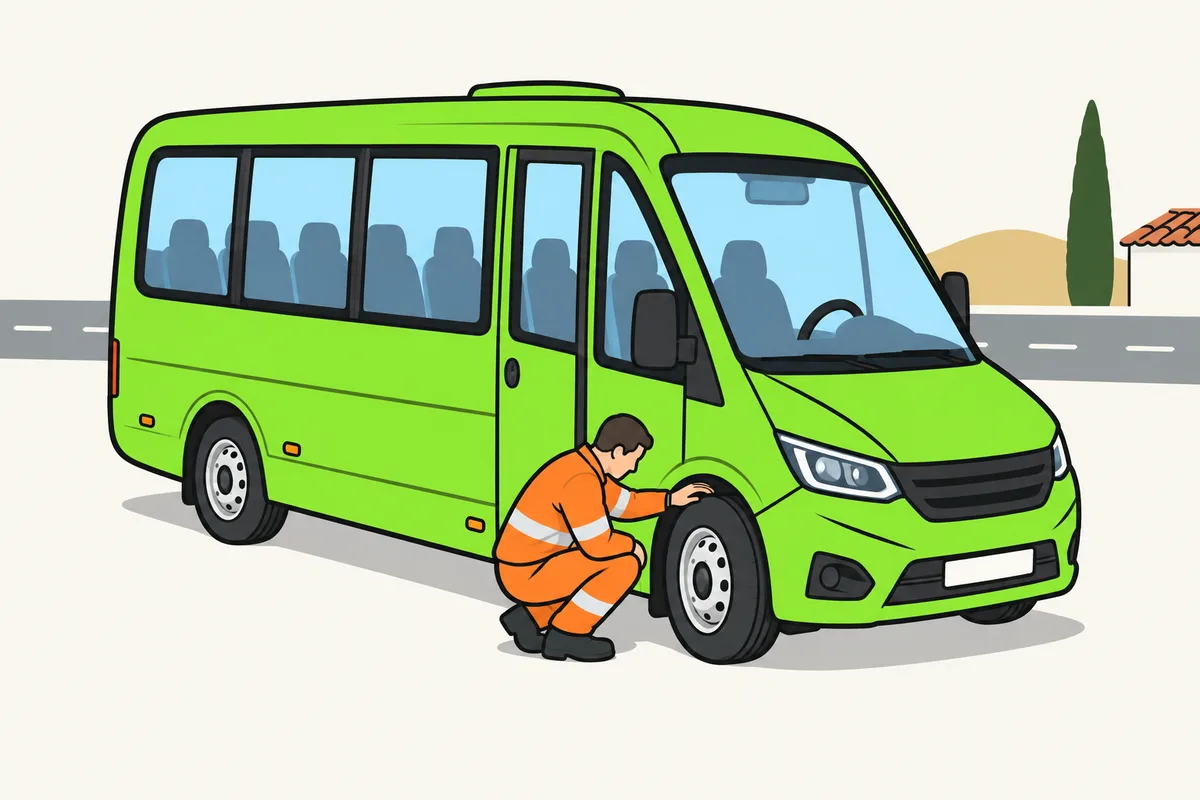
Before demanding use or a long journey, check the tyres, pressure, tread, uneven wear, lights, optical signalling and general condition of the brakes.
- Check essential levels whenever the vehicle requires it: oil, coolant, brake fluid and windscreen washer fluid, because they affect safety and visibility.
- Check doors, locks, mirrors, wipers and dashboard warning lights before starting the service, especially if another driver used the vehicle before you.
- If you find a defect affecting an essential component, do not treat it as a minor nuisance: it affects braking, stability, visibility and passenger safety.
2.2Tyres, brakes and stability
Tyres provide the actual contact with the road; pressure, tread and uneven wear alter grip, braking and cornering response.
- A braking system in poor condition lengthens stopping distance and can turn a manoeuvre that is correct on paper into an insufficient one in a real situation.
- In minibuses, mass, height and internal weight distribution mean that any wheel or brake defect is felt more when braking, turning or avoiding an obstacle.
- The exam usually presents defects as safety problems, not as isolated mechanical vocabulary; always link the defect, its consequence and the prudent conduct.
2.3Lights and optical signalling
Lights and indicators let you see, be seen and signal manoeuvres; a faulty bulb can make an action that would be normal with full visibility dangerous.
- Check indicators, position lights, dipped beam, brake lights and hazard lights with a service mindset: other road users need enough time to understand what the vehicle will do.
- In passenger transport, stopping, pulling away or a slow manoeuvre needs clear signalling to protect passengers and other road users.
- Do not memorise lighting as a closed list; think about how each light communicates presence, intent, width or a reduction in speed depending on the situation.
2.4Preparing the driving position
The DGT requires you to know how to prepare the vehicle for safe driving: seat, mirrors, seatbelt, doors and basic checks of the general condition.
- Adjusting the driving position avoids correcting your posture while under way and improves control of the sides, the near front and tracking the bodywork.
- Preparation also includes checking that the passenger compartment has no loose objects that could shift, distract the driver or affect the passengers.
- In the exam, a question about the seat or mirrors is not about comfort; it tests whether you understand how poor preparation reduces observation and reaction time.
2.5Load, luggage and trailer
If the vehicle is towing a trailer or carrying a load, check the couplings, locks, electrical connections and balanced weight distribution before setting off.
- Badly placed luggage can interfere with exits, stability or interior safety, which is why controlling it is part of the vehicle's operational maintenance.
- An unbalanced load changes how the vehicle responds when braking, cornering or performing a slow manoeuvre, even when the driver applies correct technique.
- When the exam mentions load or a trailer, first identify which element could fail: anchoring, connection, lights, weight distribution, locking or interference with passengers.
2.6Maintenance and efficient driving
Correct pressure, wheel alignment, filters in good condition and a reasonable load reduce fuel consumption and wear without changing the main safety obligation.
- Smooth driving helps, but it does not make up for a known defect in the brakes, wheels, lights or interior safety features.
- Driving with a known defect can be a reportable offence if it affects essential vehicle components; the prudent decision is to fix it before providing the service.
- Efficiency is studied alongside safety because a well-maintained vehicle responds predictably and avoids unnecessary mechanical strain.
2.7How to practise this topic
Turn every check into a cause-and-effect question: what am I checking, what risk does it prevent, and what would I do if I found a fault.
- When reviewing practice questions, note whether the correct answer relies on passenger safety, visibility, braking, stability or load control.
- Do not limit yourself to the engine; on passenger-transport licences, wheels, brakes, lights, doors, mirrors, fixings and interior features are just as examinable.
- If an answer proposes continuing to drive despite an essential defect, be suspicious: the exam standard usually rewards stopping, checking or fixing before continuing.
Step 3. Key points
If you only have a minute before the exam, revise this.
- 1.Check tyres, pressure, tread and wear before demanding services.
- 2.Check brakes, lights, indicators and wipers before setting off.
- 3.Adjust the seat, mirrors and seatbelt before pulling away.
- 4.Check essential levels whenever the vehicle requires it.
- 5.Check doors, locks, luggage and loose objects in the passenger compartment.
- 6.Link each defect to its effect on braking, stability or visibility.
- 7.Fix any fault that affects essential components before the service.
- 8.Practise questions thinking about passenger safety, not only mechanics.
Step 4. Exam traps
Mistakes the DGT uses again and again on this topic.
- Thinking maintenance is only a garage matter and not a road-safety matter.
- Focusing on the engine and forgetting wheels, brakes, lights or fixings.
- Believing that smooth driving makes up for a major mechanical defect.
- Forgetting that badly placed luggage can also create risk inside the vehicle.
- Treating a faulty light as a minor problem even though it prevents signalling manoeuvres.
- Not linking tyre pressure and wear with braking and stability.
Step 5. Quick check
Four real exam questions on what you have just read.
In a bus, preventive maintenance of the braking system is essential because:
Step 6. Frequently asked questions about mechanics and maintenance
- In a D1 or D bus, correct tire pressure:
- Improves safety and stability. Maintaining proper pressure improves safety, stability, and helps avoid abnormal wear.See full question
- If a warning appears in a D1 or D bus indicating a major fault, the correct action is to:
- Stop safely and check the fault. In the event of a major fault, you must act prudently and not continue as if nothing were wrong.See full question
- If you notice unusual noises or vibrations in a D1 or D bus, the prudent action is to:
- Check the cause and do not dismiss it. Unusual noises and vibrations may indicate a fault that should be checked as soon as possible.See full question
- A steering fault in a D1 or D bus:
- Seriously compromises safety. Steering is an essential control element, so a fault seriously compromises safety.See full question