Step 1. The big picture
In one sentence…
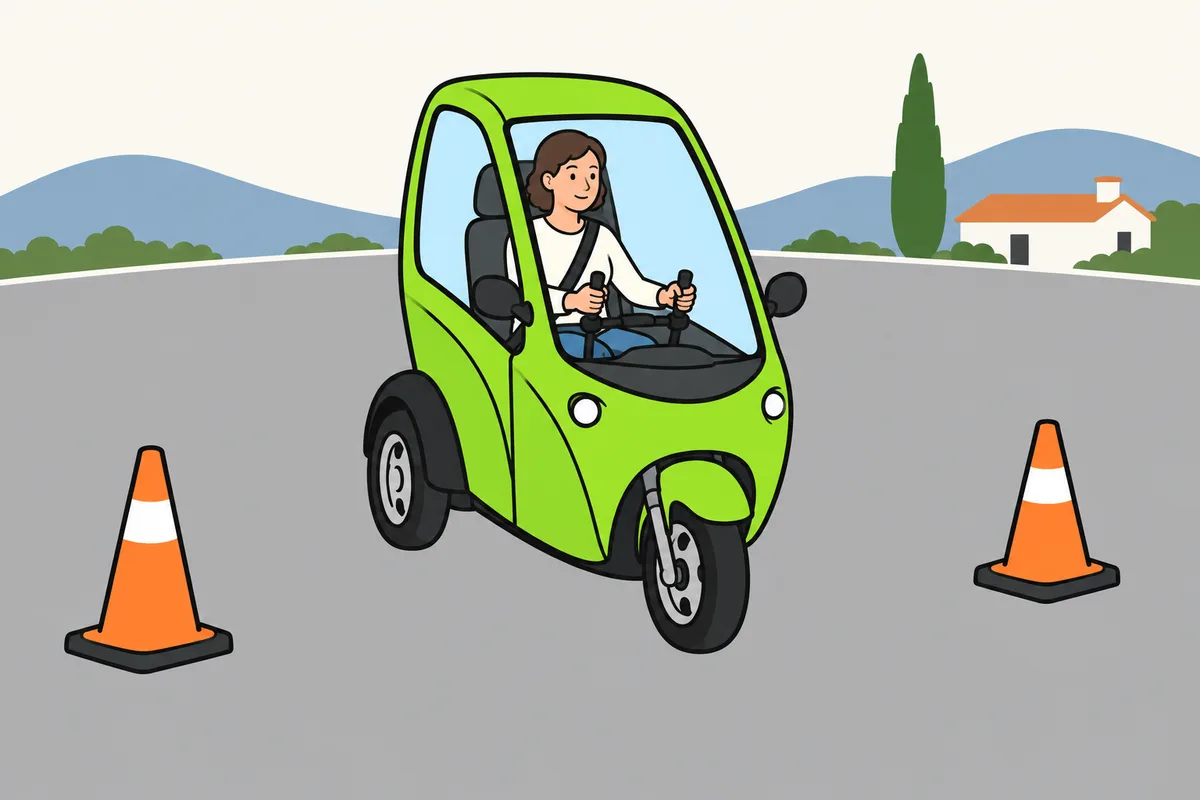
The vehicle and manoeuvres topic in LCM requires knowing the basic controls, stability control, correctly occupying space and manoeuvring at low speed with full safety. The exam tests your ability to check beforehand, observe fully and use the available space prudently.
Step 2. The syllabus
2.1Control of the vehicle
Before setting off, check the brakes, steering, wheels, lights and general condition of the vehicle for people with reduced mobility.
- The driving position and access to the controls must let you manoeuvre without effort or loss of control.
- Get to know how your vehicle responds so you are not caught out when accelerating, braking or turning in real traffic.
- A well-checked vehicle responds predictably, and that predictability is the basis of safe driving.
2.2Controls and driving position
Adjust your position to reach all the controls comfortably and to keep a stable posture throughout the trip.
- Know the function of each control and practise using them until you can operate them without taking your attention off the road.
- A firm, well-supported posture improves control and reduces fatigue on trips.
- If a control is hard to reach or to operate, sort it out before driving so it does not compromise your control.
2.3Basic manoeuvres
Manoeuvres must be carried out at low speed, with full observation and without entering areas that put pedestrians at risk.
- In changes of direction, parking or passing through narrow points, anticipation is worth more than abruptness.
- Observe the whole surroundings before starting the manoeuvre and check that you have enough space and time.
- Carry out each manoeuvre progressively so you can stop or correct if something unexpected happens.
2.4Stability and low speed
Stability and control of the vehicle must come before any attempt to squeeze through a doubtful gap.
- At low speed, sudden steering movements destabilise the vehicle more, so drive smoothly.
- Avoid loads or weight distributions that could upset the vehicle's balance while moving.
- Keeping stable control in every manoeuvre matters more than saving a few seconds.
2.5Usable space and safety
If there is no part of the road specifically set aside for you, occupy only the space strictly necessary and adapt your path to the available width and road surface.
- The usable part of the road can change because of the surface, the gradient or side obstacles, so keep reassessing it constantly.
- Do not force your way through a gap just because you believe the vehicle is small and will always fit.
- Choosing the safest path, even if it is not the shortest, avoids getting trapped or exposed.
2.6Checking beforehand as a routine
Turn checking the brakes, steering, wheels and lights into a fixed routine before every trip.
- Following the same order of checks every day means you instantly notice any change or fault.
- Spotting a fault before setting off is always better than discovering it once you are already driving and cannot react.
- The check beforehand is quick and prevents most breakdowns that catch you out halfway through a trip.
2.7Anticipation in the manoeuvre
Anticipating the manoeuvre means preparing your observation, signalling and speed before starting it.
- Foreseeing changes of direction or position in good time avoids having to correct abruptly.
- Think about what could go wrong in the next few seconds and have a safe response ready.
- Anticipation is the tool that makes up for this type of vehicle's lower speed and protection.
Step 3. Key points
If you only have a minute before the exam, revise this.
- 1.Check the controls and general condition before every trip.
- 2.Adjust your position to reach the controls comfortably.
- 3.Manoeuvre slowly and with full observation of the surroundings.
- 4.Prioritise stability over squeezing through a doubtful gap.
- 5.Use only the space strictly necessary when there is no reserved area.
- 6.Reassess the usable part of the road according to surface, gradient and obstacles.
- 7.Anticipate and signal every manoeuvre in advance.
Step 4. Exam traps
Mistakes the DGT uses again and again on this topic.
- Forcing a manoeuvre because you believe the vehicle is small and will always fit.
- Forgetting that the usable part of the road can change due to surface, gradient or side obstacles.
- Making quick or sudden manoeuvres instead of anticipating them.
- Setting off without checking the brakes, steering, wheels and lights.
- Putting saving time ahead of keeping control and stability.
Step 5. Quick check
Four real exam questions on what you have just read.
In a vehicle for persons with reduced mobility, the driver, their items, and any authorized occupant must not:
Step 6. Frequently asked questions about vehicles and manoeuvres
- Before setting off with a vehicle for persons with reduced mobility, it is advisable to check that:
- The driving position allows proper control of the controls. The driving position and supports should be properly adjusted so the vehicle can be controlled safely without loss of control.See full question
- As a general rule, how long is an LCM licence valid before age 65 and from that age?
- 10 years until age 65 and 5 years after. Ten years before age 65 and five years from that age, under Article 12.2. These are general periods: they may be shortened for a medical condition liable to worsen, and fitness requirements must continue to be met. Do not confuse them with certain professional-category periods or drive with an expired licence.See full question
- The minimum age to obtain the LCM licence is:
- 14 years old. Fourteen years old, under Article 6 of the General Driver Regulations. Until age sixteen, it does not authorise carrying passengers. Do not confuse this reduced-mobility-vehicle licence’s age with that of other licences.See full question