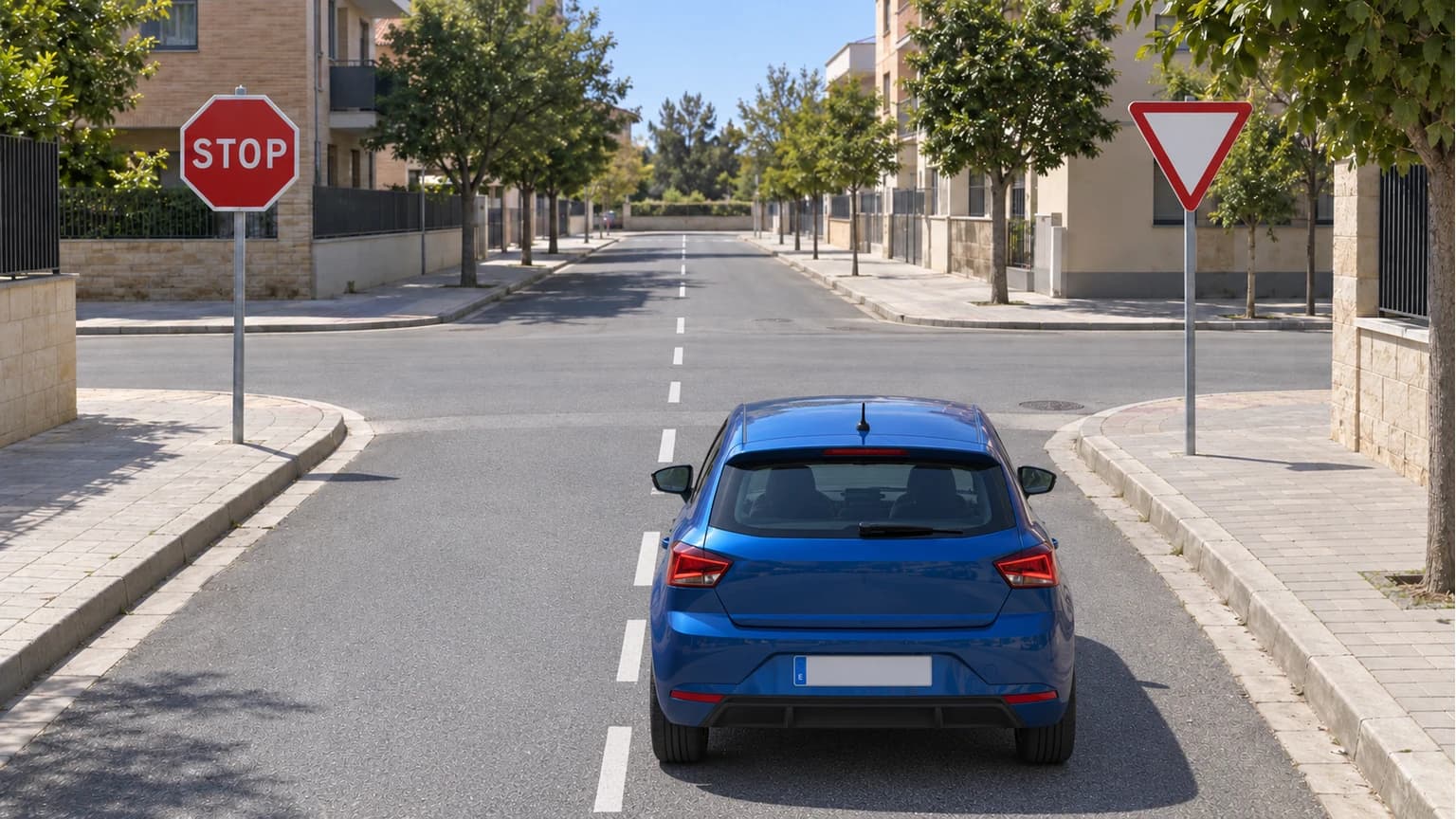
Correct answer
The give way sign.
When at a crossroads or intersection we find vertical signs with a different meaning on the driver's right and left, drivers who want to turn left or carry straight on must obey only the traffic lights or vertical signs on their left, while those who want to turn right must follow the ones on the right-hand side. So the blue vehicle, if it wants to turn right, must obey the give way vertical sign.
Practice more B licence questions
A 3-minute quick test with exam-style questions. Free, no signup.
All options
The STOP sign, because it is more restrictive.
The give way sign.
The STOP sign, because it is located on the left.
Editorial status: editorially approved. This status does not certify legal review. Report a correction
Share this question
Keep studying
Glossary terms in this question
Related questions
- At night, a group of pedestrians is on the carriageway or shoulder of an interurban road. In addition to the elements required for each pedestrian, what lights must the group carry?
- A Spanish-registered car is immobilised on a Spanish road after its load falls onto the carriageway. From 2026, how must the danger be warned of?
- Except in special circumstances, all road users are obliged to obey traffic signs...
- If a joining vehicle risks causing a crash because its driver has not seen you, how may you warn of your presence when necessary?
- What does the road marking with a P and an N on either side of a cross indicate?
- How is the reversing manoeuvre usually signalled?