Correct answer
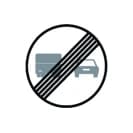
End of the prohibition on overtaking for lorries.
Vertical sign R-503, included among the End of Prohibition or Restriction signs, marks the point from which the prohibition on overtaking for lorries ends.
Practice more C1 licence questions
A self-check with exam-style questions on Traffic signs. Free, no signup.
All options
End of parallel traffic.
End of all previous local-character prohibitions relating to lorries.
End of the prohibition on overtaking for lorries.
Editorial status: editorially approved. This status does not certify legal review. Report a correction
Share this question
Keep studying
Glossary terms in this question
Related questions
- At a properly marked pedestrian crossing with no traffic lights, agents or signs modifying its operation, do pedestrians have priority over vehicles?
- An unauthorised private car reaches a signed area reserved exclusively for urban public transport stopping and parking. What voluntary actions are prohibited there?
- When a driver extends their arm horizontally with the palm of the hand facing backwards, what does this indicate?
- In a built-up area, a bus signals that it intends to move off from a signposted stop. What must other drivers do?
- An ordinary lorry with MAM of 4,000 kg, not carrying dangerous goods, uses a paved conventional road outside built-up areas, with one lane each way and a 1.40 m shoulder. No sign imposes a lower limit. What is its general maximum speed?
- A car intends to overtake your heavy vehicle. You cannot keep fully to the right edge, but the manoeuvre can be carried out safely. How may you indicate that possibility?