Correct answer
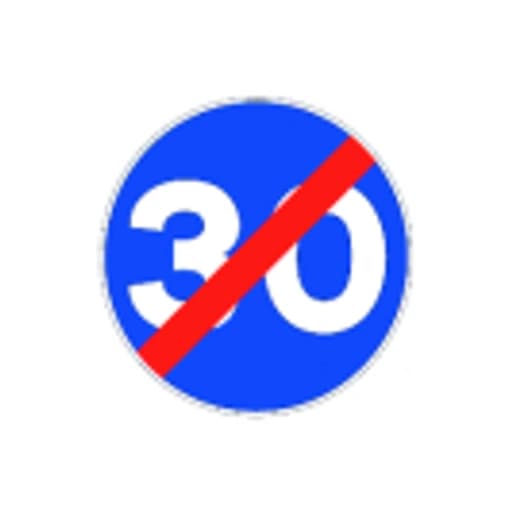
The obligation to travel at least 30 km/h ends.
R-506 ends the indicated minimum-speed requirement, here 30 km/h. It does not establish a 30 km/h maximum. Other signs, general limits and appropriate speed for the conditions still apply.
Practice more B licence questions
A 3-minute quick test with exam-style questions. Free, no signup.
All options
A recommendation to travel at no more than 30 km/h ends.
An obligation to travel at no more than 30 km/h begins.
The obligation to travel at least 30 km/h ends.
Editorial status: editorially approved. This status does not certify legal review. Report a correction
Keep studying
DGT test in English: free practice
Exam-style questions in English, no signup. You can also sit the official exam in English.
All Spanish traffic signs and their meanings
Full DGT catalogue: warning, regulatory and information signs.
Sign R-506: the end of minimum speed
What this sign means, its category and its shape.
Related questions
- You anticipate that traffic will require a substantial reduction in speed and can warn in advance without compromising control. How should you warn following drivers?
- Under current rules, may a car exceed the permitted maximum speed on a conventional road merely because it is overtaking?
- By how many km/h will the maximum motorway speed be reduced for school transport vehicles?
- A motorcycle without a trailer travels on a dual carriageway outside a built-up area, with no lower specific limit or special circumstances. What is its general maximum speed?
- Driving in a lane designated for travel in the opposite direction to the usual one…
- If speed increases while reaction time and braking conditions remain unchanged, stopping distance...