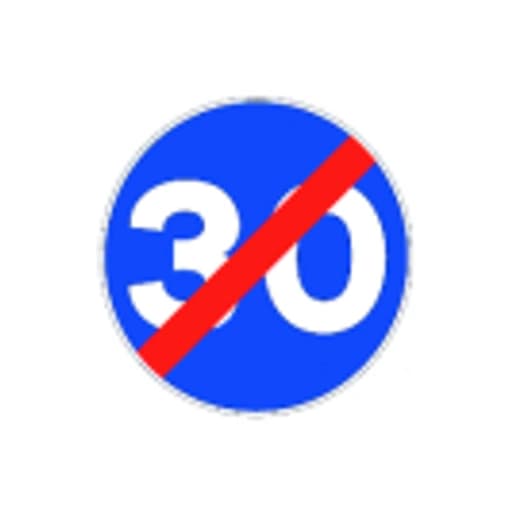
Correct answer
It ends the requirement to travel at a minimum speed of 30 km/h.
This sign marks the end of the requirement to travel at that minimum speed. From the point where the sign is placed, you must drive taking into account the road's general minimum speed.
Practice more C licence questions
A self-check with exam-style questions on Traffic signs. Free, no signup.
All options
It ends the requirement to travel at a minimum speed of 30 km/h.
It reminds you that it is compulsory to maintain a minimum speed of 30 km/h.
From this point, it is compulsory to travel at a speed below 30 km/h.
Editorial status: editorially approved. This status does not certify legal review. Report a correction
Share this question
Keep studying
Glossary terms in this question
Related questions
- With no higher-priority instruction or signal indicating otherwise, what must you do at this STOP sign?
- A lorry with a MAM of 5,000 kg is authorised to use the road. In which case may it use a lane opened in the direction opposite to normal, provided it is not expressly prohibited?
- Roadworks require a lane to be opened against its usual direction. Your lorry is authorised on that road, there is no express prohibition and no lower limits are established or signed. How must you travel in that lane?
- An ordinary lorry, without special transport or dangerous goods, travels on a paved conventional road. With no reason justifying travel below the minimum, below what speed would it breach the general minimum-speed rule?
- As a general rule, may a lorry use a lane opened in the opposite direction to normal to improve traffic flow, without special authorisation?
- If you are driving a van with a maximum authorised mass (MAM) of four tonnes without a load, may you enter a road that has this sign at the entrance?