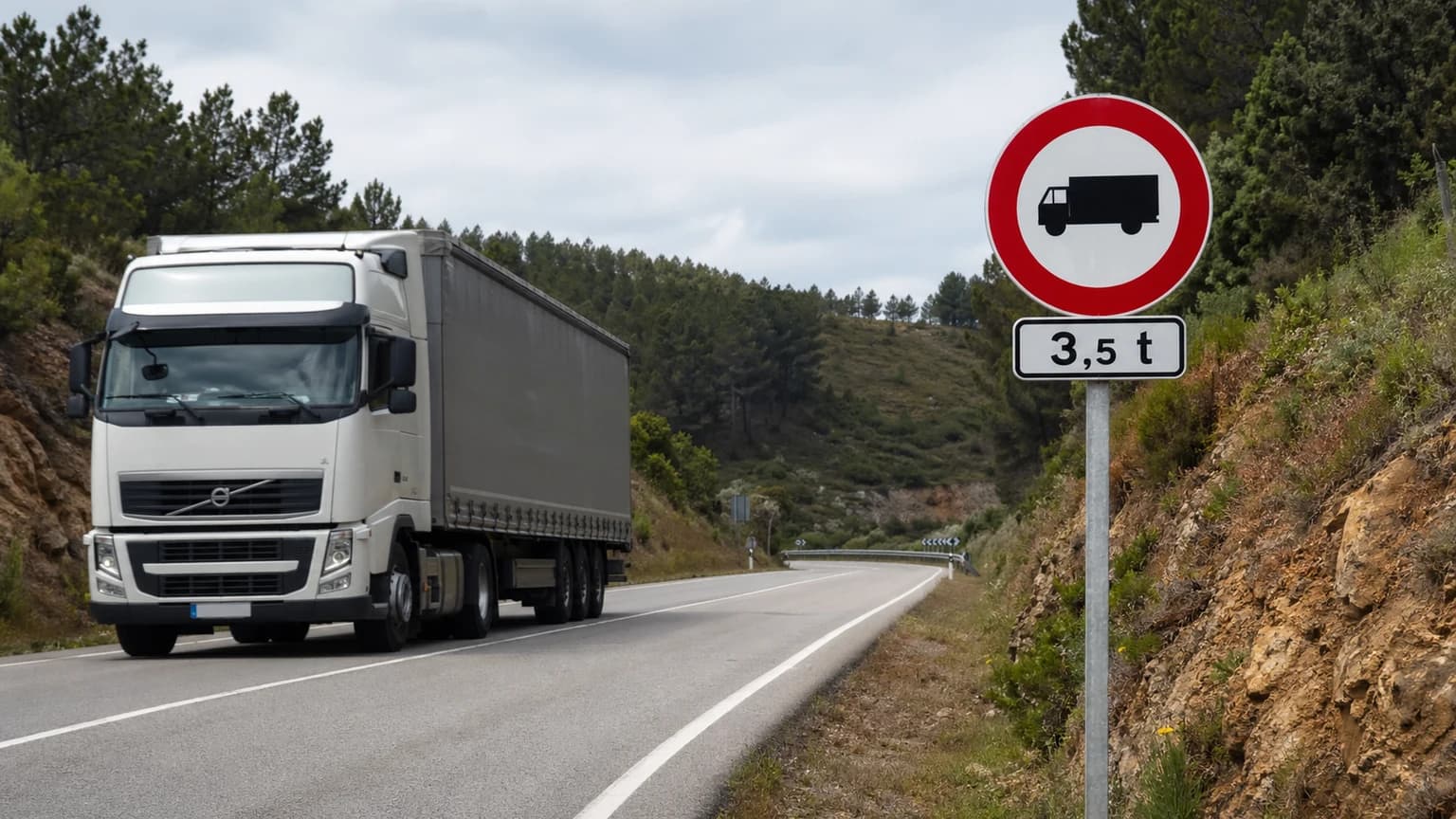
Correct answer
Yes; its MAM exceeds 3.5 t even when empty.
Yes. R-107 displaying 3.5 t prohibits goods vehicles whose MAM exceeds that figure, even when empty. A MAM of 4 t exceeds 3.5 t. The comparison is not merely with current actual mass or limited to a particular body type. The panel gives the applicable threshold; it is not by itself a truck-category panel without a mass condition.
Practice more C1 licence questions
A self-check with exam-style questions on Traffic signs. Free, no signup.
All options
No; an empty lorry is always exempt from this sign.
Yes; its MAM exceeds 3.5 t even when empty.
It applies only if its load alone exceeds 3.5 t.
Editorial status: editorially approved. This status does not certify legal review. Report a correction
Keep studying
DGT test in English: free practice
Exam-style questions in English, no signup. You can also sit the official exam in English.
All Spanish traffic signs and their meanings
Full DGT catalogue: warning, regulatory and information signs.
Sign R-107: no entry for vehicles intended for carrying goods with a maximum authorised mass greater than the one indicated
What this sign means, its category and its shape.
Related questions
- One lane is opened against its usual direction, leaving a single adjacent lane in your normal direction. You drive your lorry in that remaining lane, with no lower limits established or signed. How must you travel?
- At a junction inside a built-up area there are two marked lanes in the same direction. With no other prohibition, a lorry overtakes a two-wheeled motorcycle on the right after checking it can do so safely. Do these overtaking rules allow it?
- On a bend or crest with reduced visibility, what does the rule prohibit for voluntary stopping: only a brief stop, only parking, or both?
- When a vehicle cannot reach the minimum speed required and there is a danger of a rear-end collision, the direction indicator lights must be used as a hazard warning signal.
- On a two-way carriageway with three lanes in total separated by broken longitudinal markings, what may a lorry use the centre lane for when the manoeuvre is safe and permitted?
- An ordinary lorry and an ordinary three-wheeled vehicle arrive simultaneously at a narrow passage where they cannot pass and one must reverse. There are no signs, controlling instructions or steep gradient. Which has priority?