Step 1. The big picture
In one sentence…
Risk factors are studied as a real cause of error: alcohol, drugs, speed, distraction, fatigue, adverse weather and overconfidence. On motorcycles their effects tend to multiply. Learn to recognise each factor and how the exam presents them so they don't catch you off guard.
Step 2. The syllabus
2.1Alcohol and drugs while riding
The law does not only penalise obvious intoxication: it also penalises exceeding the legal limits or riding with drugs present in your system, even if you feel fit to ride.
- Alcohol reduces reflexes, distorts your perception of speed and gives a false sense of control, an especially dangerous combination on two wheels.
- Novice riders during their first two years, and certain professional transport drivers, have stricter alcohol limits than other drivers.
- On a motorcycle there's no bodywork to cushion a mistake, so any reduction in attention from alcohol or drugs turns into a fall or an impact sooner.
2.2Medication and psychophysical state
Medication that reduces reflexes, vision or attention requires reading the leaflet, avoiding riding where appropriate, and never offsetting the risk with overconfidence.
- Psychophysical state includes emotions and stress: riding angry, in a hurry or very worried also narrows your attention and worsens decision-making.
- Many exam questions want you to recognise that a driver can be a risk without being drunk, just from medication, illness or a bad moment.
2.3Distraction, an everyday risk
Holding your phone, programming the sat nav while moving, or looking away from the road for a few seconds is enough to cover many metres practically blind.
- Distraction is dangerous because it seems harmless and happens daily; normalising small lapses ends up turning them into the cause of a scare or an accident.
- On a motorcycle you need both hands and full attention for balance, braking and your line, so any gesture that takes away your concentration weighs more than it would in a car.
- To practise this, get into the habit of preparing your route before setting off and not checking notifications or your phone while riding.
2.4Inadequate speed and distance
Incorrect speed is not only exceeding the limit: it is also riding within the limit but without adapting your speed to rain, traffic, visibility or grip.
- Safe distance must allow you to stop without a collision, and it increases if the vehicle is heavy, articulated, two-wheeled, or riding in unfavourable conditions.
- The higher the speed, the longer the braking distance and the shorter the time to react, two effects the exam often contrasts with the idea of always going fast.
- On a motorcycle, late braking leaves little margin, so anticipating and keeping your distance protects you more than relying on braking hard at the last moment.
2.5Fatigue and drowsiness while riding
Drowsiness reduces alertness, lengthens reaction time and increases the chance of running off the road, rear-end collisions and lapses of concentration, especially on monotonous, long journeys.
- Warning signs are usually yawning, frequent blinking, involuntary changes in speed, difficulty remembering the last few kilometres and the need to correct your course.
- The only safe response to fatigue is to stop, rest and continue only once your control abilities have fully recovered; neither music nor coffee removes it.
2.6Weather and grip
With rain, fog, ice, wind or glare, you must reduce speed, increase distance, smooth out your manoeuvres and use the correct lights to see and be seen.
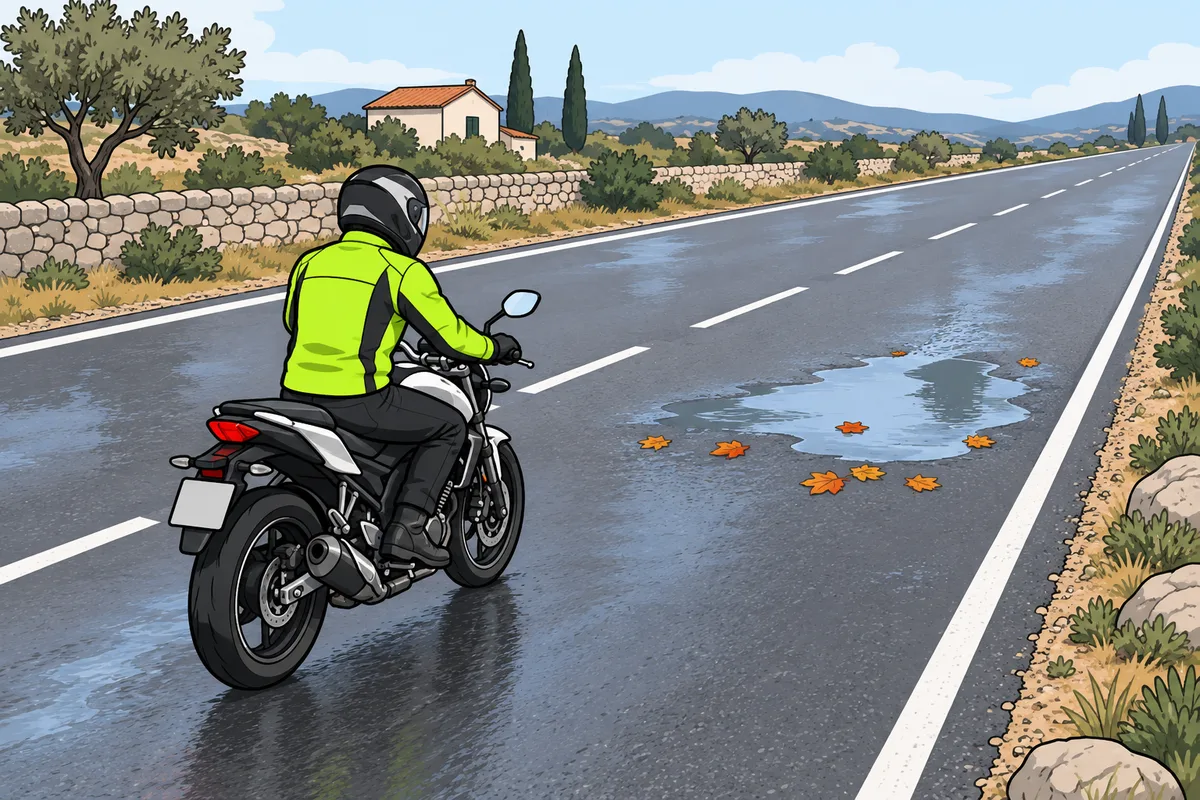
- Grip changes with a wet road surface, gravel or leaves, and a surface a car barely notices can completely destabilise a motorcycle.
- The exam tests whether you link the weather to a real change in conduct, not just turning on the lights: it's about adapting your pace, line and distance.
2.7Risks specific to motorcycles
On a motorcycle, other drivers' visibility of you is a risk in itself: never assume the other driver has seen you, especially at junctions and merges.
- Road markings, drain covers, sand, leaves, gravel and crosswind have a much greater effect on two wheels than in a car and can cause a fall.
- Risk perception improves when you anticipate junctions, pedestrians, vulnerable road users, merging traffic, school zones, roadworks and changes in grip before you reach them.
2.8Overconfidence
Experience helps, but believing you no longer need to adapt distance and speed is itself a risk factor the exam tends to penalise.
- Overconfidence appears when you know the route or are in a hurry, and it leads to neglecting checks you would otherwise do without thinking.
- Riding defensively means assuming others can make mistakes and always leaving a margin to correct, rather than relying entirely on your own reflexes.
Step 3. Key points
If you only have a minute before the exam, revise this.
- 1.Identify risks that affect attention, vision or reaction time.
- 2.Don't ride under the influence of alcohol, drugs or medication that reduces reflexes.
- 3.Adapt speed and distance to your physical state, the road and grip.
- 4.Stop at the first signs of drowsiness or fatigue.
- 5.Don't normalise small, repeated distractions such as your phone.
- 6.Change your conduct, not just your lights, in bad weather.
- 7.Assume that on a motorcycle you may not have been seen, and ride defensively.
Step 4. Exam traps
Mistakes the DGT uses again and again on this topic.
- Thinking that as long as you don't exceed the speed limit, you're always riding correctly.
- Reducing risk to alcohol alone and forgetting medication, fatigue or distraction.
- Believing experience removes the need to adapt distance and speed.
- Assuming coffee, an open window or music solve drowsiness while riding.
- Considering a brief distraction harmless because it seems to last only a moment.
- Forgetting that a slippery surface affects a motorcycle much more than a car.
Step 5. Quick check
Four real exam questions on what you have just read.
What is the main function of lubricating the moving parts of a combustion engine?
Step 6. Frequently asked questions about risk factors
- Which of these situations requires particular care because of potentially low grip when riding a motorcycle?
- Riding over wet road markings with conventional paint. Wet road markings with conventional paint can offer little grip. Reduce speed beforehand and avoid abrupt braking or excessive lean over them. Some special paints improve grip, but grip must not be assumed. Rain can also reduce grip on other surfaces; assess actual road conditions.See full question
- On a conventional road outside a built-up area, with two-way traffic, no physical separation and no specific posted limit, the shoulder is 1 metre wide. What is the general speed limit for a motorcycle?
- 90 kilometres per hour. The general limit is 90 km/h; shoulder width does not increase it. On a physically separated conventional road, the road authority may set 100 km/h for motorcycles, but physical separation does not automatically raise the limit. Speed must also suit the conditions and comply with specific signs.See full question
- According to WHO, worldwide, how important are road traffic injuries in mortality among people aged 5–29?
- They are the leading cause of death in that age group. They are the leading cause of death in this age group worldwide. This concerns children and young people as road users, not only drivers or people of all ages. It does not by itself describe the causes of individual crashes or the situation in a particular country.See full question
- What aerodynamic function does a fairing properly designed for a motorcycle perform?
- It can reduce air resistance and provide aerodynamic protection. It can reduce aerodynamic drag and protect the occupant from airflow. Its effect depends on the design and does not guarantee greater stability in a strong crosswind: gusts can push the motorcycle off course. In windy conditions, adapt speed, maintain control and anticipate exposed areas.See full question
- When choosing a motorcycle you can ride calmly and safely, which criterion should you prioritise?
- That its weight, power and ergonomics suit your experience and handling ability. Choose a motorcycle suited to your experience, handling ability and needs, considering weight, power and seat height. A custom, trail or sport label alone does not guarantee easy handling, comfort on every trip or a particular power output. You must be able to control the specific model and hold the licence that authorises it.See full question
Official sources
Test what you've studied on risk factors
Exam-style questions on this topic, with an explanation after every answer.
Now, practise it
Test what you have read with exam-style questions and an explanation after each answer.
Related lessons
- A2Risk factors
Risk factors are studied as a real cause of error: alcohol, drugs, speed, distraction, fatigue, adverse weather and overconfidence. On motorcycles their effects tend to multiply. Learn to recognise each factor and how the exam presents them so you're not caught off guard.
- AMRisk factors
Risk factors are studied as a real cause of error: alcohol, drugs, speed, distraction, fatigue, adverse weather and overconfidence. On mopeds their effects tend to multiply because of the rider's lower stability and lower physical protection.
- BRisk factors
Risk factors are studied as a real cause of error: alcohol, drugs, speed, distraction, fatigue, adverse weather and overconfidence. In passenger cars on roads open to general traffic their effects tend to multiply, which is why the exam insists on anticipating and correcting before you lose control.
- A1Protective equipment
On a motorcycle the helmet is mandatory, but serious study also covers gloves, boots, jacket, technical trousers and visibility. The best technique does not remove the risk of injury. Study each item of gear by its protective function and learn to separate what's mandatory from what's merely recommended.
- A1Mechanics and maintenance
Preventive motorcycle maintenance is part of road safety: it avoids breakdowns, reduces braking distance, improves stability and cuts down on errors both in the exam and in real riding. Study each check by its effect on riding, not as a mere workshop formality.
- A1Motorcycle regulations
Study the rules specific to the A1 licence: limits on the authorised vehicle, requirements for carrying a passenger and load, and safety rules specific to motorcycles on urban and interurban roads. Knowing what you can ride and under what conditions avoids many exam mistakes.