Step 1. The big picture
In one sentence…
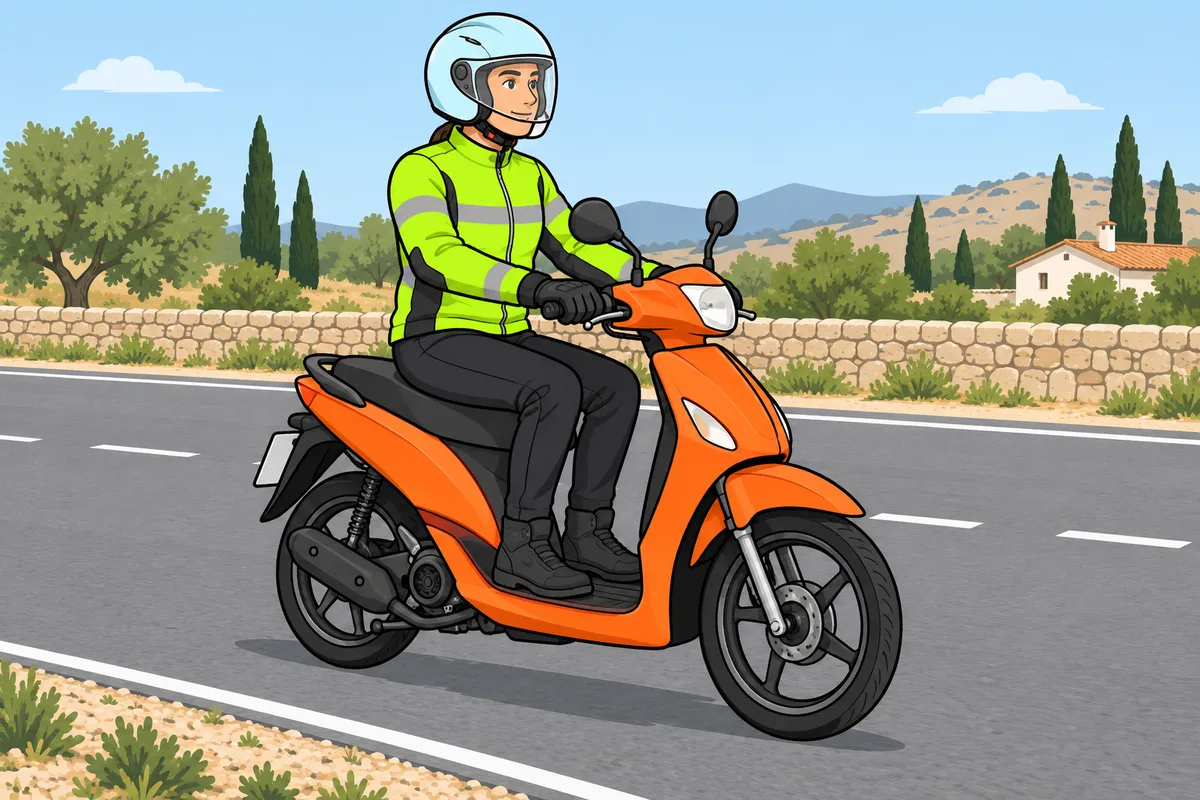
On a moped, an approved helmet is mandatory, and the rest of the equipment, although not always mandatory, is decisive for reducing injuries and improving visibility and control. The exam distinguishes between what the rule requires and what, without being mandatory, is part of riding safely.
Step 2. The syllabus
2.1Approved and mandatory helmet
The helmet must be approved, in good condition and properly fastened; wearing it loose or badly adjusted greatly reduces its real effectiveness in an impact.
- Wearing a helmet is mandatory for the rider and also for the passenger when they are authorised to be carried, with no exceptions for short trips.
- A full-face helmet or one with more coverage protects the face and jaw better than a more open one, especially outside town and at higher speed.
- After a serious knock or a significant fall, the helmet can lose its protective capacity even if the damage isn't visible from outside.
2.2Correct helmet fit
A helmet of the right size sits firmly without excessive pressure and doesn't move when you turn your head; that grip is what really protects you.
- The strap must always be done up and adjusted: an unfastened helmet can fly off on the first impact and stop being of any use.
- Check that the shell, the inner padding and the fastener are in good condition, and replace the helmet when they lose their proper condition.
- The exam tests whether you understand that a badly fitted helmet protects much less, not that it's enough just to be wearing one.
2.3Clothing and body protection
Gloves, a sturdy jacket, suitable trousers and footwear that holds the foot firmly improve protection against falls and help you control the vehicle.
- Gloves protect hands that instinctively cushion a fall, and they also keep sensitivity and precision on the controls.
- Closed, sturdy footwear supports the ankle and gives better grip than light trainers or sandals.
- Appropriate clothing isn't just about looks: it reduces abrasion and friction injuries if the body ends up in contact with the road surface.
2.4Visibility and being detected
Light colours or reflective elements make other road users spot you sooner, which is key at dawn, at dusk or in rain.
- On a small, not very visible vehicle, your own clothing is an active safety tool that gives others time to see you.
- Combine the visibility of your clothing with lighting in good condition; together they help others anticipate your presence.
- If you ride with little light or bad weather, boost as much as you can the elements that help you be seen.
2.5Weather, comfort and control
In cold or wet weather, equipment isn't just about comfort: it helps you keep mobility, sensitivity and precision on the controls and while braking.
- Hands numbed by cold respond worse and take longer to operate the brakes, which lengthens your real reaction time.
- Protecting yourself from rain and wind avoids distractions caused by discomfort and lets you keep your attention on riding.
- Choose equipment suited to the time of year, so you don't arrive exhausted or with reduced abilities.
2.6Equipment compatible with riding
Don't wear clothing or accessories that limit head movement, vision or freedom of movement on the moped.
- Scratched visors, unsuitable glasses or gloves that reduce sensitivity worsen safety even though they may seem like minor details.
- Check that no piece of your gear can catch on the controls or shift while you're riding.
- The best equipment is that which protects without reducing information or control: if something gets in the way of riding, it isn't suitable.
Step 3. Key points
If you only have a minute before the exam, revise this.
- 1.Always wear an approved helmet, in good condition and properly fastened.
- 2.Check the helmet is your size and doesn't move.
- 3.Protect hands, legs and feet with gloves, clothing and sturdy footwear.
- 4.Look after visibility with light colours or reflective elements.
- 5.Adapt equipment to cold, heat and rain.
- 6.Replace the helmet after a serious knock or when it deteriorates.
- 7.Avoid any garment that limits vision, head movement or motion.
Step 4. Exam traps
Mistakes the DGT uses again and again on this topic.
- Thinking a helmet protects the same even when badly adjusted or unfastened.
- Treating the rest of the equipment as something cosmetic rather than for safety.
- Believing a helmet that's taken a knock still protects if the damage isn't visible.
- Forgetting that visible clothing is active protection for being detected.
- Assuming that in the cold your hands respond the same on the controls.
Step 5. Quick check
Four real exam questions on what you have just read.
If it is essential to remove a casualty’s helmet because it obstructs care of their breathing, how should the manoeuvre be performed to reduce the risk of neck injury?
Step 6. Frequently asked questions about protective equipment
- You witness an accident with casualties who are not in immediate danger. If you lack first-aid knowledge and help has not been called, what should you do?
- Call 112 and follow instructions without unnecessary movement. Call 112, protect yourself from further hazards and follow instructions without unnecessarily moving casualties. Do not give food or drink or make them walk. Avoiding movement is not absolute in immediate danger, such as fire, and must not prevent vital actions directed by emergency services. Lack of training does not justify leaving without alerting anyone; seek help and provide the location.See full question
- After an accident, a person has severe pain, swelling and deformity in an arm. Which injury should you suspect among these options?
- A possible arm fracture. A possible fracture. These signs do not confirm a diagnosis or rule out other injuries. Do not feel or force the limb to test it or try to straighten it: keep the area at rest and call 112 for help. Follow their instructions and avoid moving the casualty unless there is immediate danger.See full question
- What should you consider when buying a helmet?
- That it has sufficient air intake and exhaust holes for good ventilation. When choosing a moped helmet, check suitability, size, a firm fit without looseness, fastening and ventilation. Among these options, good ventilation is the advisable feature; appearance alone is insufficient and a loose helmet is unsuitable. It must meet the applicable safety requirements. The first transitional provision of RD 518/2026 allows certified moped helmets to continue being used for one year from 1 October 2026; do not imply that this allowance has already ended.See full question
- Your protective helmet is quite loose. Do you think it will protect you adequately in the event of an accident?
- No. When buying a protective helmet for riding a moped, you must choose the correct size. It should fit snugly without causing discomfort and, above all, it must not be loose, as otherwise it will not protect the rider properly.See full question
- While waiting for help to arrive for the injured in an accident, should they be kept warm?
- Yes, as a general rule. If, while assisting the injured in a road traffic accident, we find that they are cold or unconscious, it is advisable to cover them with clothing or blankets to prevent them from losing their body temperature after the incident.See full question
Official sources
Test what you've studied on protective equipment
Exam-style questions on this topic, with an explanation after every answer.
Now, practise it
Test what you have read with exam-style questions and an explanation after each answer.
Related lessons
- A1Protective equipment
On a motorcycle the helmet is mandatory, but serious study also covers gloves, boots, jacket, technical trousers and visibility. The best technique does not remove the risk of injury. Study each item of gear by its protective function and learn to separate what's mandatory from what's merely recommended.
- A2Protective equipment
On a motorcycle, the helmet is compulsory, but serious study also covers gloves, boots, jacket, technical trousers and visibility. Good technique does not remove the risk of injury. Study each item of gear for the protective function it serves, and learn to separate what's compulsory from what's merely advisable.
- AMVehicle equipment
Before riding a moped you must know its basic equipment, check that it responds safely, and understand that a small fault on two wheels has bigger consequences than in a car. In the exam this topic appears as pre-ride checks and as the direct link between each mechanical fault and its risk.
- AMRisk factors
Risk factors are studied as a real cause of error: alcohol, drugs, speed, distraction, fatigue, adverse weather and overconfidence. On mopeds their effects tend to multiply because of the rider's lower stability and lower physical protection.
- AMSigns
Master the hierarchy between officers, temporary signage, traffic lights, vertical signs and road markings, and study the current official catalogue with attention to the most recent updates. In the moped exam, many questions are solved by correctly applying that priority order.
- AMMoped riding techniques
Moped technique focuses on balance, where you look, progressive braking and visible positioning. The typical learner mistake is looking too close and reacting late, which is why the exam insists on anticipation and on not mistaking the vehicle's agility for permission to take risks.