Step 1. The big picture
In one sentence…
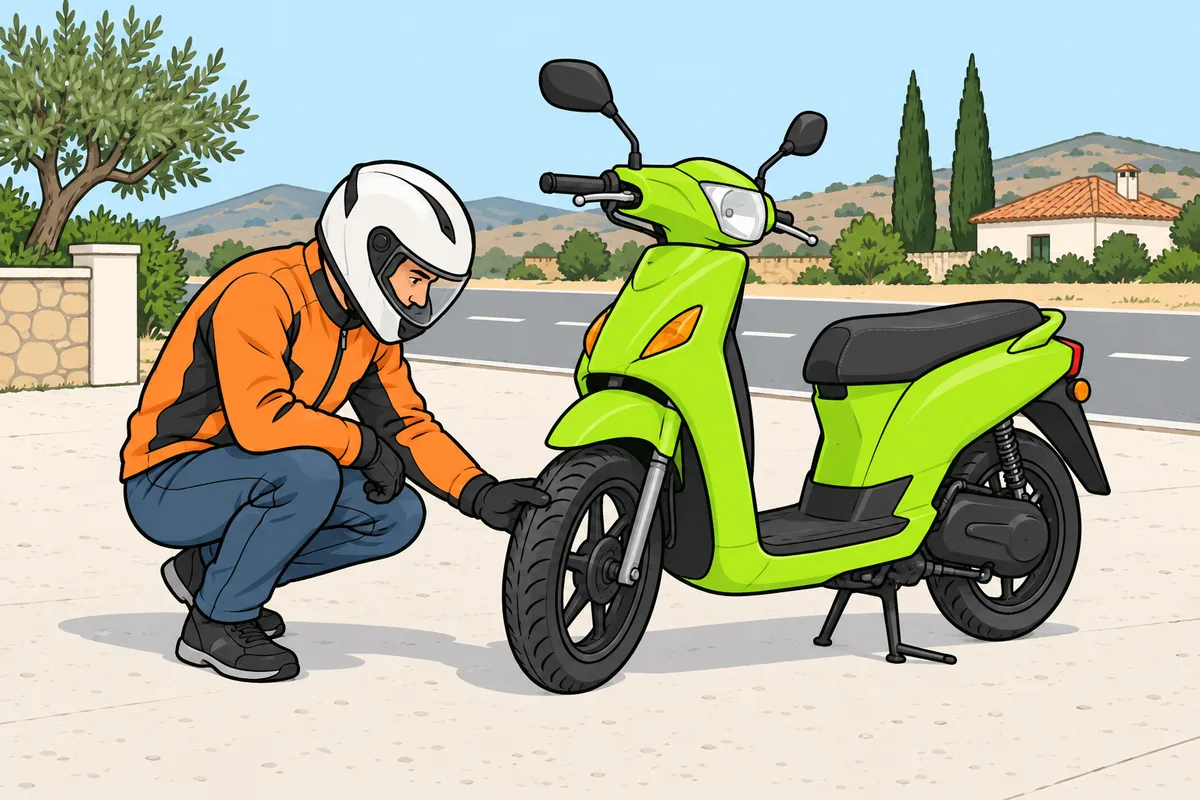
Before riding a moped you must know its basic equipment, check that it responds safely, and understand that a small fault on two wheels has bigger consequences than in a car. In the exam this topic appears as pre-ride checks and as the direct link between each mechanical fault and its risk.
Step 2. The syllabus
2.1Essential parts of the moped
Before every ride, check the brakes, tyres, lights, indicators, the required mirror or mirrors, the horn and the general condition of the controls and transmission.
- Each of these elements is safety equipment, not an accessory: if one fails, your ability to stop, be seen or correct your course is compromised.
- The exam often presents equipment as something secondary; remember that riding with a faulty safety item isn't allowed, even for a short trip.
- Learn to tell apart a fault that's merely annoying from one that means you shouldn't ride, such as brakes that don't respond or lights that don't work.
2.2Tyres and grip
On two wheels, incorrect tyre pressure or wear immediately affects stability, braking and grip in bends, much more than in a car.
- A worn or poorly inflated tyre reduces the contact area with the road surface and lengthens the distance you need to stop safely.
- Check for cuts, deformities or embedded objects, and adjust the pressure according to the load you're carrying that day.
- In rain or on a dirty road surface, tyre condition makes the difference between keeping control and losing grip while braking.
2.3Lighting and being seen
Lights and indicators are safety equipment because they make you visible and announce your intentions; they're not just decoration on the moped.
- Check that the sidelight, dipped beam and indicators come on and are clearly visible, including during the day when visibility is low.
- A blown bulb or a faulty indicator stops other drivers anticipating your manoeuvre and greatly increases the risk of a rear-end collision.
- The exam tests whether you link each light with its function of warning, seeing and being seen, not just lighting up at night.
2.4Brakes, controls and transmission
Don't ride with spongy brakes, excessive travel or brakes that don't respond progressively, because on two wheels a braking failure usually ends in a fall.
- Check that the controls return to their position on their own and that the throttle doesn't stick, which is especially dangerous at low speed.
- If the moped has a chain or belt transmission, check its tension and condition as specified by the manufacturer before riding.
- A stiff control, a frayed cable or a loose transmission are warnings that the vehicle needs maintenance before going back on the road.
2.5Position, helmet and preparation
Adjust your posture to reach all controls naturally, plant your feet when needed and keep your balance without tension or forced positions.
- An approved, properly fastened helmet is part of preparing the rider and vehicle together; wearing it loose reduces its real protection.
- Also prepare your vision and clothing: a clean visor and equipment that doesn't get in the way are part of riding safely.
- Spending a few seconds on this check before starting off avoids discovering a fault right when you're already riding and can't react in time.
2.6Load and accessories
A loaded moped, or one with a poorly fixed accessory, reacts worse and can become unstable even at low speed or on a gentle bend.
- Distribute any load evenly and fasten it securely so it doesn't shift, cover the lights or alter how the vehicle handles.
- Don't hang objects from the handlebars or carry loads that limit your freedom of movement or the full turning of the steering.
- Every badly placed weight changes the mass distribution and, on two wheels, that's noticeable immediately in stability.
2.7Preventive checks and weather
Before setting off, check for possible leaks, the basic tension of the transmission if applicable, and that lights and brakes work correctly.
- In rain or cold, a small fault becomes more dangerous because the grip margin is already smaller and any mistake is punished sooner.
- Turn the check into a fixed routine: doing the same order every day helps you instantly spot what has changed.
- If in doubt between riding with a fault or fixing it, on two wheels it always comes first to put the vehicle in proper condition before riding.
Step 3. Key points
If you only have a minute before the exam, revise this.
- 1.Check the brakes, wheels, lights and controls before every ride.
- 2.Check tyre pressure and wear regularly.
- 3.Verify that all lights and indicators work and are visible.
- 4.Don't ride with faulty safety equipment.
- 5.Fasten load and accessories without covering lights or reducing control.
- 6.Link each mechanical fault to its direct risk.
- 7.Check more thoroughly in rain or cold.
Step 4. Exam traps
Mistakes the DGT uses again and again on this topic.
- Thinking that at low speed a bad tyre or a faulty brake barely matters.
- Forgetting that lighting and visibility are safety equipment, not just an accessory.
- Believing you can ride with a faulty safety item if the trip is short.
- Ignoring that a badly fixed load affects the stability of a two-wheeled vehicle.
- Assuming a minor fault doesn't get worse in rain, cold or on a slippery surface.
Step 5. Quick check
Four real exam questions on what you have just read.
When there are refuges or islands in the centre of the carriageway, which side must you pass them on as a general rule?
Step 6. Frequently asked questions about vehicle equipment
- Outside a built-up area, when does the general rule allow a passenger to ride in a moped’s trailer?
- In no case. In no case. Article 12.3 prohibits carrying people in the towed vehicle. Towing also requires its mass not to exceed 50% of the towing vehicle’s unladen mass, daylight with adequate visibility, and a 10% reduction from the corresponding general speed. Meeting those conditions does not permit trailer passengers. Urban circulation is governed by the applicable municipal ordinances.See full question
- On a two-wheeled moped less than 1 metre wide, how far may the load extend sideways, measured from its longitudinal centreline?
- Up to 0.50 metres on either side of the longitudinal centreline. For vehicles less than 1 metre wide, the load may extend up to 0.50 metres on either side of the longitudinal centreline. This distance is measured from the centreline, rather than the vehicle’s edge. It must not project beyond the front or more than 0.25 metres behind the rear. It must be secured and must not compromise stability or safety.See full question
- On a two-wheeled moped authorised to carry a passenger and tow a trailer, with the legal conditions met, where must the passenger sit?
- On the passenger seat behind the rider, astride with feet on the footrests. The passenger must use the seat behind the rider, sit astride and keep their feet on the footrests. They must wear a helmet meeting the applicable requirements: the first transitional provision of RD 518/2026 allows certified moped helmets to continue being used for one year from 1 October 2026. They may not sit between the handlebars and rider or travel in the trailer. All other passenger and towing requirements apply.See full question
- Are mopeds allowed to hold speed competitions on public roads or roads open to public use?
- No, unless previously authorised. The traffic authority strictly prohibits moped drivers from holding speed competitions with each other on public roads and roads open to public use, unless prior authorisation has been granted.See full question
- On a two-wheeled moped, when should the orientation of the mirrors be checked?
- Before starting to move. Before moving off, with the moped stationary and the rider in the riding position. Adjust the mirrors for that position to observe the rear and sides. Do not manipulate the mirrors while riding.See full question
Official sources
Test what you've studied on vehicle equipment
Exam-style questions on this topic, with an explanation after every answer.
Now, practise it
Test what you have read with exam-style questions and an explanation after each answer.
Related lessons
- AMProtective equipment
On a moped, an approved helmet is mandatory, and the rest of the equipment, although not always mandatory, is decisive for reducing injuries and improving visibility and control. The exam distinguishes between what the rule requires and what, without being mandatory, is part of riding safely.
- AMRisk factors
Risk factors are studied as a real cause of error: alcohol, drugs, speed, distraction, fatigue, adverse weather and overconfidence. On mopeds their effects tend to multiply because of the rider's lower stability and lower physical protection.
- AMSigns
Master the hierarchy between officers, temporary signage, traffic lights, vertical signs and road markings, and study the current official catalogue with attention to the most recent updates. In the moped exam, many questions are solved by correctly applying that priority order.
- AMMoped riding techniques
Moped technique focuses on balance, where you look, progressive braking and visible positioning. The typical learner mistake is looking too close and reacting late, which is why the exam insists on anticipation and on not mistaking the vehicle's agility for permission to take risks.