Step 1. The big picture
In one sentence…
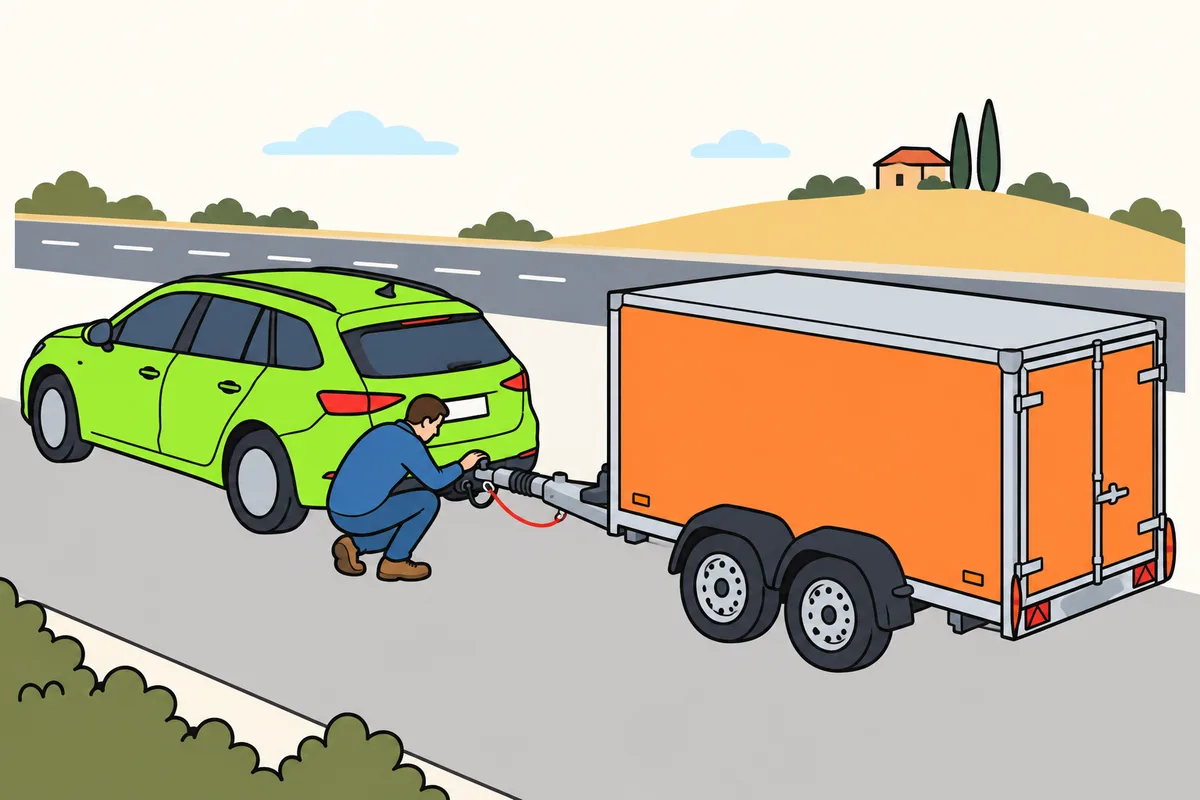
Preventive maintenance of towing-vehicle-and-trailer combinations is part of road safety: it avoids breakdowns, reduces braking distance, improves stability and cuts down on errors in the exam and in real driving. In B+E you must check both the car and the trailer.
Step 2. The syllabus
2.1Checks before setting off
Check tyres, pressure, tread, uneven wear, lights, optical signalling and brake condition before a demanding use or a long journey.
- Check essential levels when the vehicle requires it: oil, coolant, brake fluid and windscreen washer fluid before a demanding use.
- If the vehicle is towing a trailer or carrying a load, also check fastenings, catches, electrical connections and balanced distribution before joining traffic.
- Do the check before you need it on the road. A breakdown with a trailer complicates stopping, visibility, manoeuvring and the safety of other road users.
2.2Tyres and wheels
Tyres provide the grip, braking and stability. In a combination, a defect is transmitted to the tractor vehicle, the trailer and the load.
- Correct pressure, alignment and tread condition reduce consumption and wear, but above all they keep the response predictable in a bend or under braking.
- Also check the trailer's wheels, including pressure and visible wear. Don't treat the trailer as a secondary accessory just because it has no engine.
- After periods of standing idle, it's especially worth checking the trailer's tyres, lights and brakes before trusting their normal response.
2.3Brakes and stability
A poorly maintained vehicle can alter the response under braking, in a bend or in a slow manoeuvre, and ruin even a driver's correct technique.
- Maintaining the hitch, the connections, the bearings and the trailer's pressure is just as important as maintaining the tractor vehicle's.
- If the combination brakes unevenly, becomes unstable or its stopping distance lengthens, don't correct it with confidence, check it.
- In the exam, relate brakes and load. The more demand the combination bears, the more important it is that the basic elements are in good condition.
2.4Lighting and signalling
The DGT requires the candidate to know how to prepare the vehicle for safe driving: seat, mirrors, seatbelt, doors and basic checks of general condition.
- In professional and combination licences, the exam values prior checks on coupling, brakes, wheels, lights, anchorages and load safety.
- The trailer's lights, indicators and reflectors must be clearly visible. If they're dirty, broken or poorly connected, other road users won't anticipate your manoeuvres.
- Don't wait for another driver to alert you to a fault. Checking the lights before setting off is part of the B+E technical routine.
2.5Load and fastenings
A reasonable, well-distributed load reduces consumption, wear and swaying. If it shifts, it changes how the combination responds when braking and cornering.
- Fastenings, catches and anchorages stop the load moving or falling. A good engine doesn't make up for a badly secured load.
- When the scenario mentions balanced distribution, think of stability and braking distance, not only of avoiding damage to the goods.
- Before resuming the journey after a stop, it's worth checking whether the load or the catches have shifted due to vibration or earlier manoeuvres.
2.6Efficiency and breakdowns
Correct pressure, alignment, filters in suitable condition and a reasonable load reduce the combination's consumption and wear.
- Driving with a known defect isn't just unsafe; it can also be reportable if it affects essential elements of the vehicle.
- Neglected maintenance causes breakdowns that force the combination to be immobilised in awkward or dangerous places. Prevention avoids additional risks.
- Efficient driving with a trailer starts with mechanical condition. If wheels, brakes or lights fail, no amount of smooth technique solves the underlying problem.
2.7How to study it
Classify checks by function: grip, braking, visibility, coupling, load and driver comfort. That way you remember why they always matter.
- The exam isn't testing whether you can repair parts, but whether you can spot unsafe situations and decide not to drive, or to check first.
- Practise with checklists, but understand the consequence of each point. Memorising without relating risk to element leads to confusion.
- In B+E, answer thinking of two vehicles joined together. Any defect in the trailer can change the safety of the tractor vehicle and of the whole combination.
Step 3. Key points
If you only have a minute before the exam, revise this.
- 1.Know what to check before setting off with tractor vehicle and trailer.
- 2.Relate tyres, brakes and lights to real safety.
- 3.Check the hitch, connections, anchorages, catches and load.
- 4.Check essential levels when the vehicle requires it.
- 5.Don't drive with defects affecting essential elements.
- 6.Understand that a mechanical defect changes both driving and the exam.
- 7.Check the trailer especially after periods of standing idle.
Step 4. Exam traps
Mistakes the DGT uses again and again on this topic.
- Thinking maintenance is only a workshop matter and not one of road safety.
- Focusing on the engine and forgetting wheels, brakes, lights or fastenings.
- Checking the tractor vehicle and forgetting the trailer because it has no engine.
- Trusting that driving slowly compensates for a known defect.
- Separating load and maintenance when both affect stability.
- Not checking the trailer's lights until you're already driving.
Step 5. Quick check
Four real exam questions on what you have just read.
Which trailer check directly helps reduce risks related to its tyres before driving?
Step 6. Frequently asked questions about mechanics and maintenance
- In a B+E combination, which effect must be avoided when arranging the load and objects in relation to the driver’s required visibility?
- Obstruct the visibility needed for safe driving. They must not obstruct the visibility needed for safe driving. Distribute and secure the load properly and check that mirrors provide the required field of view for the combination; mirrors suited to the trailer may be needed. A trailer limiting direct rearward sight does not remove the duty to provide the required indirect view.See full question
- To reduce the risk of trailer sway, the load should be placed:
- Evenly distributed and without overloading the rear section. A well distributed and secured load helps maintain stability. Concentrating too much weight at the rear encourages sway.See full question
- If a warning appears in a B+E combination indicating a major fault, the correct action is to:
- Stop safely and check the fault. In the event of a major fault, you must act prudently and not continue as if nothing were wrong.See full question
Official sources
Test what you've studied on mechanics and maintenance
Exam-style questions on this topic, with an explanation after every answer.
Now, practise it
Test what you have read with exam-style questions and an explanation after each answer.
Related lessons
- C+EMechanics and maintenance
Preventive maintenance for C+E is directly part of road safety: it avoids breakdowns, improves braking, preserves stability and reduces errors when preparing the vehicle. Study the whole combination, because it covers category C vehicles with a trailer or semi-trailer of over 750 kg, and no defect in the towed unit is offset by a towing vehicle in good condition.
- C1+EMechanics and maintenance
Preventive maintenance for C1+E is directly part of road safety: it avoids breakdowns, improves braking, preserves stability and reduces errors when preparing the vehicle. Study the whole combination, because it covers category C1 vehicles with a trailer or semi-trailer, and combinations up to 12,000 kg, and no defect in the towed unit is offset by a towing vehicle in good condition.
- D+EMechanics and maintenance
Preventive maintenance of D+E combinations prevents breakdowns, improves braking and cornering, protects passengers and reduces exam mistakes. Study it as preparation for the service, not as a task unrelated to the driver.
- D1+EMechanics and maintenance
Preventive maintenance of D1+E combinations prevents breakdowns, improves braking and cornering, protects passengers and reduces exam mistakes. Study it as preparation for the service, not as a task unrelated to the driver.
- B+ESafety devices
The combination's safety devices prevent uncoupling, improve visibility and allow the trailer to keep its stability and braking capacity within the law. In B+E you must check them before driving and understand exactly what failure each one prevents.
- B+ERegulations for combinations
In B+E you must study authorised masses, coupling, load distribution, the stability of the combination and specific signalling for driving with a trailer or semi-trailer within the framework allowed by this class. The key is always to think of the towing vehicle and trailer as a single unit that is longer, heavier and slower to react.