Step 1. The big picture
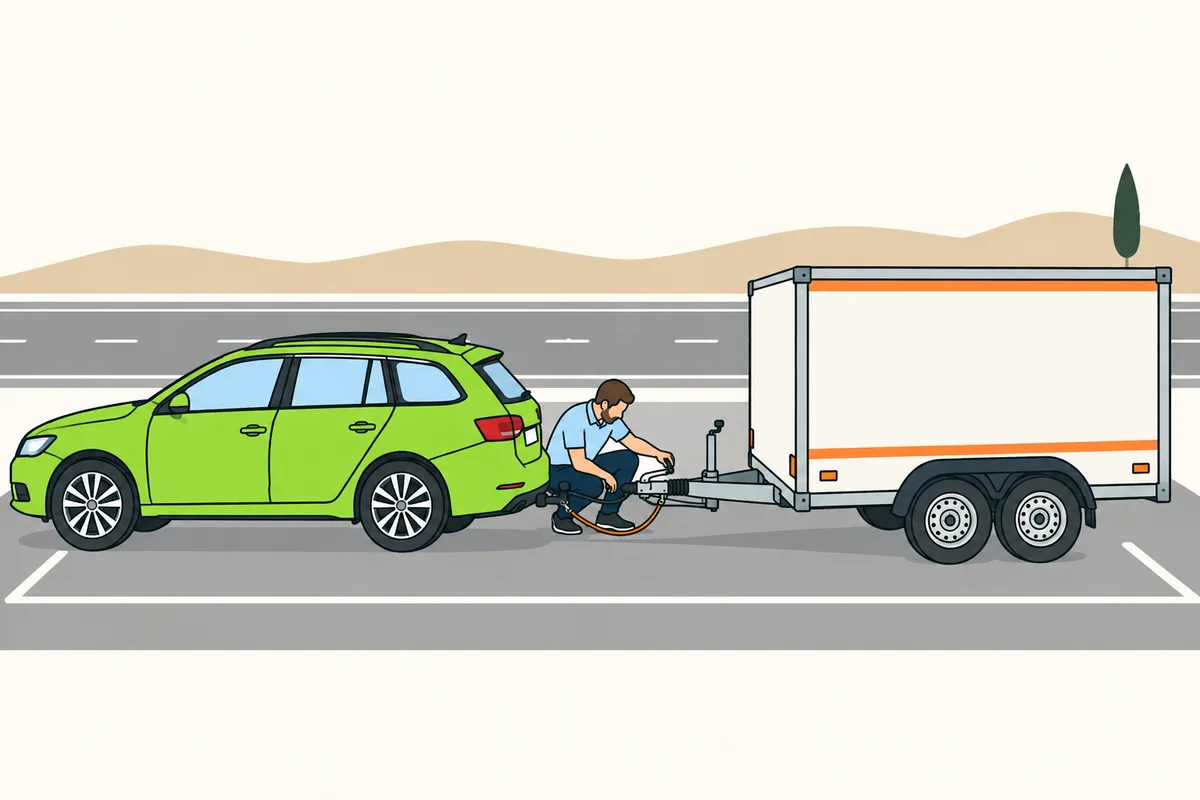
In one sentence…
The combination's safety devices prevent uncoupling, improve visibility and allow the trailer to keep its stability and braking capacity within the law. In B+E you must check them before driving and understand exactly what failure each one prevents.
Step 2. The syllabus
2.1Main coupling
The hitch must be compatible, in good condition and correctly secured before starting to drive with the loaded combination.
- A correct coupling joins tractor vehicle and trailer as a stable combination. If there's play, incomplete catches or improvised parts, driving must not begin.
- Check visually and mechanically that the lock is engaged. Don't just listen for a sound or assume it's closed out of habit.
- In the exam, the correct option usually includes checking compatibility and securing. The tractor vehicle's power doesn't make up for an unsafe hitch.
2.2Auxiliary retention
The auxiliary retention or safety system, where fitted, is not a decoration: it reduces the consequences of an accidental disconnection of the trailer.
- It must be positioned so it can perform its function. Letting it drag, crossing it incorrectly or leaving it unhooked makes it useless.
- Never drive with catches partially closed, improvised pins or unstable electrical connections, even if the planned journey is short and familiar.
- If the scenario presents a fault in retention or locking, don't answer with driving more slowly. The defect must be fixed first, or you don't drive.
2.3Rear signalling
The trailer must always correctly show lights, indicators, reflectors, number plate and other elements required to be seen from behind.
- Dirt or poor positioning of lamps and plates can cancel out the combination's visibility for other road users.
- The rear communicates braking, turning and presence. If others can't see these signals, the risk of a rear-end collision or an unexpected manoeuvre increases.
- Before setting off, check that the indicators, brake light, position lights and electrical connection work. A light on the tractor vehicle can be hidden by the trailer.
2.4Trailer brakes
Wheels, pressure, bearings, the trailer's brake where fitted, and the stability of the support must be checked before using the full combination.
- A combination doesn't brake the way a solo passenger car does. If the trailer doesn't respond correctly, distances lengthen and instability appears.
- Don't guess whether a particular trailer should have one system or another. Apply the safe idea: if it exists, it must work and be checked before use.
- On downhill stretches, in bends or in heavy traffic, any brake defect becomes more critical. The prudent response is maintenance and smooth driving.
2.5Wheels, support and levelling
A faulty wheel or poor levelling has a much greater effect when the mass is towed and the journey is long.
- Check pressure, visible condition and wear before demanding journeys. A fault in one of the trailer's wheels can pull the whole combination off its path.
- The support and levelling affect stability while the trailer is stationary and when starting off with a load.
- If the combination ends up tilted or unevenly loaded, don't treat it as a cosmetic detail. It can lead to swaying, wear and loss of control.
2.6Connections and catches
Electrical connections must stay firm and protected. An unstable connection can leave the trailer without signals exactly when they're needed most.
- Catches, tailgates, tarpaulins and access points are part of safety. If they open while driving, the load or the trailer itself can create danger.
- Check that no cables, chains or auxiliary items are dragging. Anything touching the ground can come loose, catch on something or stop doing its job.
- The recommended routine is to check from front to back: coupling, retention, electrics, lights, wheels, brakes, load and catches before setting off.
2.7Application in the exam
B+E requires thinking of devices as successive safety barriers. If one fails, the combination loses visibility, retention, braking or stability.
- The question may look like mechanics, but it assesses conduct: checking before driving, not improvising repairs, and stopping if the defect affects safety.
- Don't study loose names. Relate each device to the risk it prevents: uncoupling, rear-end collision, loss of load, swaying or lack of visibility.
- When two answers seem valid, choose the one that checks the defect before setting off, not the one that trusts compensating for it by driving carefully.
Step 3. Key points
If you only have a minute before the exam, revise this.
- 1.Check the coupling and retention system.
- 2.Check there are no partially closed catches or improvised pins.
- 3.Check the trailer's lighting and rear signalling.
- 4.Check wheels, pressure, support, levelling and brakes where fitted.
- 5.Secure electrical connections, tailgates, tarpaulins and load.
- 6.Don't drive with a defect that affects visibility or stability.
- 7.Relate each device to the risk it prevents.
Step 4. Exam traps
Mistakes the DGT uses again and again on this topic.
- Thinking the trailer automatically inherits the towing vehicle's safety.
- Forgetting that the combination's visibility also depends on the cleanliness and positioning of the rear lamps.
- Accepting temporary catches or improvised pins as a sufficient solution.
- Driving more slowly instead of correcting a fault in the coupling.
- Checking only the lights and forgetting wheels, brakes, support or auxiliary retention.
- Confusing a question about devices with a simple workshop question.
Step 5. Quick check
Four real exam questions on what you have just read.
To drive a B+E combination safely, it is advisable to keep especially clean:
Step 6. Frequently asked questions about safety devices
- Before setting off with a B+E trailer, it is especially important to check that:
- The trailer lights work and the plate is visible. In a towing vehicle and trailer combination, the required lights and the trailer registration plate must be visible and work properly for safe and lawful driving.See full question
- Driving a B+E combination with poorly adjusted mirrors:
- Reduces visibility of the surroundings. Poorly adjusted mirrors reduce the information available about the surroundings of the vehicle.See full question
- Before moving off with a trailer, what must you check in the coupling system?
- That the coupling is locked and secure. That it is correctly locked and secured according to manufacturer instructions to prevent uncoupling. Also check the applicable connections and safety devices. Adjusting the seat or preparing documents does not replace inspection of the coupling.See full question
- On a trailer, the auxiliary safety elements of the coupling must:
- Be correctly fitted and secured. The safety elements of the coupling must be fitted correctly to prevent combination failure.See full question
- Before hitching a trailer to a B+E towing vehicle, a basic safety measure is to:
- Immobilize the trailer so it cannot move. Before the maneuver, it is advisable to secure the trailer against unintended movement. Immobilizing it reduces risk during coupling.See full question
Official sources
Test what you've studied on safety devices
Exam-style questions on this topic, with an explanation after every answer.
Now, practise it
Test what you have read with exam-style questions and an explanation after each answer.
Related lessons
- C+ESafety devices
In C+E, the combination's safety devices aren't checked as a formality: they support braking, lighting, signalling, stability and control of the towed unit. Study every check by thinking about how a faulty connection, a support leg or a wheel can turn a normal manoeuvre into an unsafe situation.
- C1+ESafety devices
In C1+E, the combination's safety devices aren't checked as a formality: they support braking, lighting, signalling, stability and control of the towed unit. Study every check by thinking about how a faulty connection, a support leg or a wheel can turn a normal manoeuvre into an unsafe situation.
- D+ESafety devices
The safety devices of a D+E combination protect the mechanical coupling, the exterior signalling, the stability of the trailer and the service to passengers. Study them as a chain: if one element fails, the combination stops being predictable.
- D1+ESafety devices
The safety devices of a D1+E combination protect the mechanical coupling, the exterior signalling, the stability of the trailer and the service to passengers. Study them as a chain: if one element fails, the combination stops being predictable.
- B+EMechanics and maintenance
Preventive maintenance of towing-vehicle-and-trailer combinations is part of road safety: it avoids breakdowns, reduces braking distance, improves stability and cuts down on errors in the exam and in real driving. In B+E you must check both the car and the trailer.
- B+ERegulations for combinations
In B+E you must study authorised masses, coupling, load distribution, the stability of the combination and specific signalling for driving with a trailer or semi-trailer within the framework allowed by this class. The key is always to think of the towing vehicle and trailer as a single unit that is longer, heavier and slower to react.