Step 1. The big picture
In one sentence…
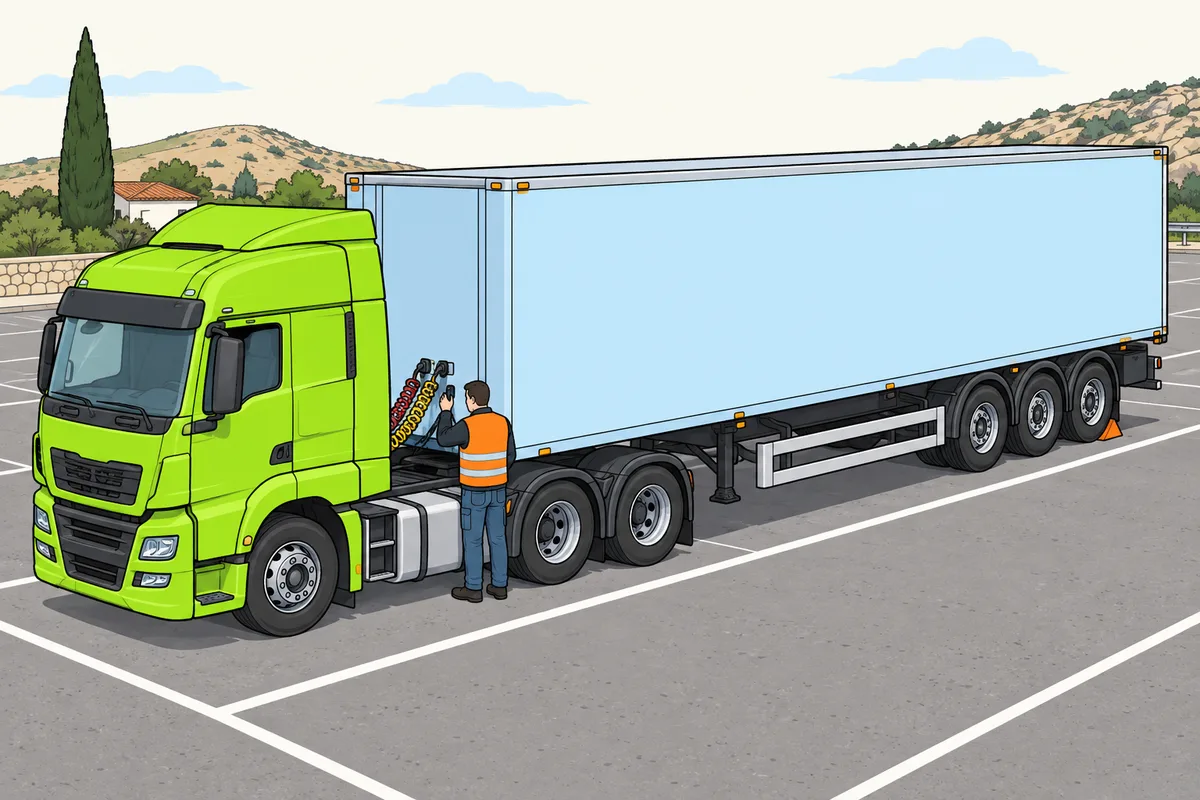
In C+E, the combination's safety devices aren't checked as a formality: they support braking, lighting, signalling, stability and control of the towed unit. Study every check by thinking about how a faulty connection, a support leg or a wheel can turn a normal manoeuvre into an unsafe situation.
Step 2. The syllabus
2.1Overview of the combination
The C+E licence covers category C vehicles with a trailer or semi-trailer of over 750 kg, so you must always think of two parts travelling as a single unit that share the same risks.
- Before moving off, confirm that the devices on the towing vehicle and on the towed unit work together: one part being correct doesn't make up for a fault in the other.
- In the exam, questions tend to present an apparently minor fault and ask you for its real consequence for braking, lights, stability or signalling.
- The check is preventive because many defects in the towed unit go unnoticed until late, when the combination is already turning, braking or driving with poor visibility.
2.2Coupling and locking
The coupling must be locked, properly seated and free of abnormal play, because it is the point that transmits forces between the towing vehicle and the towed unit.
- Looking from a distance isn't enough: you must check that the locking mechanism is working correctly and that there is no intermediate position that could release under vibration.
- If the coupling isn't secure, any braking, tight turn or change in road camber can multiply the risk of losing control of the combination.
- A common trap is confusing 'coupled' with 'visually hitched'; in exam study, the key word is effective locking, not simple contact.
2.3Electrical and service connections
Mechanical, electrical and service connections must be fastened, protected and free of tension, so they don't disconnect when turning or manoeuvring.
- A faulty electrical connection can leave the rear of the combination without tail lights, active reflectors or the warnings other road users need to see you.
- A badly made service connection can affect braking or the towed unit's response, so the fault isn't merely administrative.
- In multiple-choice questions, be wary of answers that allow you to drive when only one connection has failed; if it affects safety, it must be fixed first.
2.4Brakes and the towed unit's response
The braking system must be understood as a single unit: if the towed part doesn't match the braking, the towing vehicle can lose stability or take longer to stop.
- Check the behaviour before a demanding journey, especially when loaded, because mass and inertia make any defect more noticeable.
- An unbalanced brake can show up in the exam as swaying, drifting, jerking or a sensation of being pushed from behind when slowing down.
- The correct response isn't to compensate by driving harder, but to avoid driving with a defect that compromises the combination's basic safety.
2.5Wheels, tyres and support legs
The towed unit's tyres also bear load, indirect steering and lateral forces, so their wear or pressure cannot be ignored.
- A fault in a towed wheel can start without clear symptoms and become critical in a bend, under braking or in a slow manoeuvre with a sharp angle.
- Support legs and immobilising elements must be retracted or positioned as required, because they affect stability and safety while stopped or moving off.
- In the exam, avoid answering as if only the towing vehicle's front wheels mattered; every axle of the combination plays a part in safety.
2.6Lighting, plates and reflectors
Clean, visible and working tail lights, reflectors and plates let other road users judge the combination's length, width, position and manoeuvre.
- Signalling must stay legible in rain, dirt or poor lighting; a long, poorly visible vehicle increases the risk during joining manoeuvres and overtaking.
- Check that the rear signalling isn't hidden by the load, mud, accessories or poor positioning, because the road user behind you depends on it.
- Questions tend to penalise the idea of driving in daylight without correct rear lights; the obligation to signal doesn't disappear just because ambient light is good.
2.7Study method and practice
Practise the inspection in the same order every time: coupling, connections, brakes, wheels, support legs, lighting and signalling, so you don't rely on improvised memory.
- When you read a question, first identify which device is failing, then ask what function the combination loses: braking, being seen, staying joined or staying supported.
- Link every device to a specific manoeuvre; for example, connections in turns, brakes on descents, wheels in bends and lights in night driving.
- Remember the C+E specific format: 20 questions, a maximum of 2 errors and 20 minutes, so it's best to answer by function, not by intuition.
Step 3. Key points
If you only have a minute before the exam, revise this.
- 1.Check the coupling is effectively locked before moving the combination.
- 2.Check the electrical and service connections are firm and free of tension.
- 3.Check the brakes of the towing vehicle and the towed unit as a single system.
- 4.Look at the towed unit's wheels, wear, pressure and support legs before driving.
- 5.Confirm that tail lights, reflectors, plates and rear signalling are visible.
- 6.Link every fault to the safety function it stops fulfilling.
- 7.Stop for any defect that affects braking, lights, the coupling or stability.
Step 4. Exam traps
Mistakes the DGT uses again and again on this topic.
- Relying on a superficial visual check of the coupling without thinking about the locking mechanism.
- Forgetting that an electrical fault leaves the combination without part of its required signalling.
- Answering as if the towed unit were passive and didn't affect braking or stability.
- Believing good daytime visibility allows driving with faulty tail lights or reflectors.
- Focusing on the towing vehicle and skipping the towed unit's wheels, support legs or connections.
- Confusing a workshop inspection with a basic check before setting off.
Step 5. Quick check
Four real exam questions on what you have just read.
Does the D1+E licence you hold allow you to drive a bus intended for passenger transport with 17 seats, not counting the driver's seat, that has a non-light trailer attached?
Step 6. Frequently asked questions about safety devices
- Does the C1E driving licence authorise you to drive a truck with a maximum authorised mass (MAM) exceeding 16,000 kg, towing a non-light trailer?
- No. No. In this case, C1+E permits a C1 towing vehicle with a MAM no greater than 7,500 kg, a trailer over 750 kg, and a combined MAM no greater than 12,000 kg. A lorry over 16,000 kg already exceeds those limits. That lorry with a non-light trailer requires C+E and any other applicable requirements; turning 21 does not itself expand a C1+E licence.See full question
- The braking distance of a C1+E or C+E combination:
- May increase with speed, load, or rain. Braking distance can increase with speed, load, and a wet or slippery road surface.See full question
- If the combination of vehicles you are driving is towing a two-axle trailer, you should know that the MAM for each of the trailer's single axles must not exceed:
- 10 Tonnes. The general limit for each single non-driven trailer axle is 10 tonnes, under Annex IX of the General Vehicle Regulations. This is a limit per axle, distinct from the general 18-tonne maximum mass of the complete two-axle trailer. The vehicle’s authorised technical limits and other applicable combination limits must also be observed; adding axle limits does not justify any total mass.See full question
- In a test for the C1+E and C+E licences, the examiner may check that the applicant is wearing:
- The appropriate protective or safety equipment, where required. The examiner may verify that the applicant has the appropriate protective or safety equipment where required.See full question
- An adult drives a goods lorry with a maximum authorised mass over 3,500 kg, towing a trailer with a maximum authorised mass of 1,000 kg. What maximum breath-alcohol concentration does Spain’s General Traffic Regulation specify?
- 0.15 milligrams per litre of exhaled breath. 0.15 milligrams per litre of exhaled breath, under Article 20 for goods vehicles with a maximum authorised mass over 3,500 kg. The corresponding blood limit is 0.3 grams per litre, a different measurement; do not confuse the units. The trailer does not raise the limit. When driving, the safest choice is not to consume alcohol.See full question
Official sources
Test what you've studied on safety devices
Exam-style questions on this topic, with an explanation after every answer.
Now, practise it
Test what you have read with exam-style questions and an explanation after each answer.
Related lessons
- B+ESafety devices
The combination's safety devices prevent uncoupling, improve visibility and allow the trailer to keep its stability and braking capacity within the law. In B+E you must check them before driving and understand exactly what failure each one prevents.
- C1+ESafety devices
In C1+E, the combination's safety devices aren't checked as a formality: they support braking, lighting, signalling, stability and control of the towed unit. Study every check by thinking about how a faulty connection, a support leg or a wheel can turn a normal manoeuvre into an unsafe situation.
- D+ESafety devices
The safety devices of a D+E combination protect the mechanical coupling, the exterior signalling, the stability of the trailer and the service to passengers. Study them as a chain: if one element fails, the combination stops being predictable.
- D1+ESafety devices
The safety devices of a D1+E combination protect the mechanical coupling, the exterior signalling, the stability of the trailer and the service to passengers. Study them as a chain: if one element fails, the combination stops being predictable.
- C+EMechanics and maintenance
Preventive maintenance for C+E is directly part of road safety: it avoids breakdowns, improves braking, preserves stability and reduces errors when preparing the vehicle. Study the whole combination, because it covers category C vehicles with a trailer or semi-trailer of over 750 kg, and no defect in the towed unit is offset by a towing vehicle in good condition.
- C+ERegulations for heavy combinations
In C+E you study articulated goods combinations or ones with a heavy trailer: correct authorisation, coupling, restrictions on mass and length, and dynamic behaviour more demanding than a rigid vehicle. The goal is to recognise when the rules, the road or the combination's configuration require greater caution and margin.