Step 1. The big picture
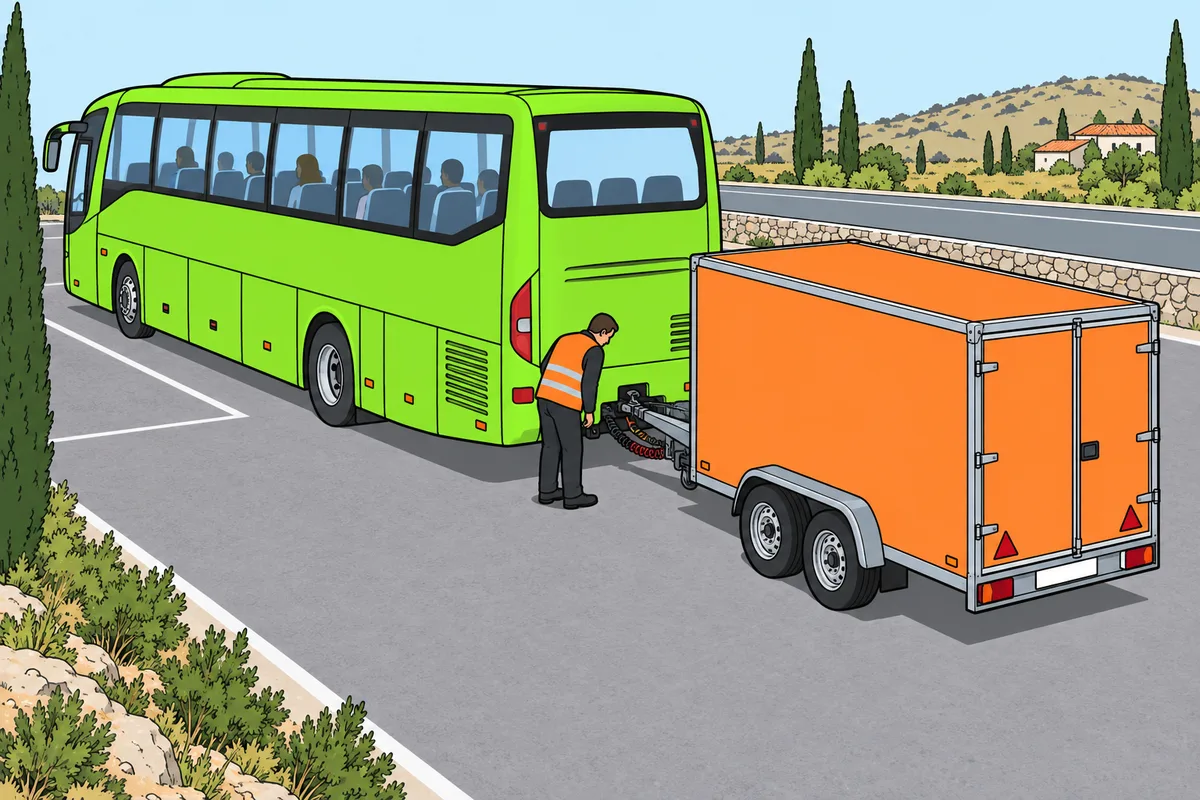
In one sentence…
The safety devices of a D+E combination protect the mechanical coupling, the exterior signalling, the stability of the trailer and the service to passengers. Study them as a chain: if one element fails, the combination stops being predictable.
Step 2. The syllabus
2.1Coupling before the service
Before moving the bus with the trailer, confirm that the coupling is closed, secured and checked. In the exam, this check appears as a compulsory preliminary step.
- Check the associated connections, because they let the trailer respond and communicate manoeuvres. A forgotten connection can turn a normal exit into an avoidable risk.
- Do not start the service if you have doubts about the lock, any play or any safety element. The prudent response is to check before driving with passengers.
- Practise a fixed routine: observe, check connections, check the lock and look over the whole combination. This order avoids oversights when the question introduces haste or routine.
2.2Exterior signalling
Rear and side signalling lets you judge length, width and trajectory. In a long combination, being visible is directly part of driving safely.
- Faulty lights or reflectors worsen how other road users perceive the trailer when turning, joining traffic or braking. The exam may present them as minor faults, but they affect the whole combination.
- Check that the trailer does not hide or contradict the signalling of the lead vehicle. Other road users must read a single clear, consistent unit.
- Link each light to the action it announces: braking, turning, marking presence or signalling position. This helps you answer questions with images of the combination better.
2.3Wheels, pressure and support
Wheels, pressure and visible wear affect the stability, braking and tracking of the trailer. A defect at the back also affects the lead vehicle.
- The support of the towed element must be checked when coupling, uncoupling or when stationary. Neglected support can create risk before you even start driving.
- Do not inspect only the lead bus. Many questions exploit this mistake and place the defect on the trailer, even though it affects the whole combination.
- If a wheel, the pressure or the support raises any doubt, check it and fix it before the service. With passengers on board, anticipating the fault is part of safety.
2.4Brakes and stability
The brakes must allow a progressive, stable response. With a trailer, harsh braking can cause swaying, a loss of margin and discomfort for passengers.
- Think of the combination as a whole, not as two separate vehicles. If the trailer does not follow the braking, the trajectory stops being predictable.
- The exam links brakes to prior preparation, following distance and smoothness. Memorising the isolated part helps less than understanding its consequence.
- Careful driving does not make up for a faulty device. If the system is not in working order, the solution is to check it before starting the service.
2.5Passengers and other road users
Passengers depend on elements they cannot see: coupling, connections, wheels, brakes and signalling. That is why the prior check has real professional value.
- Pedestrians, cyclists and nearby drivers need time to interpret the combination. A faulty light or an unstable trailer increases the surrounding risk.
- When a question talks about a partial failure, ask who it affects. In these combinations, it almost always affects the trailer, the lead vehicle and the surroundings.
- Practise situations of setting off, stopping, joining traffic and turning. In these, the safety devices become a real margin for avoiding incidents.
2.6Study method
Study each device with three questions: what does it protect, how is it checked, and what happens if it fails. This method avoids mechanical lists without judgement.
- If an exam option plays down a trailer defect, be suspicious. In passenger combinations, a fault at the back is not secondary.
- Use the order coupling, connections, signalling, wheels and brakes to revise. It covers the existing facts without mixing in figures you do not need.
- When a specific technical detail is missing, decide by caution and refer to the current regulation. Do not invent limits to answer a safety question.
Step 3. Key points
If you only have a minute before the exam, revise this.
- 1.Check the coupling and lock before starting the service.
- 2.Check the electrical connections and elements associated with the trailer.
- 3.Check the rear and side lights, indicators and reflectors.
- 4.Check the wheels, visible pressure, wear and support of the trailer.
- 5.Link the brakes and stability to passenger safety.
- 6.Stop if a check raises doubts before driving.
- 7.Study each device as part of the whole combination.
Step 4. Exam traps
Mistakes the DGT uses again and again on this topic.
- Treating a trailer fault as secondary when the lead vehicle is correct.
- Confusing signalling visible from the front with signalling for the whole combination.
- Forgetting that faulty connections can hide braking or turning signals from traffic behind.
- Separating the trailer's wheels and brakes from overall stability.
- Starting a service with passengers without checking the coupling and lock.
Step 5. Quick check
Four real exam questions on what you have just read.
To drive a D1+E or D+E combination safely, it is advisable to keep especially clean:
Step 6. Frequently asked questions about safety devices
- In a D+E combination, before setting off you must also verify that the trailer coupling system:
- Is properly secured. Besides the connections, the coupling system must be properly secured to prevent dangerous uncoupling while driving.See full question
- In a test for the D1+E and D+E licences, the examiner may check that the applicant is wearing:
- The appropriate protective or safety equipment, where required. The examiner may verify that the applicant has the appropriate protective or safety equipment where required.See full question
- Before leaving with a D+E combination, you must check that the trailer connections:
- Are properly connected and secured. Electrical connections and, where fitted, brake lines must be properly connected and secured to travel safely.See full question
Official sources
Test what you've studied on safety devices
Exam-style questions on this topic, with an explanation after every answer.
Now, practise it
Test what you have read with exam-style questions and an explanation after each answer.
Related lessons
- B+ESafety devices
The combination's safety devices prevent uncoupling, improve visibility and allow the trailer to keep its stability and braking capacity within the law. In B+E you must check them before driving and understand exactly what failure each one prevents.
- C+ESafety devices
In C+E, the combination's safety devices aren't checked as a formality: they support braking, lighting, signalling, stability and control of the towed unit. Study every check by thinking about how a faulty connection, a support leg or a wheel can turn a normal manoeuvre into an unsafe situation.
- C1+ESafety devices
In C1+E, the combination's safety devices aren't checked as a formality: they support braking, lighting, signalling, stability and control of the towed unit. Study every check by thinking about how a faulty connection, a support leg or a wheel can turn a normal manoeuvre into an unsafe situation.
- D1+ESafety devices
The safety devices of a D1+E combination protect the mechanical coupling, the exterior signalling, the stability of the trailer and the service to passengers. Study them as a chain: if one element fails, the combination stops being predictable.
- D+EMechanics and maintenance
Preventive maintenance of D+E combinations prevents breakdowns, improves braking and cornering, protects passengers and reduces exam mistakes. Study it as preparation for the service, not as a task unrelated to the driver.
- D+ERegulations for passenger combinations
D+E passenger combinations combine carrying people with the dynamic complexity of a heavy trailer. You must master the scope of the licence, the specific exam and the practical consequences of driving a D-category bus with a trailer of more than 750 kg.