Step 1. The big picture
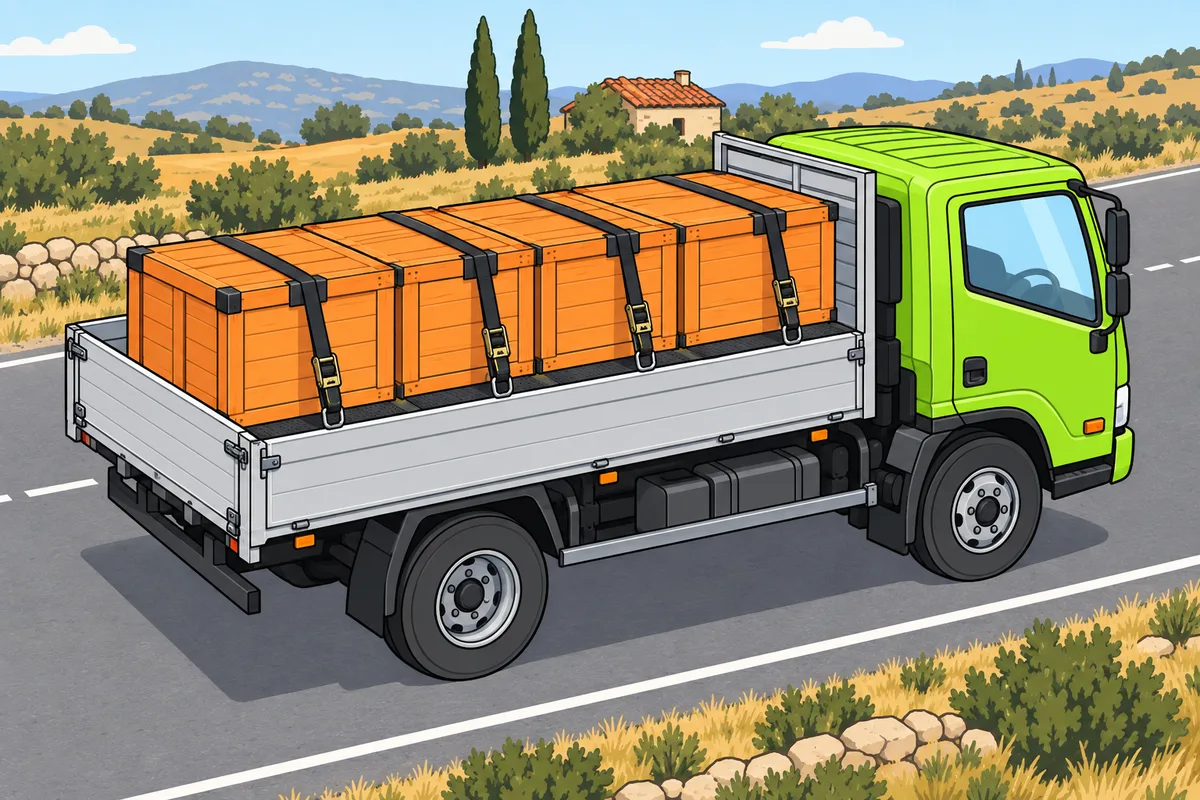
In one sentence…
Safe loading isn't just a logistics matter: incorrect stowage shifts the centre of gravity, lengthens braking distance and can cause a rollover or loss of objects onto the road. For the C1 licence - Light truck, study it as a matter of safety, responsibility and anticipation.
Step 2. The syllabus
2.1Loading principles
The load must be secured so it cannot shift, fall, drag or compromise the vehicle's stability, visibility or the effectiveness of its devices while under way.
- Weight distribution must respect the vehicle's capabilities; place the heaviest items low and centred whenever the load and space allow it.
- Stowage starts before you set off: check the support base, restraints, fastenings, tarpaulins, panels and any element that prevents falls or movement.
- Don't study loading as an isolated formality; in the exam it is linked to braking, bends, gradients, visibility, signage and the driver's responsibility.
2.2Distribution and centre of gravity
A high or off-centre load shifts the centre of gravity and reduces your margin in bends, evasive manoeuvres or crosswinds, even if the vehicle stays within its authorised limits.
- Poorly distributed weight can load the tyres, suspension and brakes unevenly, which is why the correct answer isn't always just about maximum mass.
- If the load changes during the journey, through partial unloading or internal movement, you must rethink stability before carrying on as if nothing had changed.
- Practise by imagining where the load would push in braking, a bend and a gradient; that mental picture helps you answer without memorising loose phrases.
2.3Restraints and checks
Doors, tarpaulins, panels, restraints and fastenings are checked before setting off and during the journey if the route, vibration or load demand it.
- A restraint that was sound at the start can lose effectiveness through harsh driving, an uneven surface or the goods resettling, so vigilance doesn't end once you set off.
- If you notice shifting, loss or a risk of the load coming loose, you must stop in safe conditions and fix it before rejoining traffic.
- In multiple-choice questions, be wary of answers that put off fixing the problem until you reach your destination when there is already a risk to the road or other users.
2.4Driving with a load
The greater the mass and the worse the distribution, the longer the braking distance and the poorer the response in bends, evasive manoeuvres and slow manoeuvring, even with a technically sound vehicle.
- Smooth driving preserves the stowage: accelerate, brake and turn progressively so a well-secured load doesn't become a dynamic hazard.
- In rain, on gradients, on an uneven surface or in crosswinds, increase your safety margin because the load amplifies any late correction or abrupt manoeuvre.
- The exam tends to reward anticipation: if a situation looks uncertain, the safe answer is usually to ease off, observe more and avoid abruptness.
2.5Responsibility on the road
A vehicle whose load stains, drags along or falls onto the road may not be driven, because the risk no longer affects only the truck's driver.
- This responsibility includes checking that the load doesn't restrict visibility, lighting, optical signalling or any visible devices needed to signal manoeuvres.
- Signs restricting mass, height, width, length or goods vehicles can constrain your route even if the stowage looks correct.
- When a question mixes route and load, first confirm the vehicle can use that stretch of road, then analyse restraint and distribution.
2.6Exam practice
In the C1 specific test you get 20 questions, a maximum of 2 errors and 20 minutes; answer quickly, but always from the rule and the case described.
- Turn every case into four questions: what could move, what could fall, what could be obstructed, and what could change the vehicle's stability.
- Don't answer purely by common sense; look for the option that requires preventing the risk before the load affects braking, visibility or the road.
- Revise loading together with mechanics and truck techniques, because the DGT combines these topics to check whether you understand the vehicle's real behaviour.
Step 3. Key points
If you only have a minute before the exam, revise this.
- 1.Secure the load before setting off.
- 2.Distribute the weight with stability in mind.
- 3.Place the heaviest items low and centred where possible.
- 4.Check doors, tarpaulins, panels, restraints and fastenings.
- 5.Increase your margin in rain, on gradients, in wind or on an uneven surface.
- 6.Stop safely if you notice shifting or loss of the load.
- 7.Check the load doesn't block visibility or signalling.
- 8.Link every case to braking, bends and responsibility on the road.
Step 4. Exam traps
Mistakes the DGT uses again and again on this topic.
- Thinking it's enough not to exceed the maximum authorised mass.
- Forgetting that harsh driving can ruin stowage that was initially correct.
- Confusing a secured load with one that is simply placed on board.
- Ignoring that the load can affect visibility, lights and optical signalling.
- Waiting until the destination even when there is a risk of the load coming loose.
- Answering purely on total weight without considering distribution, centre of gravity and route.
Step 5. Quick check
Four real exam questions on what you have just read.
An ordinary trailer or semi-trailer has a MAM no greater than 750 kg. Does it need its own traffic-authority registration to be used on the road?
Step 6. Frequently asked questions about safe loading
- A lorry over 3,500 kg MAM follows another vehicle without signalling an intention to overtake. In which situation does the additional minimum 50-metre gap apply to allow a following vehicle to overtake?
- On a road outside a built-up area with one lane per direction, overtaking permitted and no congestion preventing it. On a road outside a built-up area with one lane in each direction, where overtaking is permitted and traffic is not too congested to allow it. Article 54 requires this additional minimum for vehicles over 3,500 kg MAM and vehicles or combinations longer than 10 metres. It does not apply in built-up areas, where overtaking is prohibited, where more than one lane serves the same direction, or where congestion prevents overtaking. In every case retain enough stopping distance to avoid a collision if the vehicle ahead brakes suddenly; that distance can exceed 50 metres.See full question
- A lorry has a non-driven front steering axle and a single rear drive axle. Which axle contains the half-shafts that transmit drive from the differential to the wheels?
- On the drive axle. On the drive axle. Half-shafts transmit rotation from the differential’s side gears to the driven wheels. In this case the front axle only steers and does not receive engine torque. Steering and driving are different functions: an axle can perform both in other configurations, but that arrangement is excluded here.See full question
- A rigid four-axle lorry with conventional diesel propulsion is not carrying roundwood or operating under a special authorisation. None of its drive axles has dual tyres. Subject to technical and axle limits, which general MAM limit in Spain’s vehicle regulation table applies?
- 31 tonnes. 31 tonnes, for other rigid four-axle vehicles. This case does not meet the 32-tonne row’s conditions: a rigid four-axle vehicle with two steering axles and the specified dual-tyre and air-or-equivalent-suspension conditions, or dual tyres on each drive axle with each axle’s maximum mass no greater than 9.5 tonnes. Air suspension alone does not give every four-axle lorry a 32-tonne limit. The rules also contain special cases, including specified roundwood transport, which are excluded here. Technical mass, axle limits and other applicable restrictions must be observed even if lower.See full question
- How should the load that has to be transported be stowed?
- In a way that does not compromise the stability of the vehicle. The transported load and its protection must be arranged and stowed in such a way that they do not compromise the stability of the vehicle or fall or shift dangerously.See full question
- During an ordinary loading or unloading operation, what rule applies to where you deposit the goods?
- Do not deposit it on the carriageway, shoulder or pedestrian areas. Goods must not be deposited on the carriageway, shoulder or pedestrian areas during these operations. Loading and unloading must take place off the road; when doing so on the road is exceptionally unavoidable, observe stopping and parking rules and applicable local provisions without danger or serious disruption. Work, where possible, on the side nearest the carriageway edge, using sufficient means and avoiding unnecessary noise and inconvenience. Speed of unloading does not permit depositing goods in those spaces.See full question
Official sources
Test what you've studied on safe loading
Exam-style questions on this topic, with an explanation after every answer.
Now, practise it
Test what you have read with exam-style questions and an explanation after each answer.
Related lessons
- CSafe loading
Safe loading isn't just a logistics matter: incorrect stowage shifts the centre of gravity, lengthens braking distance and can cause a rollover or objects to fall onto the road. In the C licence - Truck, study it as a matter of safety, responsibility and anticipation.
- C1Mechanics and maintenance
Preventive maintenance of trucks and goods vehicles is part of road safety: it avoids breakdowns, reduces braking distance, improves stability and cuts errors in both the exam and real driving. For the C1 licence - Light truck, basic checks are part of driving with anticipation.
- C1Goods transport regulations
A C1 licence - Light truck driver must master the goods transport framework: the authorised category, visibility, the vehicle's masses and dimensions, stowage, route and the prudence obligations of a heavy vehicle. This topic ties together the licence, the load, signs and everyday responsibility.
- C1Signs
Master the hierarchy between officers, circumstantial signalling, traffic lights, vertical signs and road markings, and study the official catalogue in force, paying attention to the most recent updates. For the C1 licence - Light truck, always add the restrictions specific to goods vehicles and heavy vehicles.
- C1Truck driving techniques
Truck technique demands observing far ahead, managing the blind spot, using the brakes smoothly and changing pace well in advance. The heavier the vehicle, the less room there is to improvise, especially with a load or in tight environments.
- C1Driving and rest times
Driving and rest times are road-safety and labour regulations. For professional licences you must memorise the base limits of Regulation (EC) 561/2006 and understand their preventive logic, because the goal is to avoid fatigue and unsafe decisions.