Step 1. The big picture
In one sentence…
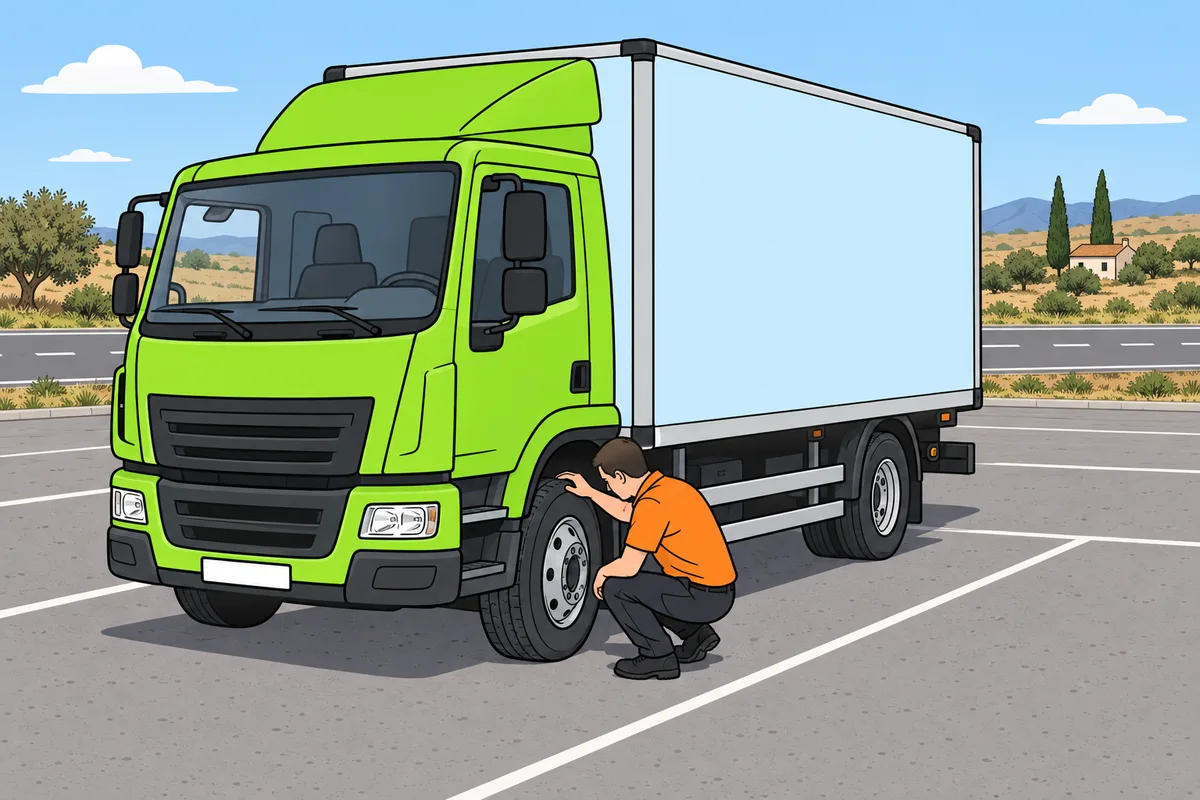
Preventive maintenance of trucks and goods vehicles is part of road safety: it avoids breakdowns, reduces braking distance, improves stability and cuts errors in both the exam and real driving. For the C1 licence - Light truck, basic checks are part of driving with anticipation.
Step 2. The syllabus
2.1Checks before driving
Check tyres, pressure, tread, uneven wear, lighting, optical signalling and brake condition before a demanding use or a long journey.
- Check essential levels when the vehicle requires it: oil, coolant, brake fluid and windscreen washer fluid, without waiting for a breakdown to appear.
- If the vehicle is towing a trailer or carrying a load, check fastenings, fasteners, electrical connections and balanced distribution before moving off safely.
- Preparation also includes seat, mirrors, seatbelt, doors and reading the surroundings, because a basic fault complicates any manoeuvre that follows.
2.2Tyres and contact with the road
Tyres are the point of contact with the road surface; incorrect pressure, poor tread or uneven wear worsen braking, steering and stability.
- A reasonable, well-distributed load helps the wheels and suspension work predictably, especially in bends, on gradients or on an uneven surface.
- The exam may present a tyre defect as a minor issue; remember that on a heavy vehicle it directly affects safety and control.
- Practise linking each visible symptom, such as uneven wear or incorrect pressure, with a consequence: more distance, worse grip or an imprecise response.
2.3Brakes, steering and suspension
On heavy vehicles it is essential to watch the brakes, suspension, steering and any leaks, because mass magnifies the effect of any defect.
- A poorly maintained vehicle can alter the response in braking, a bend or a slow manoeuvre and ruin driving that was otherwise correct.
- Don't rely on skill to compensate for a mechanical defect; if it affects essential elements, the safe option is not to drive until it is fixed.
- Questions mix maintenance and technique: with a descent, a load or a slippery surface, a brake defect reduces the available margin even further.
2.4Lights, doors and signalling
Lighting and optical signalling let you see and be seen; if they fail, other road users may not understand your position, braking or manoeuvre.
- Doors, fastenings and elements that contain the load are part of safety, because an accidental opening can create an immediate hazard.
- Electrical connections matter when there is a trailer or auxiliary elements; it isn't enough for the towing vehicle alone to look in good condition.
- In the exam, separate the cosmetic from the functional: lights, signalling and fastenings are functional because they affect warning, visibility and the load.
2.5Efficient, legal maintenance
Correct pressure, correct alignment, filters in good condition and a reasonable load reduce fuel consumption, wear and mechanical strain.
- Driving with a known defect isn't only unsafe; it can also be reportable if it affects essential elements of the vehicle.
- A pre-drive check doesn't replace scheduled maintenance, but it helps catch obvious faults before they turn into a risk situation.
- Study efficiency as a consequence of good condition and smooth driving, not as an excuse to ignore brakes, tyres or lighting.
2.6Exam practice
In the C1 specific test you get 20 questions, a maximum of 2 errors and 20 minutes; answer quickly, but always from the rule and the case described.
- Faced with a mechanics question, first identify whether the defect affects braking, steering, seeing, being seen, securing the load or maintaining stability.
- Memorise short lists, but also train cause-and-effect links: pressure, brakes, lights, fastenings and levels each have distinct practical consequences in real driving.
- If two answers seem possible, choose the one that prevents the risk before starting or continuing to drive with a relevant defect.
Step 3. Key points
If you only have a minute before the exam, revise this.
- 1.Check tyres, brakes, lights and optical signalling.
- 2.Check essential levels when appropriate.
- 3.Adjust seat, mirrors, seatbelt and doors before setting off.
- 4.Check fastenings, fasteners and connections if there is a load or trailer.
- 5.Link every defect to braking, stability or visibility.
- 6.Don't drive with defects that affect essential elements.
- 7.Distinguish preventive maintenance from late repair.
- 8.Practise questions by cause, effect and safe decision.
Step 4. Exam traps
Mistakes the DGT uses again and again on this topic.
- Thinking maintenance is only a workshop matter and not a road-safety one.
- Focusing on the engine and forgetting tyres, brakes, lighting or fastenings.
- Believing driver skill compensates for an essential defect.
- Forgetting electrical connections and fastenings when there is a trailer or load.
- Confusing efficient driving with carrying on despite poor mechanical condition.
- Treating a visible defect as irrelevant because the vehicle still moves.
Step 5. Quick check
Four real exam questions on what you have just read.
If your lorry’s engine takes too long to reach normal operating temperature, which component should be checked?
Step 6. Frequently asked questions about mechanics and maintenance
- When approaching a foreseeable stop, if conditions allow safe deceleration, what helps save fuel in a combustion-engine vehicle?
- Release the accelerator with an appropriate gear engaged, braking when needed. Anticipation lets you release the accelerator and slow down with an appropriate gear engaged, using the brakes when needed. Unnecessary shifts to very low gears or maximising engine-braking time are not required. In fuel-injected engines, fuel delivery may stop during overrun above idle speed. Never drive with the engine switched off.See full question
- In a lorry’s friction clutch with a manual gearbox, which component is pressed against the flywheel to transmit engine rotation to the gearbox input?
- Clutch disc. The clutch disc. The pressure mechanism clamps it against the flywheel, allowing rotation to reach the gearbox input. Disengaging the clutch interrupts that transmission. The gearbox and final-drive/differential assembly have other functions and are not the part pressed against the flywheel. Drive reaching the wheels also requires a selected gear and a functioning drivetrain: an engaged clutch alone does not drive the wheels when the gearbox is in neutral.See full question
- Should you periodically check the level of the windscreen washer fluid?
- Yes, by checking the level and that the nozzles are not blocked. Yes. Regularly check the fluid level and that the nozzles are unobstructed to maintain visibility. Refill using the manufacturer-specified fluid and dilution, suitable for expected temperatures. Dedicated washer fluid may contain cleaning agents; that does not mean you should add household detergent yourself. This maintenance is not limited to preventing engine overheating.See full question
- Stopping distance when braking for a hazard is the sum of...
- reaction distance and braking distance. Reaction distance and braking distance. The first is travelled from perceiving the hazard until braking begins; the second from braking begins until the vehicle stops. Both depend on speed; reaction time also matters, as do brakes, tyres, grip and gradient during braking. The following distance from the vehicle ahead is a separation to maintain, not a third stopping phase.See full question
- In a conventional four-cylinder, four-stroke engine, how far does the crankshaft rotate during one complete piston stroke from one dead centre to the other?
- Half a revolution of the crankshaft. Half a revolution: 180 degrees. A stroke is the piston’s movement from top dead centre to bottom dead centre or vice versa. The complete four-stroke cycle requires four strokes and two crankshaft revolutions, 720 degrees. A stroke, a complete cycle and the firing interval between different cylinders are distinct concepts.See full question
Official sources
Test what you've studied on mechanics and maintenance
Exam-style questions on this topic, with an explanation after every answer.
Now, practise it
Test what you have read with exam-style questions and an explanation after each answer.
Related lessons
- A1Mechanics and maintenance
Preventive motorcycle maintenance is part of road safety: it avoids breakdowns, reduces braking distance, improves stability and cuts down on errors both in the exam and in real riding. Study each check by its effect on riding, not as a mere workshop formality.
- A2Mechanics and maintenance
Preventive maintenance of motorcycles is part of road safety: it avoids breakdowns, reduces braking distance, improves stability and cuts down on errors in the exam and in real riding. Study each check for its effect on riding, not as a simple workshop formality.
- CMechanics and maintenance
Preventive maintenance of trucks and goods vehicles is part of road safety: it avoids breakdowns, reduces braking distance, improves stability and cuts down on errors in the exam and in real driving. In the C licence - Truck, basic checks are part of driving with anticipation.
- DMechanics and maintenance
Preventive maintenance of buses and minibuses is part of road safety: it prevents breakdowns, reduces braking distance, improves stability and cuts down on exam and real-driving errors. On the D licence you must treat it as part of your routine as a driver, not as a task left to the garage.
- D1Mechanics and maintenance
Preventive maintenance of buses and minibuses is part of road safety: it prevents breakdowns, reduces braking distance, improves stability and cuts down on exam and real-driving errors. On the D1 licence you must treat it as part of your routine as a driver, not as a task left to the garage.
- C1Safe loading
Safe loading isn't just a logistics matter: incorrect stowage shifts the centre of gravity, lengthens braking distance and can cause a rollover or loss of objects onto the road. For the C1 licence - Light truck, study it as a matter of safety, responsibility and anticipation.