Choosing a driving school in Barcelona is not just about price
If you live in Barcelona, the range of B-license driving schools is huge: from the Eixample to Sants, Gràcia, and L'Hospitalet, you have dozens of options. But having many choices does not make comparison easy. The most common mistake is deciding based only on the enrollment fee, when the largest cost drivers are practical lessons and possible extra attempts.
A solid choice combines three things: a transparent quote with every item broken down, a clear method for theory preparation, and a realistic plan for practical lessons. Ask about all three before paying anything, because changing rhythm later is much harder without losing time.
Daily logistics also matter in Barcelona. If the school is convenient for theory but practical lessons are offered at impossible times, the process can stall. Weigh location, availability, and instructor continuity alongside price.
What you can drive with the B license
The B license can be obtained from age 18 and is the standard permit for cars and light vehicles. It allows you to drive motor vehicles with a maximum authorized mass up to 3,500 kg and vehicles with up to 9 seats including the driver. It also covers trailers up to 750 kg and some vehicle-plus-trailer combinations that do not exceed 4,250 kg total MAM.
The B license also allows AM-class mopeds without another permit, as well as tricycles and light quadricycles within its conditions. It does not replace truck, bus, or heavy-combination permits, so if your goal is not just driving a private car, confirm the right license before you start.
This point may sound basic, but it prevents paying for training that does not match your goal. If you want urban mobility, a family car, or light-vehicle work, B is usually the route. If you need heavy professional transport, do not treat it as a small add-on.
The exam in Barcelona: language, center, and timing
In Catalonia, the theory exam can be taken in Spanish or Catalan: you choose. The Servei Català de Trànsit manages part of the process together with the DGT, and exams are held at the Provincial Traffic Office in Barcelona, on Calle Numancia, or at authorized centers depending on your school.
For the B license, the theory exam has 30 multiple-choice questions, three options, a maximum of 3 errors, and 30 minutes. Questions may include signs, priority rules, road safety, speed, maneuvers, and image-based situations. Studying only by repetition leaves gaps when the question wording changes.
As in other large cities, some months are better than others. If you can, avoid June and September: lists get saturated and wait times stretch. Autumn and early-year months usually have lower demand and more available exam slots.
How to compare quotes without falling for an incomplete offer
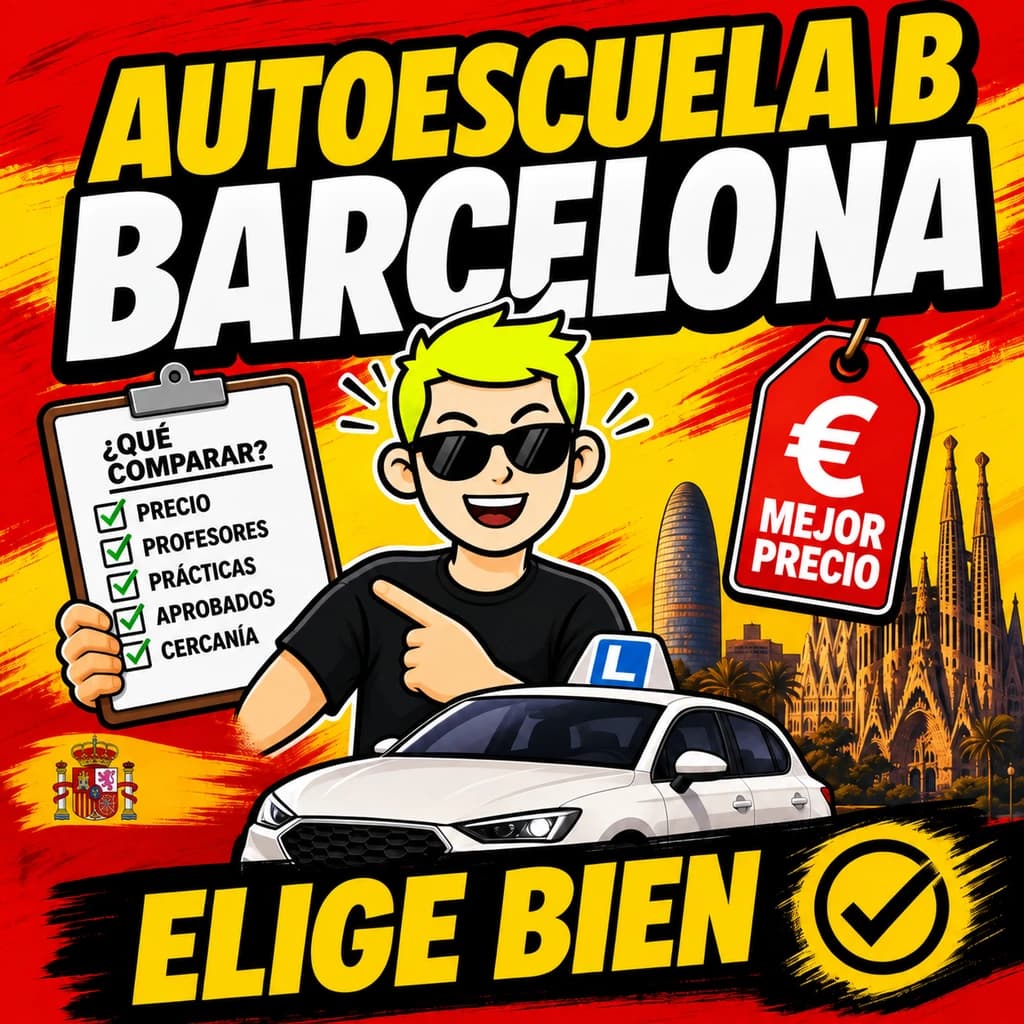
Do not compare only enrollment. Ask for the price of included practical lessons, the cost per extra lesson, the DGT fee, the medical certificate, theory material, and retake conditions. If a school cannot explain this clearly or in writing, you do not have a serious basis for deciding.
The DGT exam fee for the B license is 94.05 euros, and the medical certificate usually falls around 35 to 60 euros. Practical lessons depend on the school and the learner, so the initial package rarely tells the whole story. What matters is knowing what happens if you need more lessons than planned.
Also ask how your progress is measured. A school that only gives you access to tests without reviewing mistakes may work if you are very independent, but not if you need structure. Tracking prevents you from repeating the same errors.
Strong theory preparation is still the best way to save money
Whether you are in Poblenou or Les Corts, the most reliable savings come from arriving strong for the theory exam. If you fail or reach practical lessons with weak foundations, costs climb through extra classes and new exam fees. A cheap enrollment does not help if it pushes you toward retakes.
Organize study in short cycles: read theory, answer a block of questions, review mistakes, and return to the topic that failed. Classify mistakes by signs, priority, speed, maneuvers, road safety, and maintenance. That map tells you what to review, not just how many answers you got right.
When you can chain full simulations with 0, 1, or 2 errors on different days, you are much closer to booking with judgment. If your scores rise and fall sharply, you still need to stabilize the base.
Mistakes that cost money in Barcelona
The most common mistake is enrolling impulsively because an offer ends soon. A rushed decision can leave you with incompatible schedules, limited practical availability, or extra costs that appear late. Before paying, confirm the full quote and real availability.
Another mistake is choosing only by neighborhood. Having the school nearby helps, but if the theory method is weak or practical lessons are hard to book, proximity does not compensate. In Barcelona, where moving between areas can consume time, balance location with organization.
It also gets expensive to sit the theory exam because tests are “almost” going well. The exam allows up to 3 errors, but if you always train on the limit, you have little margin. Booking with stable results reduces pressure and protects the budget.
Is it better to take the theory exam in Spanish or Catalan?
Choose the language in which you understand the questions and nuances best. In Catalonia you can take the theory exam in Spanish or Catalan, so there is no benefit in choosing the language that feels less comfortable. The goal is to reduce misunderstandings.
If you study with material in one language and then want to sit the exam in another, do several full simulations in the final language. Some words around signs, priority, or road safety can change enough to create doubts.
How many driving schools should I compare?
Compare at least three options with the same breakdown. You do not need to visit every school in your area, but you do need enough of a sample to detect what each one includes and what is left out.
If an offer seems much cheaper, do not reject it or accept it immediately: ask about included lessons, extra lesson cost, materials, fees, and retakes. A good difference is one you can understand; a risky difference is one nobody explains.
When should I book the exam?
Book when your mock exams are stable, not when you are in a hurry. The goal is to reach the 30-question exam with enough margin over the maximum of 3 errors. If every test depends on luck, it is not the moment yet.
Also look at the calendar. If you can avoid June and September, you will face less demand pressure. If you cannot choose, compensate with more notice and a review routine that keeps the syllabus fresh until exam day.