When you can exchange and when you cannot
The DGT separates EU and EEA licenses from licenses issued by countries with a bilateral exchange agreement. EU and EEA licenses do not require an exam, while for other countries the possibility of exchange depends on the agreement and on the category you want to obtain in Spain.
The DGT itself highlights an important limit: a license obtained in your country of origin is not exchangeable if you were already a legal resident in Spain, with specific exceptions such as the case noted for the Republic of Korea.
That condition is one of the most common issues behind exchange-related searches. That is why, before starting any procedure, it is worth checking your situation regarding residency and the country that issued your original license.
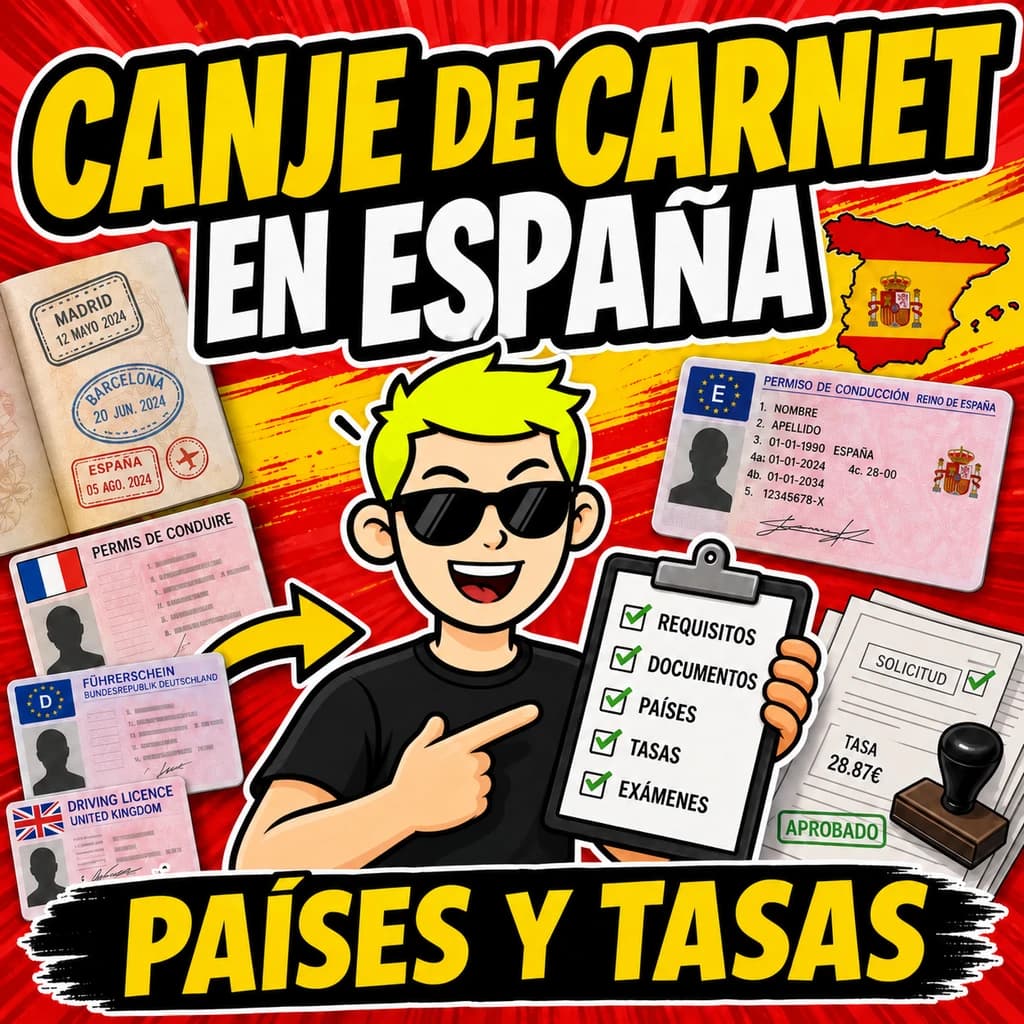
EU and EEA versus agreement countries
If your license is from the European Union or the European Economic Area, the exchange is more direct and requires no exam. It is the simplest route and the one that involves the fewest tests, though it still requires an administrative procedure.
If your license comes from a country outside the EU or the EEA, the key is whether an exchange agreement with Spain exists. That agreement determines which categories can be exchanged and under what specific conditions.
Not every agreement covers every category. That is why it is not enough to search for the exchange price: you have to confirm first whether your country appears on the list of agreements and what exactly that agreement allows for your type of license. Checking this from the start stops you beginning a procedure you might not be able to finish.
When there is an exam and how much it costs
On its non-EU exchange page, the DGT states that for cars, motorcycles and light vehicles without additional tests, fee 2.3 applies, at €28.87. It is the cheapest procedure because it involves no exam.
For truck or bus licenses that require additional tests, fee 2.1 applies, at €94.05, and that fee gives the right to two exam calls. The price difference directly reflects whether your procedure involves an exam or not.
The DGT also explains that, in general, exchanges of A and B do not require an exam, while C and D permits usually require additional aptitude tests. That is why you should search for exchange plus category type, not just the price.
How to approach the procedure step by step
A practical sequence saves time and avoids unnecessary payments. First, check whether your country appears on the list of exchange agreements with Spain, because everything else depends on that.
Then, confirm which tests your specific category requires, because exchanging a car license is not the same as exchanging a truck or bus one. Finally, check the cost of the fee that applies to your case depending on whether it involves an exam.
For the documents and the appointment, the most reliable option is to consult the official information at dgt.es before going to any office. That order avoids booking an appointment or paying without being sure the exchange is really viable in your situation.
What to do if your case does not fit
If your license is not exchangeable, for example because you obtained it while already a legal resident in Spain or because your country has no agreement, the alternative is usually to obtain the Spanish license through the ordinary route.
That route means going through the usual theory and practical exam process, like any learner starting from scratch. It is not what many people expect, but it is the way out when the exchange is not available.
Confirming this before spending on fees or appointments is what saves you time. Knowing as early as possible whether your case fits the exchange or whether you will have to take the exam lets you plan realistically and without surprises. It is a longer route, but at least it gives you a clear alternative when a direct exchange is not possible.
Mistakes that cost time and the role of CAP
The mistake that costs the most time is paying fees or booking appointments without first confirming whether the exchange is possible. Starting by checking viability avoids paperwork that later turns out to be useless and has to be undone.
Another mistake is looking only at the price and not at the category. The cost changes depending on whether there is an exam, so searching only for a cheap exchange can lead you to wrong conclusions about your procedure.
Also, if your goal is to drive professionally, remember that the exchange is only one part of the process. Depending on the category and country there may be exams, and CAP may then come into play if the activity is professional road transport.
Can I exchange my EU license in Spain?
Yes. For EU or EEA licenses, the DGT does not require an exam for the exchange, which is the simplest route.
Even so, it is worth reviewing the specific documents and deadlines in the DGT's official information before starting the procedure, because it is still an administrative process. Gathering the documents in advance avoids last-minute delays in what is usually a quick procedure.
How much does it cost to exchange a foreign license?
For cars, motorcycles and light vehicles without additional tests, fee 2.3 applies, at €28.87.
For truck or bus licenses that require additional tests, fee 2.1 applies, at €94.05, which gives the right to two exam calls. Confirming the fee type before paying makes sure you pay exactly what corresponds to your category.
Do I need an exam to exchange the license?
In general, exchanges of the A and B categories do not require an exam, while C and D usually require additional aptitude tests.
Whether there is an exam also depends on the agreement with your country of origin, so it is worth confirming before starting the procedure and paying the fee. And if your category involves tests, preparing them in time reduces the risk of using up both included attempts.