Accept the time you actually have
If your schedule is tight, the most common mistake is waiting for the perfect study day. That day rarely appears. It is better to accept that you only have short blocks and build a routine you can repeat even when the week is difficult.
Fifteen or twenty focused minutes can help if you are consistent. What does not work is studying three hours once and disappearing for the rest of the week. The theory exam improves with frequent contact: theory, questions, and review.
For this to work, define a minimum time, not an ideal time. For example: “after lunch I do a short test” or “before bed I review five mistakes.” If the block depends on motivation, it will break. If it depends on a small concrete action, it is much easier to repeat.
When time is scarce, energy matters too. If you can only study at the end of the day, leave lighter tasks for that moment: reviewing mistakes, signs, or one short explanation. Save full mock exams for moments with more concentration. That way you do not confuse tiredness with lack of knowledge and you judge your real level better.
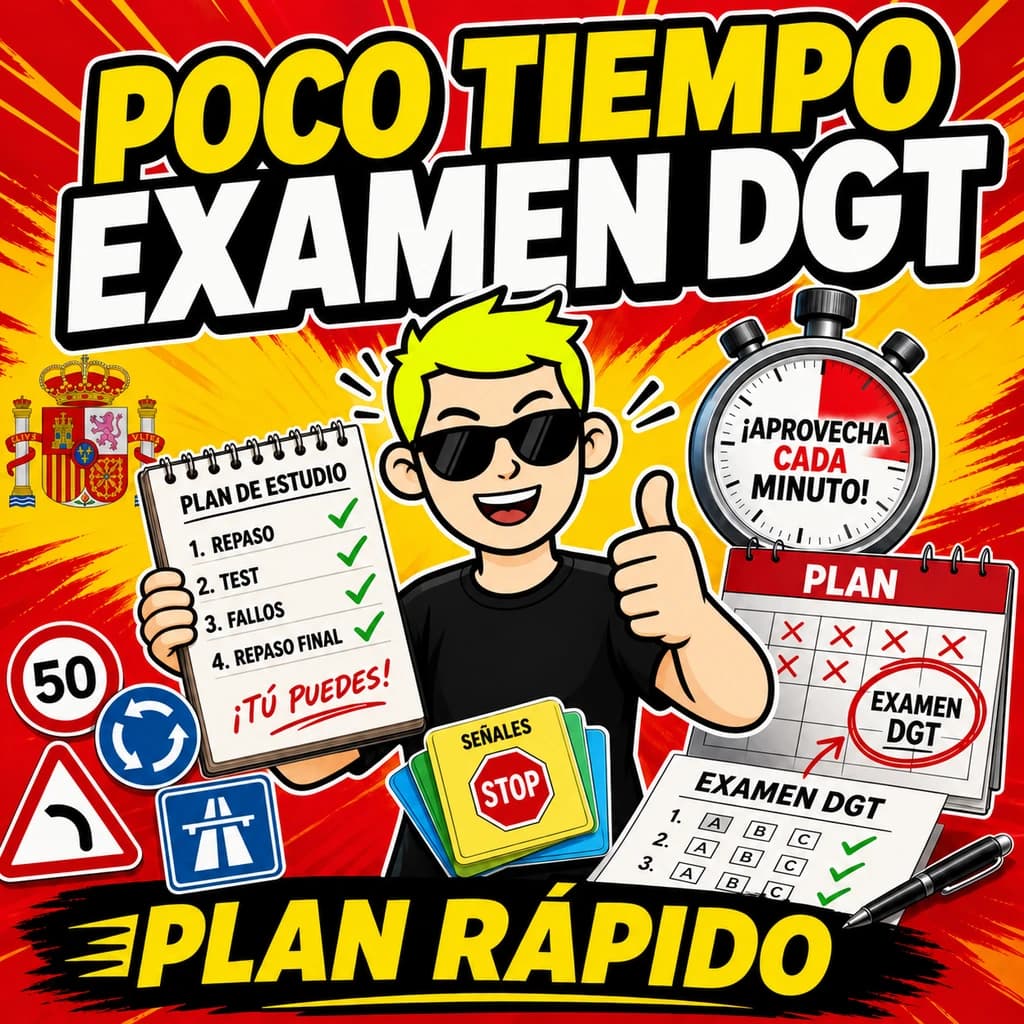
Prioritize the topics that block learners most
Do not try to read the whole manual from start to finish if time is limited. Start with signs, priority, speed, safe distance, documents, alcohol, distractions, and behavior around vulnerable road users. These topics appear often and explain many mistakes.
Then add the blocks where you personally fail. If your mock exams always fall because of signs, you do not need more mechanical theory before fixing signs. Fast preparation must be selective, not chaotic.
Prioritizing does not mean abandoning everything else forever. It means ordering. First you close the gaps that cost the most points, and then you complete less urgent topics. In a short plan, each session should answer one question: which mistake am I trying to remove today?
If you share your progress with an autoescuela or teacher, bring concrete questions. “I do not understand priority” is too broad; “I miss it when there is give way and a pedestrian nearby” allows a useful explanation. With little time, each doubt should come from a real mistake and return as a practical rule.
The 20-minute session
A simple structure works well: five minutes of theory, ten minutes of tests, and five minutes of review. Theory gives context, the test shows how the DGT asks questions, and review turns the mistake into learning. If you remove review, the session loses much of its value.
On days with even less time, use a minimum version: three difficult questions and one written explanation. The important point is not breaking the chain. A small focused session is worth more than an ideal session that never happens.
The review part must be active. It is not enough to read “correct answer B.” Ask what detail you did not see, what rule you confused, or which option attracted you because of habit. That short explanation is what turns the test into real study.
Another way to save time is to reuse your own mistakes as the syllabus. Instead of asking each day what to study, open the mistake list and start with the most repeated one. That automatic decision saves energy and makes the plan measurable: fewer repeated mistakes, more real preparation.
A two-week plan with little margin
During the first days, mix basic theory and topic tests. In the middle of the plan, start doing full timed mock exams. The B exam has 30 questions, a maximum of 3 errors, and 30 minutes, so you should practice the real rhythm before test day.
In the final days, reduce volume and increase precision. Repeat mistakes, review signs, and focus on questions that change because of one word: except, unless, mandatory, prohibited, or allowed. Do not add new topics at the last minute if basic doubts are still open.
If one day you cannot do the full mock exam, do not replace it with nothing. Do a micro-task: five signs, three missed questions, or one priority rule. Daily contact reduces the effort needed to return the next day.
How to review mistakes without wasting time
Do not copy long explanations. Write one sentence with the correct rule and another with the reason for your mistake. For example: “I read allowed as mandatory” or “I confused roundabout priority.” That short note is easy to review.
Group mistakes by topic every two or three days. If one block repeats, make it the priority the next day. This way, preparation adapts to your reality instead of following a generic topic list.
Checklist to protect consistency
Prepare the next block before closing each session: topic, test, or mistake list. Studying with little time requires reducing friction. If you have to decide from zero every day, quitting becomes easier.
Use specific gaps: commute, lunch break, or before bed, but avoid doing tests when you are extremely tired. In that case, review notes or signs. Save difficult questions for a moment when you have more attention.
Can I prepare the theory exam in two weeks?
You may make strong progress in two weeks if you already have some base, consistency, and daily review. If you are starting from absolute zero, you may need more margin. Measure progress with mock exams, not only by study hours.
How many tests should I do each day?
There is no universal number. With little time, start with quality: a short set of questions reviewed properly. When your mistakes go down, add full mock exams to train timing, reading, and endurance.
What should I do the day before the exam?
Review your frequent mistakes, signs, and basic rules. Avoid saturating yourself with many new questions without review. Prepare documents, time, and transport so exam day does not start in a rush.