Definition
The V-16 is a DGT-approved beacon placed on the roof of the vehicle to signal it has stopped due to breakdown or accident. It is designed to replace warning triangles: the driver does not need to leave the car to deploy it, reducing the risk of being hit on the shoulder or carriageway. From January 1, 2026, the connected V-16 (with DGT 3.0 geolocation) is the only valid pre-signalling system in Spain.
The V signs
The V-16 belongs to Spain's catalogue of vehicle signs — the V series, carried on the vehicle itself to tell other road users something. The ones the approved question bank uses are V-1 (priority-vehicle light), V-2 (amber light on roadworks and service vehicles), V-6 (vehicle or combination over 12 m), V-15 (driver with a disability, allowed into the HOV lane alone), V-16 (pre-signalling of danger), V-20 (panel marking a load that overhangs at the rear), V-25 (the environmental sticker) and V-26 (shared rental vehicles). There is no V-23 or V-27 in any of the 12,154 approved questions: the beacon the rules require is the connected V-16.
Key facts
- From January 1, 2026, the connected V-16 is mandatory; triangles are no longer valid.
- Deployed from inside the car, no need to walk onto the road.
- Visible 360° from 1 km, minimum 30-minute autonomy.
- Only DGT-approved NB-IoT-connected models are valid.
- It is one of the vehicle signs (V series), alongside V-1, V-2, V-6, V-15, V-20, V-25 and V-26.
Where to buy a connected V-16
Amazon affiliate links: if you buy through them, sacatelcarnet may earn a commission at no extra cost to you.
These models appear in the DGT's list of certified V-16 devices. The order is not a recommendation.
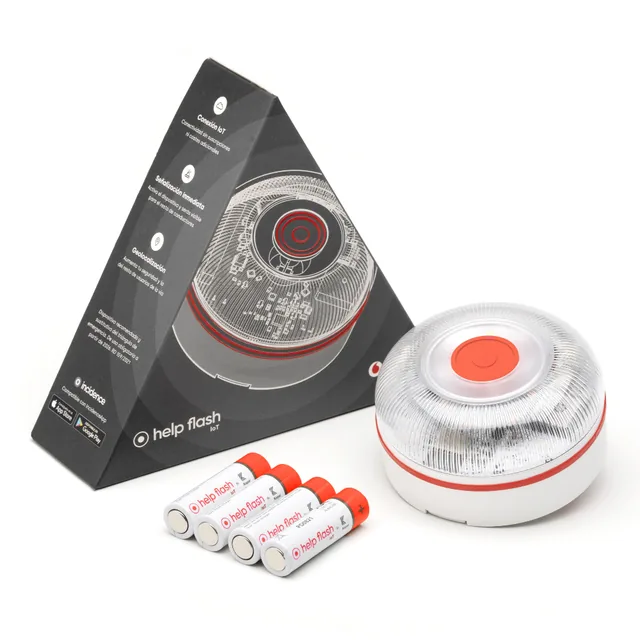 Help Flash IoTPhoto: NetunSee on Amazon
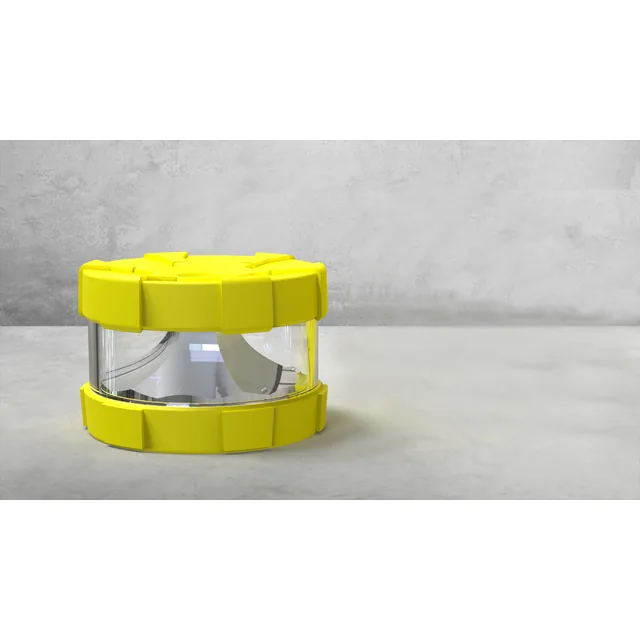 iWottoLight IoTPhoto: iWottoLightSee on Amazon
 OSRAM LEDguardian ROAD FLARE Signal V16 IoTPhoto: OSRAMSee on Amazon
Before you pay, check that the exact brand and model are on the official list and that the beacon is connected (DGT 3.0): since 1 January 2026 it is the only valid one. List of certified V-16 devices (dgt.es)
As an Amazon Associate, sacatelcarnet earns from qualifying purchases.
Frequently asked questions
- Where do you put the V-16 beacon?
- As high as possible on the vehicle, normally on the roof, so it is visible without the driver stepping onto the carriageway. Not on the windscreen or the dashboard, and there is no need to walk 50 metres up the road as with triangles.
- Is there a V-27 sign or a V-27 beacon?
- No V-27 or V-23 appears in any of the 12,154 approved questions in our bank. The luminous pre-signalling device named by the rules is the V-16, in its version connected to the DGT 3.0 platform.
- Do I still need warning triangles in Spain?
- From 2026 the connected V-16 replaces triangles as the mandatory way to pre-signal an immobilised vehicle. Triangles still appear in older exam questions, but they are no longer the correct answer when the question is set in 2026.
Practice real questions on this topic
Free DGT 2026 test with exam-style questions and explanations. No signup. Or explore the free DGT test in English hub for everything in one place.
In the DGT exam
- Which of these is NOT a lighting device on the vehicle?
- A row of fixed or flashing amber lights…
- A breakdown in a tunnel requires the vehicle to stop, and an accessible emergency area is nearby in the direction of travel. If it can be reached safely, where should the vehicle be immobilised?