Step 1. The big picture
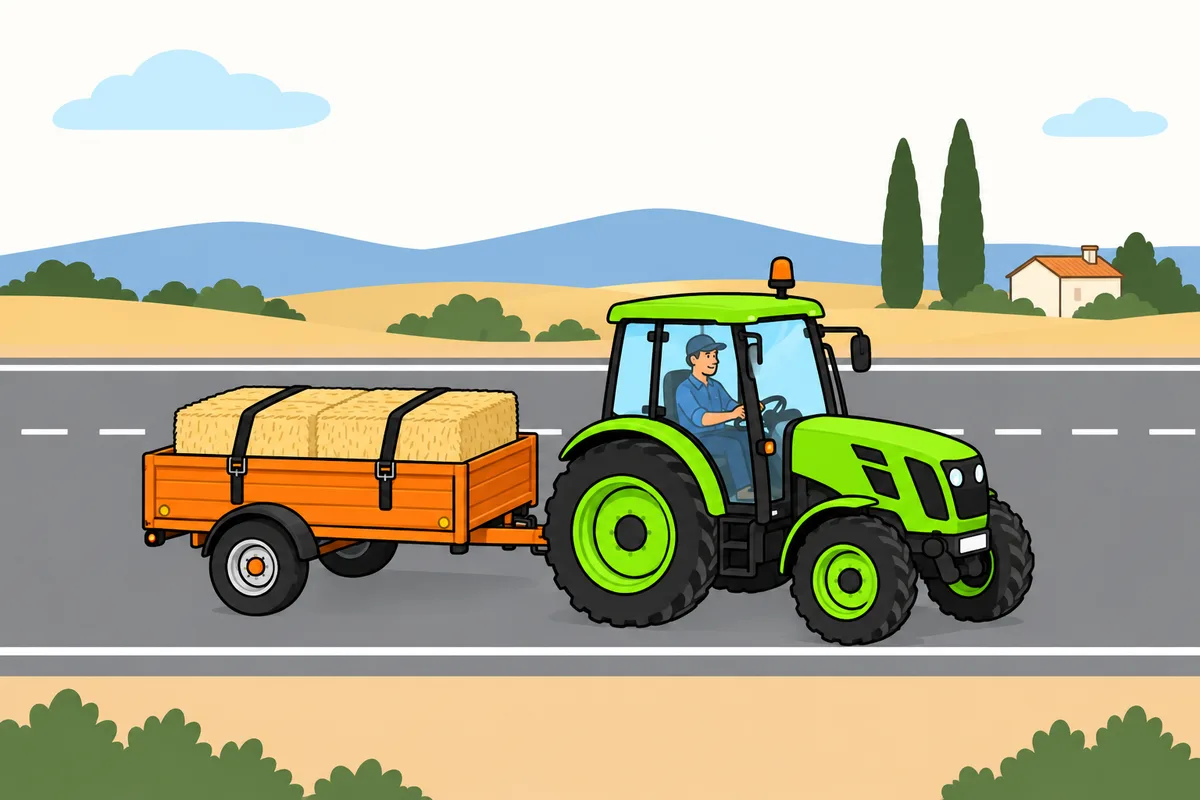
In one sentence…
Load and the road in LVA means securing produce, implements or trailers, not dirtying or unduly encroaching on the carriageway, and adapting to coexist with the rest of the traffic. The exam tests your ability to secure the load, use the hard shoulder or carriageway correctly, and keep the road clean.
Step 2. The syllabus
2.1Securing the load
The load must be secured so that it does not shift, fall or drag along the road while driving or manoeuvring.
- A poorly secured load can shift during braking or on a bend and upset the stability of the combination.
- Distribute the weight evenly so as not to compromise the steering, braking or control of the vehicle.
- Check the securing before setting off and check it again if the trip is long or the road surface is uneven.
2.2Implements and trailers
Implements or trailers must be kept within the permitted safety and signalling conditions before going out onto the public road.
- A badly positioned or unsignalled implement increases the risk because other drivers do not properly judge its real dimensions.
- Check the couplings and the fastening of the trailer so that it does not come loose or sway while driving.
- Folding or securing the implements reduces the effective width and height and makes for safer driving.
2.3Use of the hard shoulder and the carriageway
When there is no part of the road specifically set aside, these vehicles must use a passable and adequate hard shoulder or, failing that, the strictly necessary part of the carriageway.
- Occupying more carriageway than necessary gets in the way of the rest of the traffic and increases the risk of being hit from behind by faster vehicles.
- Assess whether the hard shoulder is passable and safe before using it, because a hard shoulder in poor condition can be a worse option than the carriageway.
- Drive in the position that the rule and real safety recommend on each stretch, not out of habit.
2.4Width of the combination and manoeuvres
The real width of the combination requires you to plan crossings, other vehicles' overtaking manoeuvres and turns onto tracks or farms well in advance.
- An agricultural vehicle takes up more functional width than it appears to, so leave enough margin at crossings.
- Anticipate the wide turns the combination requires so as not to enter the opposite lane or surprise the vehicle behind you.
- As far as possible, make it easy for faster vehicles to overtake you safely when the road allows it.
2.5Keeping the road clean
No mud, soil, load debris or objects must be left on the carriageway as a result of driving or of joining the road from a track.
- Mud or debris on the asphalt reduces grip and can cause other vehicles to lose control.
- If something compromises safety, you must stop and fix the situation before continuing.
- Cleaning or checking the wheels and the load before leaving a track avoids dragging soil onto the public road.
2.6Joining the road from tracks and farms
When joining the road from a track or a farm, check that you are not dragging mud or debris and that you have enough visibility.
- Joining points are risk points because they connect a slow, wide vehicle to faster traffic.
- Signal in advance and join without rushing, making sure that others have seen you.
- Being in a hurry to enter or leave a farm does not justify a manoeuvre without visibility or a safety margin.
2.7Safety and responsibility
A small loss of soil or load is not irrelevant: it has safety and liability consequences for the driver.
- Before driving, check that the load, the implements and the cleanliness of the vehicle meet the required conditions.
- If in any doubt about the securing or condition of the combination, sort it out before setting off, not while driving.
- Driving while taking into account your width, your reduced speed and your responsibility for the load is the basis of safety in LVA.
Step 3. Key points
If you only have a minute before the exam, revise this.
- 1.Secure the load and the implements so nothing falls or drags.
- 2.Distribute the weight evenly across the combination.
- 3.Check the couplings and the signalling of implements and trailers.
- 4.Use the hard shoulder or the carriageway according to the rule and real safety.
- 5.Avoid leaving mud, soil or objects on the road.
- 6.Plan crossings and turns taking into account the width of the combination.
- 7.Join from tracks with visibility and without dragging debris.
Step 4. Exam traps
Mistakes the DGT uses again and again on this topic.
- Thinking a small loss of soil or load has no regulatory relevance.
- Occupying more carriageway than strictly necessary.
- Using the hard shoulder without assessing whether it is passable and safe.
- Forgetting to signal or secure the implements before going out onto the road.
- Joining from a farm in a hurry and without enough visibility.
Step 5. Quick check
Four real exam questions on what you have just read.
If the road narrows or obstacles appear while driving an agricultural vehicle requiring an LVA licence, the proper action is to:
Step 6. Frequently asked questions about loads and road use
- If an implement can move or protrude during travel, it must:
- Be properly secured or positioned. Implements must be properly secured or positioned so they do not create danger on the road.See full question
- Before travelling on a public road with attached implements, which check directly concerns the safety of their attachment?
- That the implements are correctly secured. That they are correctly secured and configured for transport under the manufacturer’s instructions, with no risk of detachment or dangerous movement. Also check applicable dimensions, lighting and signalling. Adequate fuel or a tidy cab does not replace checking the attachment.See full question