Step 1. The big picture
In one sentence…
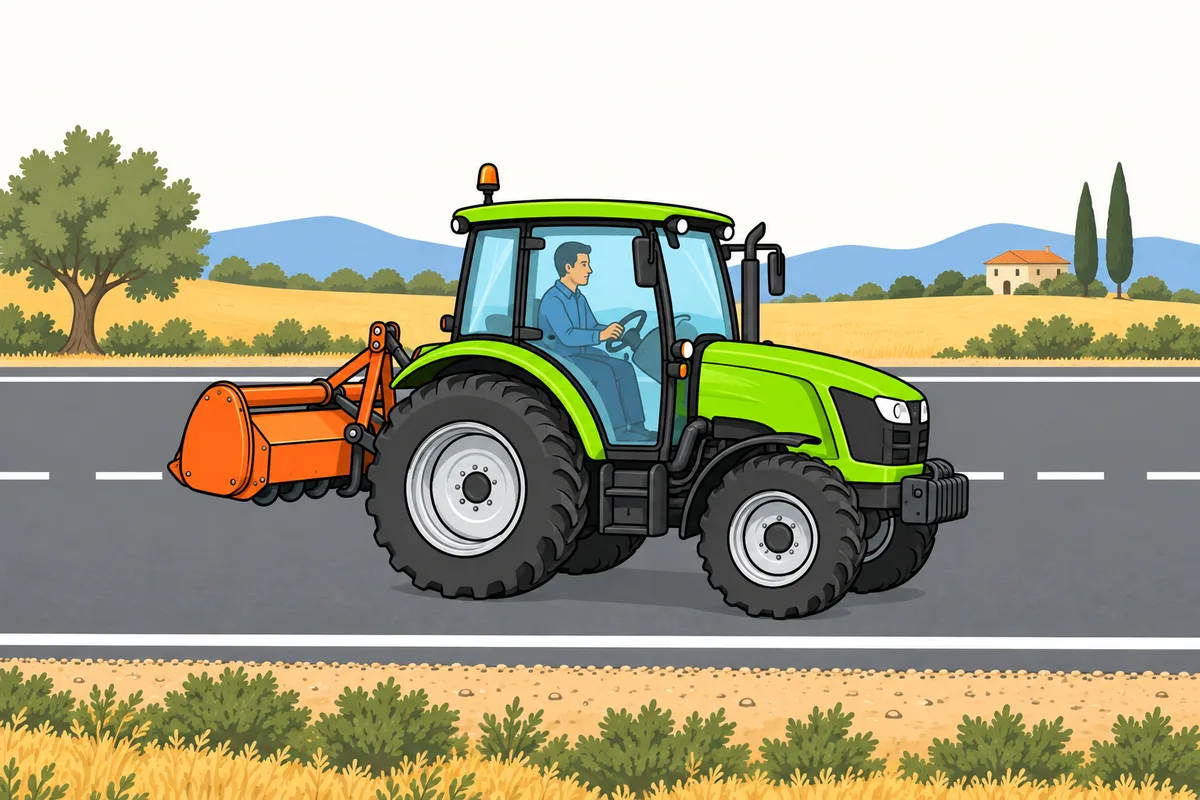
The agricultural vehicle topic focuses on types of special vehicles, controls, implements, dimensions, couplings and safe preparation for driving outside the work site. The exam tests your ability to check beforehand, understand the scope of the licence and adapt your driving to a wide, slow vehicle.
Step 2. The syllabus
2.1Preparing the vehicle
Before going out onto the public road, check the brakes, steering, wheels, lights, couplings and the fastening of implements or trailers.
- Turn this check into a fixed routine so you instantly spot any fault or poorly secured element.
- A well-prepared vehicle responds predictably, and that predictability is the basis of road safety.
- Spotting a fault before setting off is always better than discovering it once you are already driving on the public road.
2.2Implements and dimensions
Implements must be positioned or folded so that they do not compromise width, height, visibility or stability.
- A deployed implement increases the real dimensions of the combination and requires extra care at crossings and when being overtaken.
- Before driving, assess whether it is worth folding or securing the implements to reduce the effective width and height.
- Knowing the real dimensions of the combination lets you plan every manoeuvre with the necessary margin.
2.3Controls and control
Get to know the vehicle's controls and its response to accelerating, braking and turning before going out onto the public road.
- Adjust the driving position to reach the controls comfortably and to keep control at all times.
- A special vehicle does not handle like a car: you need to know its reactions well to drive it safely.
- Practising the use of the controls in a controlled environment improves the command you need in real traffic.
2.4Couplings and trailers
Check that the couplings of the trailer or implement are properly fastened and do not come loose or sway while driving.
- A faulty coupling compromises the stability of the combination and can cause very dangerous situations.
- Also check the trailer's signalling and lights so that its presence and dimensions are visible.
- Check the fastening before setting off and again if the trip is long or the road surface is uneven.
2.5Driving characteristics
The agricultural vehicle does not drive like a car: it responds differently, turns differently and can take up more functional width than it appears to.
- On a gradient, an uneven road surface or a narrow carriageway you must anticipate the manoeuvre much more and reduce your speed.
- The wide turning radius means you must plan turns in good time and from a position that lets you complete them.
- Recognising your reduced speed and your real size is the basis for prudent, predictable driving.
2.6Manoeuvres on gradients and narrow roads
On a gradient, control the speed and stability of the combination, especially if you are carrying a load or a trailer.
- On narrow roads, assess the available width before committing to a crossing or letting another vehicle overtake you.
- Anticipate narrow points and side obstacles so as not to get trapped with a wide vehicle.
- Care and anticipation make up for the manoeuvring limitations of these vehicles.
2.7Scope of the licence
The LVA licence covers the regulatory scope provided for these vehicles within their ordinary limits or their speed by construction.
- Do not confuse an agricultural authorisation with a general licence to drive heavy vehicles of another kind.
- Knowing which vehicles the licence covers avoids believing it authorises more than it really permits.
- Driving within the scope of the licence is part of complying with the rule and with road safety.
Step 3. Key points
If you only have a minute before the exam, revise this.
- 1.Check the brakes, steering, wheels, lights and couplings before driving.
- 2.Position or fold the implements without compromising width or stability.
- 3.Know the vehicle's response to the controls before setting off.
- 4.Check the fastening and signalling of trailers and implements.
- 5.Drive taking into account the greater width, turning radius and reduced speed.
- 6.Anticipate manoeuvres on gradients and narrow roads.
- 7.Know the specific scope of the LVA licence.
Step 4. Exam traps
Mistakes the DGT uses again and again on this topic.
- Forgetting to fold or secure an implement before going out onto the road.
- Confusing the special agricultural vehicle with a general licence for any heavy vehicle.
- Handling the combination like a car without accounting for its different response.
- Starting a wide turn without planning the width and turning radius needed.
- Driving with a poorly fastened coupling that compromises stability.
Step 5. Quick check
Four real exam questions on what you have just read.
The LVA licence generally refers to certain special agricultural vehicles that are:
Step 6. Frequently asked questions about agricultural vehicles
- A self-propelled agricultural special vehicle exceeds ordinary mass or dimension limits, or its maximum design speed exceeds 45 km/h. Under Article 5.9, which licence is required?
- A B licence is required. Article 5.9 requires a B licence whenever a self-propelled agricultural special vehicle or combination exceeds ordinary mass or dimension limits, or its maximum design speed exceeds 45 km/h. Exceeding either condition requires B; both need not be exceeded. Driving with LVA alone requires observing ordinary limits and not exceeding 45 km/h. Do not interpret Article 6.1.b’s wording as waiving Article 5.9’s express B requirement.See full question
- On an agricultural vehicle traveling on a public road, the tools and materials being carried must be:
- Properly placed and secured. Carried objects must be properly placed and secured so they do not come loose or affect the vehicle's stability or safety.See full question