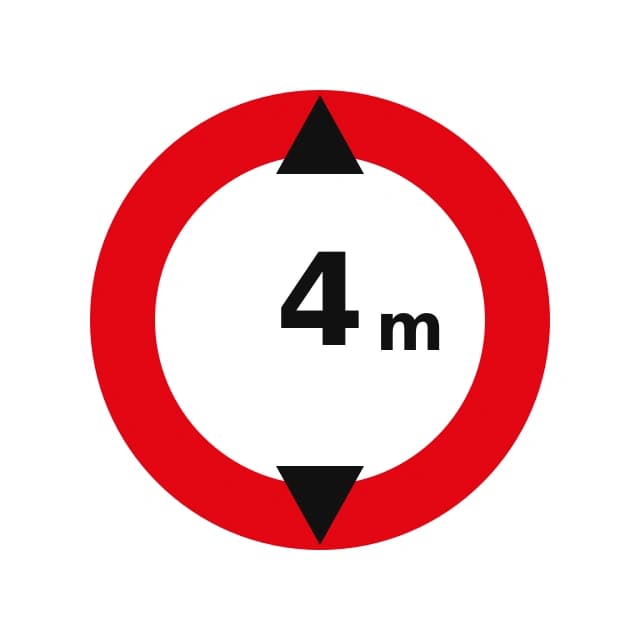
Correct answer
It may not pass if its height, including the load, exceeds 4 m.
It prohibits passage if the vehicle’s maximum height, including the load, exceeds 4 metres. Exactly 4 metres does not exceed the figure, but technical and general limits and other signs still apply. It is not a length or mass restriction, and the displayed figure is not 3.5 metres. The figure alone does not guarantee that the entire route is accessible to the vehicle.
Practice more C licence questions
A self-check with exam-style questions on Traffic signs. Free, no signup.
All options
It may not pass if its height, including the load, exceeds 4 m.
It may not pass if its length exceeds 4 m.
It may not pass if its mass exceeds 4 tonnes.
Editorial status: editorially approved. This status does not certify legal review. Report a correction
Keep studying
DGT test in English: free practice
Exam-style questions in English, no signup. You can also sit the official exam in English.
All Spanish traffic signs and their meanings
Full DGT catalogue: warning, regulatory and information signs.
Sign R-205: sets a height limitation
What this sign means, its category and its shape.
Related questions
- An ordinary rigid lorry and an animal-drawn vehicle meet at a narrow passage without signs, agents or roadworks instructions. It is not a steep-gradient section and it is uncertain who entered first. If one must reverse, which will it be?
- On a road, may a lorry reverse as a manoeuvre complementary to a U-turn?
- If a traffic officer is directing traffic while you drive a C1 or C truck, you must:
- In view of this sign...
- What does the sign shown indicate, with no tonnage figure or supplementary plate limiting its application?
- If you are driving a van with a maximum authorised mass (MAM) of four tonnes without a load, may you enter a road that has this sign at the entrance?