Correct answer
Yes.
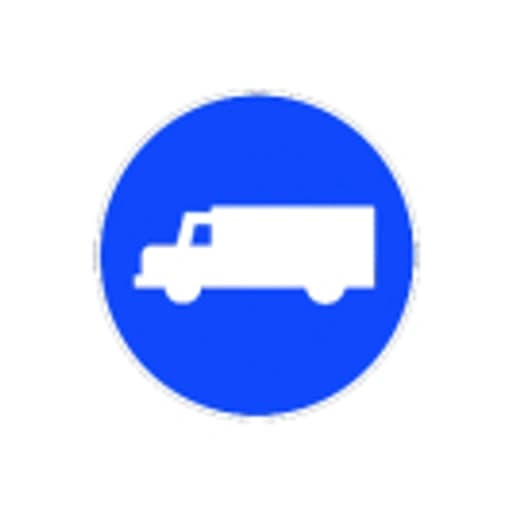
Yes. The picture shows R-406, a compulsory carriageway for lorries, tractor units and goods vans, regardless of mass when no figure is displayed. A tonnage inscription or panel would limit the obligation to vehicles or combinations whose MAM exceeds that figure. This is not S-3, the road reserved for motor vehicles. Other applicable rules, restrictions and signs still apply.
Practice more C1 licence questions
A self-check with exam-style questions on Traffic signs. Free, no signup.
All options
Only if the maximum permissible mass of the lorry is equal to or less than 3,500 kg.
No.
Yes.
Editorial status: editorially approved. This status does not certify legal review. Report a correction
Keep studying
DGT test in English: free practice
Exam-style questions in English, no signup. You can also sit the official exam in English.
All Spanish traffic signs and their meanings
Full DGT catalogue: warning, regulatory and information signs.
Sign R-406: a carriageway for lorries and vans
What this sign means, its category and its shape.
Glossary terms in this question
Related questions
- When the gaps between the dashes of a broken line are noticeably shorter than in the general case, what does this indicate to the driver?
- An ordinary lorry, performing neither special transport nor dangerous-goods transport, travels on a conventional road with a general maximum of 80 km/h. With no justified reason for slower travel, below what speed does it breach the general minimum?
- If you are approaching a roundabout or road junction with a garden, monument, fountain, etc. in the centre, which way will you generally travel?
- Considering only this sign, with no tonnage figure, may a lorry use the carriageway at whose entrance it stands?
- What does this sign prohibit?
- As a general rule, an ordinary lorry with a MAM of 5,000 kg, not carrying dangerous goods, travels on a paved conventional road outside a built-up area. Without a justified reason, below what general minimum speed must it not travel?