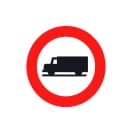
Correct answer
Lorries, tractor units and vans, regardless of mass.
Lorries, tractor units and vans intended for goods transport, regardless of mass. It is not restricted to dangerous goods and does not prohibit all passenger cars.
Practice more C1 licence questions
A self-check with exam-style questions on Traffic signs. Free, no signup.
All options
Lorries, tractor units and vans, regardless of mass.
Only vehicles carrying dangerous goods.
All passenger cars, even when carrying only passengers.
Editorial status: editorially approved. This status does not certify legal review. Report a correction
Keep studying
DGT test in English: free practice
Exam-style questions in English, no signup. You can also sit the official exam in English.
All Spanish traffic signs and their meanings
Full DGT catalogue: warning, regulatory and information signs.
Sign R-106: no entry for vehicles intended for carrying goods
What this sign means, its category and its shape.
Glossary terms in this question
Related questions
- Clearance lights are fitted to lorries when their width generally exceeds 2.10 metres, but... how many lights do they consist of?
- A lorry and a vehicle combination must pass each other at a narrowing with no priority signs, steep gradient or instructions from officers or roadworks personnel. It is known which entered first. Who has priority?
- If you are driving a lorry of more than 3,500 kg MAM on a road outside a built-up area that has three lanes in the same direction, which lanes are you permitted to use?
- A lorry travels in a normal lane, without congestion making each vehicle’s speed depend on the one ahead in its lane. Under the rule for acceleration and deceleration lanes, moving faster is not considered overtaking when compared with…
- Under the maximum-speed rule outside built-up areas for special vehicles, which statement is correct, subject to any applicable lower limits?
- A lorry over 10 metres in total length including its load travels without signalling an intention to overtake and outside a tunnel. With traffic not saturated and overtaking permitted, on which road must it additionally leave at least 50 metres to help following traffic overtake?