Correct answer
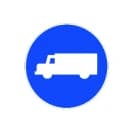
Carriageway compulsory for all types of lorries and vans.
Vertical sign R-406 establishes the obligation for drivers of all types of lorries and vans, regardless of their mass, to travel on the carriageway at whose entrance it is located. If it also bears a weight figure inside it, this means that the obligation applies only when the maximum authorised mass of the vehicle or combination of vehicles exceeds that figure.
Practice more C1 licence questions
A self-check with exam-style questions on Traffic signs. Free, no signup.
All options
Carriageway compulsory for all vehicles except lorries.
Carriageway recommended for all vehicles, especially lorries.
Carriageway compulsory for all types of lorries and vans.
Editorial status: editorially approved. This status does not certify legal review. Report a correction
Keep studying
DGT test in English: free practice
Exam-style questions in English, no signup. You can also sit the official exam in English.
All Spanish traffic signs and their meanings
Full DGT catalogue: warning, regulatory and information signs.
Sign R-406: a carriageway for lorries and vans
What this sign means, its category and its shape.
Related questions
- An ordinary lorry may use a temporary additional lane established under Article 42, with no specific prohibition or lower limits. In conditions allowing the general speeds, what obligations apply?
- A manual-gearbox lorry faces a steep uphill gradient and the engine cannot maintain a suitable speed in a high gear. What should the driver select?
- On the road you are travelling on, a lane has been enabled for use in the opposite direction to the usual one, for traffic-flow reasons. Are you allowed to use this lane if you are driving a lorry with an authorised maximum mass of more than 3,500 kilograms?
- You drive a lorry with MAM above 3,500 kg behind a bus, outside built-up areas and tunnels, on a conventional road with one lane each way where overtaking is permitted and traffic is not saturated. You do not signal an intention to overtake. In addition to enough distance to stop without collision, what minimum gap does Article 54(2) require?
- Which of these actions at the wheel combines visual, manual and cognitive distraction unrelated to driving?
- A lorry with a maximum authorised mass above 3,500 kg, carrying no dangerous goods and performing no other special transport operation, travels on an urban road with two general-use lanes in each direction and pavements separate from the carriageway. With no specific signs, what is its general maximum speed?