Correct answer
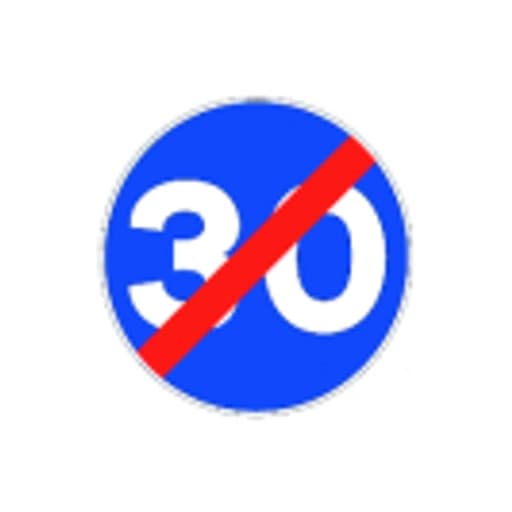
The obligation to travel at a minimum speed of 30km/h ends.
The vertical sign R-506 shown in the image indicates the end of the section requiring a minimum speed of 30 kilometres per hour, establishing that from that point onward the obligation to travel at a minimum speed of 30 kilometres per hour ends.
Practice more C licence questions
A self-check with exam-style questions on Traffic signs. Free, no signup.
All options
It is a reminder that a minimum speed of 30km/h must be maintained.
The obligation to travel at a minimum speed of 30km/h ends.
From this point onward, it will be compulsory to travel at a speed below 30km/h.
Editorial status: editorially approved. This status does not certify legal review. Report a correction
Keep studying
DGT test in English: free practice
Exam-style questions in English, no signup. You can also sit the official exam in English.
All Spanish traffic signs and their meanings
Full DGT catalogue: warning, regulatory and information signs.
Sign R-506: the end of minimum speed
What this sign means, its category and its shape.
Glossary terms in this question
Related questions
- A lorry over 3,500 kg MAM travels normally on an urban carriageway that is neither a motorway nor a dual carriageway, wide enough for three lanes in its direction but without longitudinal lane markings. Without a manoeuvre justifying otherwise, where must it travel?
- Roadworks require a contraflow lane. Your lorry is authorised on the road and is not expressly prohibited. With no lower established or signed limits and safe conditions, how must it travel in that lane?
- You are driving a lorry with a maximum authorised mass of more than 3,500 kg on a road outside a built-up area that has three lanes in each direction. Which lanes are you allowed to use?
- An unauthorised private car reaches a signed area reserved exclusively for urban public transport stopping and parking. What voluntary actions are prohibited there?
- A lorry above 3,500 kg MAM travels outside a built-up area on a carriageway with three ordinary lanes in its direction. If conditions warrant overtaking and it does not obstruct a following vehicle, may it use the centre lane subject to the other rules?
- The driver of a lorry with a maximum authorised mass (MAM) exceeding 3,500 kg who is about to overtake must...