Step 1. The big picture
In one sentence…
Master the hierarchy between officers, temporary signage, traffic lights, vertical signs and road markings, and study the current official catalogue with attention to the most recent updates. Don't memorise isolated pictures: link each sign to the conduct it requires.
Step 2. The syllabus
2.1Hierarchy of signage
The priority between signs is not arbitrary: first you obey officers' orders, then temporary signage, then traffic lights, then vertical signs and finally road markings.
- If two signs appear to contradict each other, the higher-ranking one prevails; in the exam, many questions are solved by remembering this hierarchy before looking at shape or colour.
- Signs apply from the point where they are placed, unless they indicate a distance, the length of a stretch, or the end of a prohibition.
- Remembering the full order gives you a fixed rule for resolving situations that at first glance seem ambiguous or contradictory.
2.2Families of signs
Danger warning signs warn of a nearby risk; regulatory signs impose prohibitions or obligations; and information signs guide, confirm or inform about the use of the road.
- Telling the family apart by its function, not just its picture, lets you work out the correct conduct even if you don't remember the exact sign from memory.
- Danger signs only warn, while regulatory signs command; confusing warning with obliging is a common source of mistakes in the exam.
2.3Traffic lights and officers
Traffic lights regulate passage with priority over an incompatible vertical sign, and their lights may be aimed at all road users or at a specific lane, vehicle or manoeuvre.
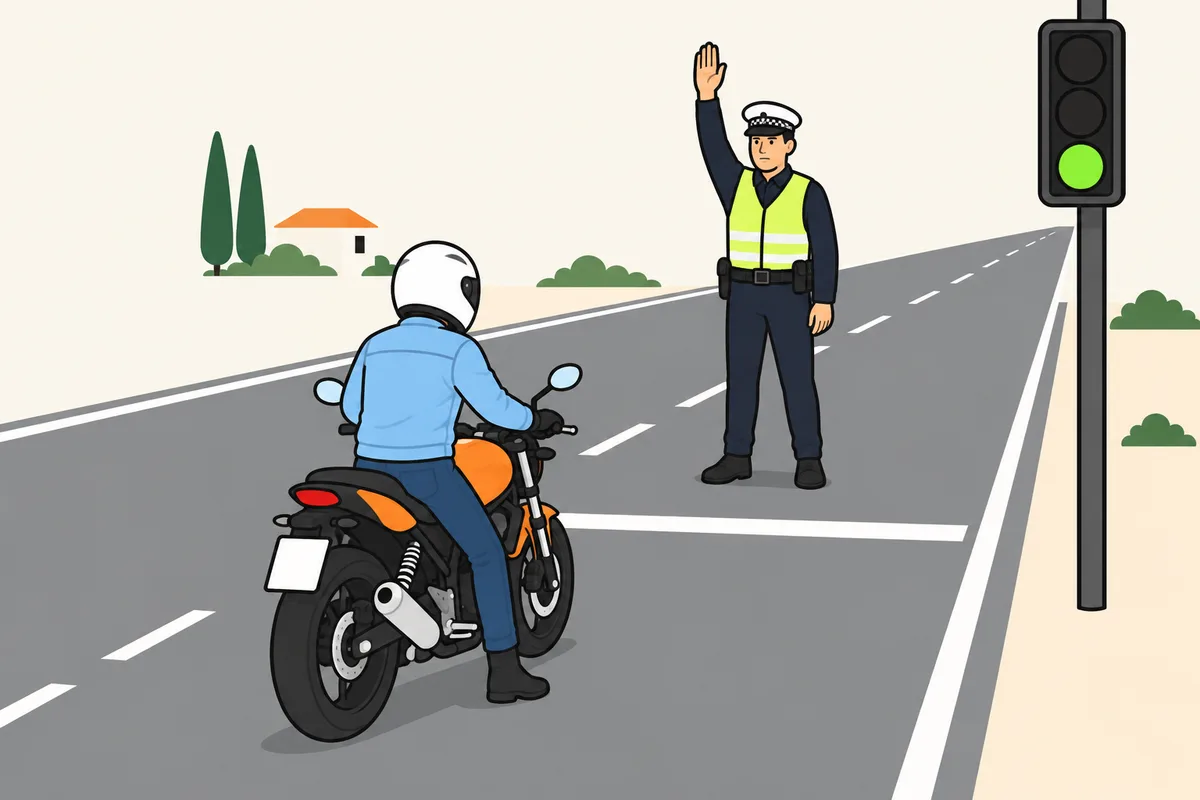
- Officers' orders rank above any traffic light or sign, so an officer directing traffic takes charge even if the traffic light indicates otherwise.
- When a question pits an officer, a traffic light and a sign against each other, always resolve it by rank: officer first, then traffic light, then vertical signage.
2.4Road markings
Road markings define lanes, excluded areas, pedestrian crossings, continuous or broken lines, and rules on stopping, parking and priority.
- A continuous line must not be crossed or driven over to overtake, while a broken line allows certain manoeuvres; reading them wrong completely changes the correct answer.
- Don't read a road marking in isolation: link it to the vertical signs and the rest of the lane's or junction's signage before deciding.
2.5Practical reading in the exam and on the road
Don't study signs as isolated pictures: link each one to the required conduct, the vehicle's position and the anticipation needed.
- At a junction, a priority sign outweighs the general priority-to-the-right rule; at roadworks, temporary signage can override the permanent signage.
- When the question mentions a reversible lane, an extra lane or a temporary diversion, pay attention to road delineation devices, arrows and variable message signs.
2.6Official catalogue and the 2025 update
The official sign catalogue was updated in 2025, with new representations and pictograms and panels adapted to current mobility.
- To study rigorously, use up-to-date material and be wary of old diagrams that still include discontinued signs or incomplete meanings.
- If a question pits a new sign against a classic one, the key remains the same: identify danger, prohibition, obligation or information and apply the correct conduct.
2.7Signs that matter most on a motorcycle
On a motorcycle you must pay special attention to slippery road surfaces, crosswind, level crossings, animals, linked bends, roadworks and category-specific restrictions.
- These warnings carry more weight on two wheels because a slippery surface or a gust of wind affects balance in a way a car barely notices.
- Anticipating the sign gives you time to reduce speed and adjust your line before reaching the dangerous stretch, instead of reacting once you're already in it.
Step 3. Key points
If you only have a minute before the exam, revise this.
- 1.Recognise the full hierarchy of signage.
- 2.Apply the officer first, then the traffic light, then the vertical sign.
- 3.Tell apart danger, regulatory, information signs and road delineation devices.
- 4.Link each sign to the required conduct and the stretch it affects.
- 5.Read road markings alongside the rest of the signage, not in isolation.
- 6.Study the updated catalogue and not just old images.
- 7.Pay attention to the signs that most affect motorcycles.
Step 4. Exam traps
Mistakes the DGT uses again and again on this topic.
- Confusing the general priority rule with a vertical sign or an operating traffic light.
- Forgetting that temporary roadworks signage can change the usual regime.
- Reading a road marking in isolation without linking it to the rest of the lane's or junction's signage.
- Confusing a danger sign, which only warns, with a regulatory sign, which obliges.
- Studying with old material that still includes signs discontinued by the 2025 reform.
- Giving priority to the traffic light over the order of an officer directing traffic.
Step 5. Quick check
Four real exam questions on what you have just read.
Can a motorcyclist use the VAO lane?
Step 6. Frequently asked questions about signs
- You are riding a motorcycle on a conventional road outside a built-up area, with one lane in each direction, no physical separation between directions and no specific posted speed limit. What is the general maximum speed?
- 90 km/h. The general motorcycle speed limit on a conventional road outside built-up areas is 90 km/h. Only on conventional roads with a physical separation between traffic directions may the road authority set a limit of 100 km/h. Any specific posted limits must be obeyed.See full question
- You are riding a motorcycle and must cross a wet transverse marking made with conventional road paint, while obeying the signs and markings. How can you reduce the risk of losing grip?
- With the motorcycle as upright as possible and without abrupt manoeuvres on the paint. Conventional road paint can provide less grip, especially when wet. If it cannot be safely avoided while obeying the signs and markings, cross with the motorcycle as upright as possible and with smooth control, avoiding abrupt braking, acceleration or steering on the paint. Do not change direction to cross every marking at 90 degrees: maintain a safe path. These precautions reduce risk but do not guarantee that a skid cannot occur.See full question
- When arriving at a traffic accident, before approaching casualties, what must you prioritise?
- Protect yourself and check that the area is safe for intervention. First protect yourself and check that the location is safe to prevent another accident. Stop and give warnings safely, without exposing yourself to traffic, fire or other hazards. If you can intervene safely, make a rapid assessment, call 112 and follow its instructions to help within your abilities. PAS begins with protection; the current DGT guide adds assessment in P. E. A. S. Do not delay an urgent call in order to complete warning measures that would be dangerous.See full question
- Which drivers does this R-405 require to use the carriageway at whose entrance it is placed?
- Drivers of two-wheeled motorcycles and three-wheeled vehicles assimilated to motorcycles. Drivers of two-wheeled motorcycles and three-wheeled vehicles assimilated to motorcycles under the current definition. It does not mean every two-wheeled vehicle: cycles and mopeds are other categories. This sign alone does not reserve the carriageway exclusively for the required vehicles.See full question
- When a motorcycle has a belt as a transmission component, it transmits the engine's power to...
- the rear wheel. The way in which we transmit the power from our engine to the rear wheel of our motorcycle is known as the secondary transmission. This power may be transmitted through a chain, a toothed belt or a cardan drive shaft, from the engine to the rear wheel.See full question
Official sources
Test what you've studied on signs
Exam-style questions on this topic, with an explanation after every answer.
Now, practise it
Test what you have read with exam-style questions and an explanation after each answer.
Related lessons
- A2Signs
Master the hierarchy between officers, circumstantial signalling, traffic lights, vertical signs and road markings, and study the current official catalogue paying attention to the most recent updates. Don't memorise loose drawings; relate each sign to the conduct it requires.
- AMSigns
Master the hierarchy between officers, temporary signage, traffic lights, vertical signs and road markings, and study the current official catalogue with attention to the most recent updates. In the moped exam, many questions are solved by correctly applying that priority order.
- BSigns
Master the hierarchy between officers, temporary signage, traffic lights, vertical signs and road markings. In the exam you must recognise which order prevails, what conduct each sign requires, and when a temporary indication changes what you would normally expect to see on the road.
- B+ESigns
Master the hierarchy between officers, circumstantial signalling, traffic lights, vertical signs and road markings, and study the current official catalogue paying attention to how combinations with a trailer behave. In B+E you must read every sign thinking about mass, length, lane, stability and the section affected.
- CSigns
Master the hierarchy between officers, circumstantial signalling, traffic lights, vertical signs and road markings, and study the current official catalogue paying attention to the most recent updates. For the C licence - Truck, always add the restrictions specific to goods and heavy vehicles.
- C+ESigns
Master the hierarchy between officers, circumstantial signalling, traffic lights, vertical signs and road markings, and study the official catalogue in force, paying attention to recent updates. In C+E, every sign must be read together with the combination's size, length, mass and manoeuvre.