Step 1. The big picture
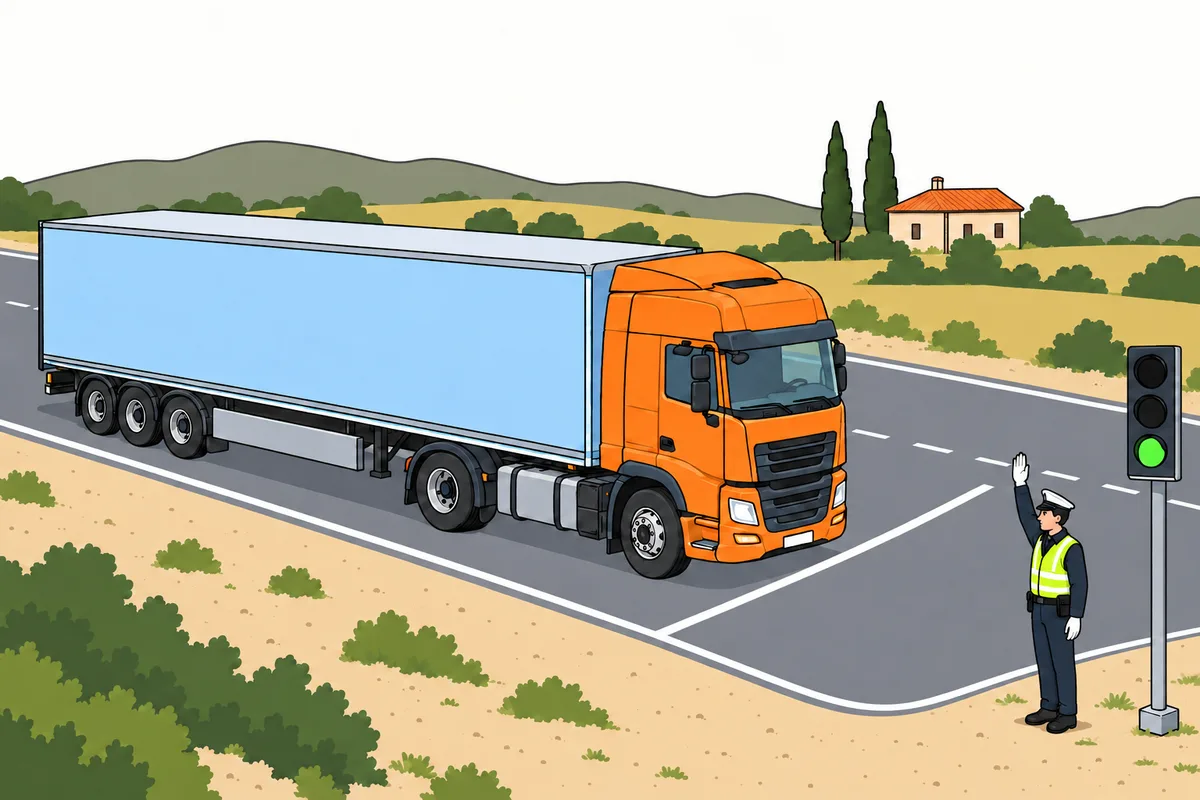
In one sentence…
Master the hierarchy between officers, circumstantial signalling, traffic lights, vertical signs and road markings, and study the official catalogue in force, paying attention to recent updates. In C+E, every sign must be read together with the combination's size, length, mass and manoeuvre.
Step 2. The syllabus
2.1Signalling hierarchy
The priority between signs isn't arbitrary: first you obey officers, then circumstantial signalling, traffic lights, vertical signs, and lastly road markings.
- If two signs seem to contradict each other, the higher-ranking one prevails; many questions are solved by applying this hierarchy before looking at details.
- Signs are binding from the place where they are positioned, unless they indicate a distance, the length of a stretch of road or the end of a prohibition.
- In combinations, the hierarchy matters even more because a temporary order can change lanes, diversions or passages allowed for long vehicles.
2.2Families of signs
Danger warning signs warn of a risk; regulatory signs impose prohibitions or obligations; information signs guide or inform.
- Traffic lights regulate right of way with priority over an incompatible vertical sign, and can apply to all users or to a specific lane.
- Road markings delimit lanes, excluded zones, pedestrian crossings, continuous or broken lines, and rules for stopping, parking and priority.
- Learn the function of each family, not just the picture, because the exam asks what behaviour you must adopt in front of the sign.
2.3Signs for combinations
For heavy combinations pay special attention to restrictions on length, mass, height, gradients, slow-vehicle lanes and overtaking bans.
- The same sign can have more demanding consequences for a combination than for a car, because the turning and braking space is different.
- When a question shows a long vehicle facing a restriction, check whether the wording includes a trailer, semi-trailer, goods or a constrained road.
- Don't answer out of car-driving habit: in C+E, the key is usually applying the sign to the whole combination and its manoeuvre.
2.4Temporary signage and roadworks
Circumstantial signalling for roadworks or incidents can change the usual regime and prevail over incompatible permanent signs during the affected stretch.
- On a provisional diversion, read road delineation devices, panels, arrows, enabled lanes and possible restrictions before deciding the combination's trajectory.
- A narrow roadworks section requires anticipation, because the towed unit can encroach on lateral space even if the towing vehicle has already passed through correctly.
- The exam trap is applying the permanent sign without recognising that the temporary one has changed priority, lane or prohibition.
2.5Road markings and lanes
Continuous lines, broken lines, excluded zones and lane arrows are interpreted together with the rest of the signalling, not as isolated pictures.
- When a reversible, extra or reserved lane appears, pay attention to lane traffic lights, panels and markings indicating permitted use.
- A combination needs more anticipation to change lane, so reading arrows and markings early reduces abrupt manoeuvres.
- In the exam, a road marking can confirm where to stop, where to drive or which manoeuvre is prohibited, even without a nearby vertical sign.
2.6Updated official catalogue
The official sign catalogue was updated in 2025, with new representations and pictograms and panels adapted to current mobility.
- Use up-to-date material and be wary of old diagrams that keep decommissioned signs, incomplete meanings or pictures that no longer match.
- If a question puts a new sign against a classic one, first identify whether it signals danger, prohibition, obligation or information so you can act.
- The update doesn't change the study method: sign, hierarchy, affected user, affected stretch of road and the correct behaviour in each situation.
2.7Exam practice
Don't study signs as loose pictures: link each one to the required behaviour, the vehicle's position and the anticipation needed.
- At a junction, a priority sign outweighs the general right-hand rule; at roadworks, the temporary sign can override the permanent one.
- When the question includes a reversible lane, an extra lane or a provisional diversion, look for road delineation devices, arrows and variable message panels before answering.
- In C+E, remember the specific test has 20 questions, a maximum of 2 errors and 20 minutes; answer by hierarchy and behaviour.
Step 3. Key points
If you only have a minute before the exam, revise this.
- 1.Recite the full hierarchy before solving questions with incompatible signs.
- 2.Distinguish danger, regulatory, information, traffic lights, markings and road delineation devices.
- 3.Link every sign to the required behaviour and the affected stretch of road.
- 4.Apply restrictions thinking about the whole combination, not just the towing vehicle.
- 5.Check temporary roadworks signage before applying the permanent one.
- 6.Study the updated catalogue and avoid materials with decommissioned signs.
- 7.Look for arrows, panels and markings when the question mentions special lanes.
Step 4. Exam traps
Mistakes the DGT uses again and again on this topic.
- Confusing the general priority rule with a vertical sign or an operating traffic light.
- Forgetting that temporary roadworks signage can change the usual regime.
- Reading a single road marking without linking it to the rest of the signalling.
- Applying a sign as if you were driving a car and not a combination with a trailer.
- Using old catalogues without checking updated signs or pictograms in force.
- Not telling whether a light or panel affects all road users or just one lane.
Step 5. Quick check
Four real exam questions on what you have just read.
At a yield sign with a C1+E or C+E combination, you must:
Step 6. Frequently asked questions about signs
- What does this S-34 sign indicate?
- A place to pull a vehicle aside in an emergency to keep the passage clear. An emergency lay-by where a vehicle can pull aside to keep the passage clear. It does not itself indicate an emergency telephone in a tunnel; that information belongs to S-34a, with the SOS symbol.See full question
- At a narrow passage with no signs or orders settling priority, it is unclear who entered first between a lorry towing a non-light trailer and a bus. Which has priority by vehicle type?
- The vehicle combination. The lorry-and-trailer combination takes precedence over the bus in the Article 62 order. If it is known who entered first, that initial priority applies under Article 60. Officer orders and applicable directions must be obeyed. Greater reversing distance decides between vehicles of the same type or unlisted cases, not between these two different types.See full question
- A vehicle combination over 7 m long travels within a built-up area on a road that is neither a motorway nor a dual carriageway, with three marked general lanes in the same direction. With no signed restriction, may it use the third lane if that lane best suits its destination and it does not obstruct others?
- Yes, if it suits the destination and does not obstruct others. Yes. Under the conditions in Article 33 of the General Traffic Regulations, use the lane best suited to your destination without obstructing others. The restriction for combinations over 7 m on roads with three or more lanes outside built-up areas must not be applied automatically to this urban case. Motorways and dual carriageways are excluded from this urban rule, and reserved lanes and signs must always be respected.See full question
- An articulated vehicle with a total length of 10 metres travels on an autovía outside a built-up area with four ordinary lanes in its direction, with no signs or exceptional circumstances changing their use. Which lanes may it use?
- Normally the one furthest to the right, though the next one may be used in certain circumstances. Combinations longer than seven metres normally use the rightmost lane on roads outside built-up areas with three or more lanes in their direction. They may use only the immediately adjacent lane to its left when traffic or road conditions make this advisable, without obstructing a following vehicle. Having four lanes does not allow free use of the three right-hand lanes or of all four. This is the ordinary rule; applicable signs and special measures must also be followed.See full question
Official sources
Test what you've studied on signs
Exam-style questions on this topic, with an explanation after every answer.
Now, practise it
Test what you have read with exam-style questions and an explanation after each answer.
Related lessons
- A1Signs
Master the hierarchy between officers, temporary signage, traffic lights, vertical signs and road markings, and study the current official catalogue with attention to the most recent updates. Don't memorise isolated pictures: link each sign to the conduct it requires.
- A2Signs
Master the hierarchy between officers, circumstantial signalling, traffic lights, vertical signs and road markings, and study the current official catalogue paying attention to the most recent updates. Don't memorise loose drawings; relate each sign to the conduct it requires.
- AMSigns
Master the hierarchy between officers, temporary signage, traffic lights, vertical signs and road markings, and study the current official catalogue with attention to the most recent updates. In the moped exam, many questions are solved by correctly applying that priority order.
- BSigns
Master the hierarchy between officers, temporary signage, traffic lights, vertical signs and road markings. In the exam you must recognise which order prevails, what conduct each sign requires, and when a temporary indication changes what you would normally expect to see on the road.
- B+ESigns
Master the hierarchy between officers, circumstantial signalling, traffic lights, vertical signs and road markings, and study the current official catalogue paying attention to how combinations with a trailer behave. In B+E you must read every sign thinking about mass, length, lane, stability and the section affected.
- CSigns
Master the hierarchy between officers, circumstantial signalling, traffic lights, vertical signs and road markings, and study the current official catalogue paying attention to the most recent updates. For the C licence - Truck, always add the restrictions specific to goods and heavy vehicles.