Step 1. The big picture
In one sentence…
Master the hierarchy between officers, circumstantial signalling, traffic lights, vertical signs and road markings, and study the current official catalogue paying attention to the most recent updates. For the C licence - Truck, always add the restrictions specific to goods and heavy vehicles.
Step 2. The syllabus
2.1Hierarchy of signalling
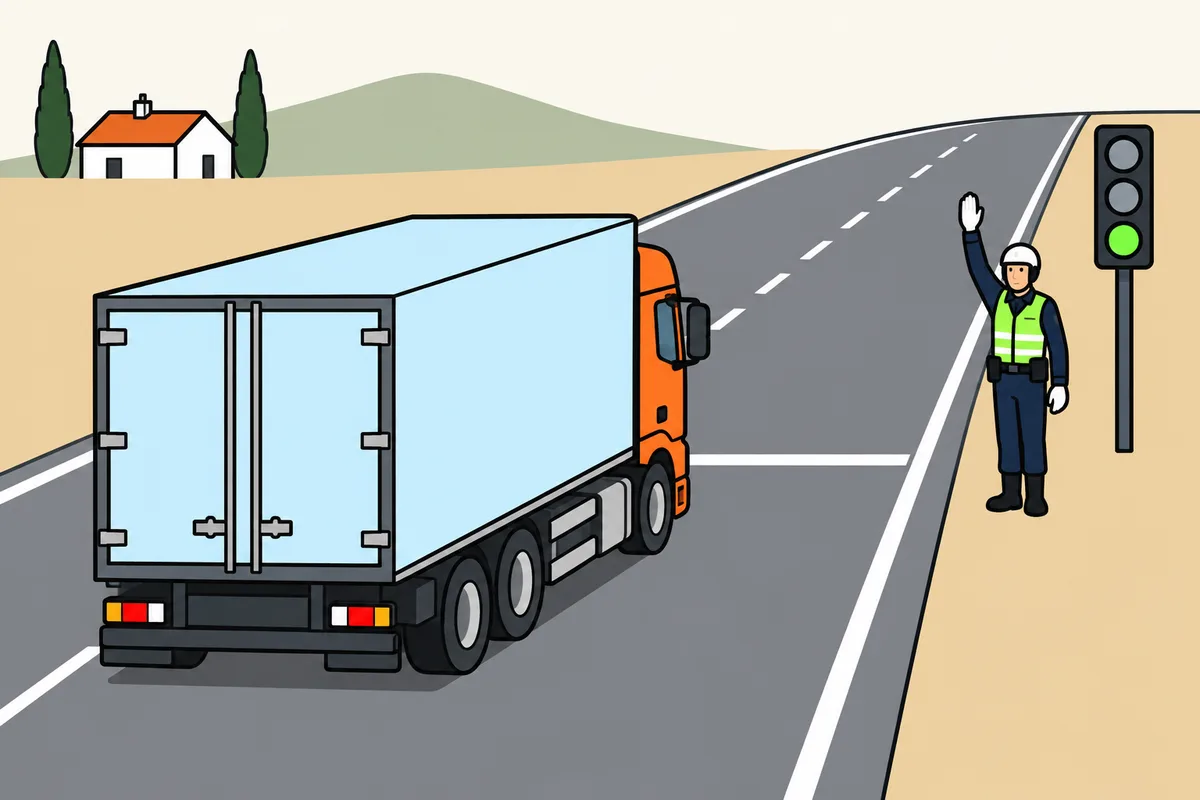
The priority between signs isn't arbitrary: first you obey officers, then circumstantial signalling, traffic lights, vertical signs and finally road markings.
- If two signs appear to contradict each other, the higher-ranking one prevails; many questions are solved by applying the hierarchy before looking at shape or colour.
- Signs apply from the place where they're positioned, unless they indicate a distance, the length of a section or the end of a prohibition.
- At roadworks, diversions or incidents, temporary signalling can modify the usual regime; don't answer out of habit if the scenario has changed.
2.2Families of signs
Danger warning signs warn of a risk; regulatory signs impose prohibitions or obligations; information signs guide or inform.
- Traffic lights regulate the right of way with priority over an incompatible vertical sign and can be aimed at all users, at lanes or at specific manoeuvres.
- Road markings define lanes, excluded zones, pedestrian crossings, continuous or broken lines and rules for stopping, parking and priority.
- Don't memorise isolated drawings: relate each family to the conduct required, the section affected and the user it's aimed at.
2.3Priority and conflicts
At a junction, a priority sign is worth more than the general rule of giving way to the right; apply the specific sign first and the general rule afterwards.
- An isolated road marking may not be enough if there's a traffic light, an officer or a temporary sign that changes the conduct required at that point.
- When a question mentions a reversible lane, an extra lane or a temporary diversion, look at the road delineation devices, the arrows and the variable message panels.
- If a sign affects only one lane, vehicle or manoeuvre, avoid extending it automatically to the whole direction of travel without checking the scenario.
2.4Signs for goods vehicles
For heavy goods, restrictions on mass, length, height, width, gradient, overtaking and access to certain routes become especially important.
- A restriction sign can force you to change route even if the vehicle is well loaded and even if the road looks wide enough.
- In C you must read every sign thinking about the real vehicle: inertia, turning radius, load, dimensions and the need for anticipation.
- The exam may show a common sign, but the key is that you're driving goods; check whether it specifically affects heavy vehicles or the load.
2.5Official catalogue and update
The official catalogue of signs was updated in 2025, with new representations and adapted pictograms and panels for current mobility.
- To study rigorously, use up-to-date material and be wary of old diagrams that still show obsolete signs or incomplete explanations.
- If a question sets a new sign against a classic one, identify danger, prohibition, obligation or information and apply the correct conduct.
- When a sign or meaning has been reformed, the current official catalogue cited in the references prevails, not an old study sheet.
2.6Exam practice
In the C-specific test you have 20 questions, a maximum of 2 errors and 20 minutes; answer quickly, but always from the rule and the case described.
- Before answering, mentally order the scene: who's in charge, which sign applies, from where it obliges and which user it affects.
- Train with images by asking what you must do, not just what the sign is called; the exam tests conduct, not decorative recognition.
- If you're torn between two answers, look for the one that respects the hierarchy, the section of application and the specific restrictions for a goods vehicle.
Step 3. Key points
If you only have a minute before the exam, revise this.
- 1.Memorise the full hierarchy of signalling.
- 2.Distinguish danger, regulatory, information, temporary signalling and markings.
- 3.Relate each sign to conduct and the section affected.
- 4.Apply sign priority before general rules.
- 5.Check restrictions on mass, dimensions and goods.
- 6.Study the updated catalogue, not just old diagrams.
- 7.Read whether the sign affects a lane, user or specific manoeuvre.
- 8.Practise with images until you decide which action is required.
Step 4. Exam traps
Mistakes the DGT uses again and again on this topic.
- Confusing the general priority rule with a vertical sign or an operating traffic light.
- Forgetting that temporary roadworks signalling can modify the usual regime.
- Reading a road marking in isolation without relating it to the rest of the signalling.
- Applying a lane sign to the whole road without checking the scenario.
- Ignoring mass or dimension restrictions in goods-related questions.
- Studying old signs without checking the current official catalogue.
Step 5. Quick check
Four real exam questions on what you have just read.
Without a supplementary panel indicating another distance, a regulatory sign’s obligations, restrictions or prohibitions begin to apply from…
Step 6. Frequently asked questions about signs
- If you are driving a van with a maximum authorised mass (MAM) of four tonnes without a load, may you enter a road that has this sign at the entrance?
- No, because it prohibits entry for lorries and vans even if they are travelling empty. No. The pictured R-107 prohibits goods vehicles whose maximum authorised mass exceeds 3.5 tonnes. The van has a maximum authorised mass of 4 tonnes, so entry is prohibited even when it is empty. The comparison uses maximum authorised mass, not actual mass or the load currently carried. The sign applies to vans as well as lorries.See full question
- Can delineation signs also indicate obstacles on a road?
- Yes, as well as indicating the course or layout of the road. Yes. Delineation can indicate obstacles as well as the course or layout of the road using lights and devices. It includes barrier devices that prevent passage and guidance devices. It is not limited to weather information and does not replace the duty to obey applicable signs and instructions.See full question
- If a traffic officer raises an arm vertically and we cannot stop our vehicle safely…
- we are not obliged to stop. An arm raised vertically requires all road users approaching the officer to stop, regardless of their direction. Drivers who cannot stop safely are excepted. At a junction, the signal also does not require drivers who have already entered it to stop.See full question
- In 2026, a lorry registered in Spain is immobilised by a breakdown on a one-way urban road. How should the danger be signalled?
- With hazard warning lights and a certified connected V-16 beacon. Switch on the hazard warning lights and use a certified connected V-16 beacon. Place it at the highest accessible position that ensures visibility, following the device’s instructions. Since 1 January 2026 it replaces warning triangles for vehicles registered in Spain required to carry it, including lorries. There is no need to walk along the carriageway to place triangles.See full question
- Without a supplementary panel indicating another distance, a regulatory sign’s obligations, restrictions or prohibitions begin to apply from…
- The road cross-section where the sign stands. As a general rule, a regulatory sign takes effect at the cross-section where it stands, unless a panel specifies a distance to another starting point. There is no general 50-metre delay or requirement to wait until the next junction before obeying it. Each regulation’s extent and end depend on the sign and its specific conditions.See full question
Official sources
Test what you've studied on signs
Exam-style questions on this topic, with an explanation after every answer.
Now, practise it
Test what you have read with exam-style questions and an explanation after each answer.
Related lessons
- A1Signs
Master the hierarchy between officers, temporary signage, traffic lights, vertical signs and road markings, and study the current official catalogue with attention to the most recent updates. Don't memorise isolated pictures: link each sign to the conduct it requires.
- A2Signs
Master the hierarchy between officers, circumstantial signalling, traffic lights, vertical signs and road markings, and study the current official catalogue paying attention to the most recent updates. Don't memorise loose drawings; relate each sign to the conduct it requires.
- AMSigns
Master the hierarchy between officers, temporary signage, traffic lights, vertical signs and road markings, and study the current official catalogue with attention to the most recent updates. In the moped exam, many questions are solved by correctly applying that priority order.
- BSigns
Master the hierarchy between officers, temporary signage, traffic lights, vertical signs and road markings. In the exam you must recognise which order prevails, what conduct each sign requires, and when a temporary indication changes what you would normally expect to see on the road.
- B+ESigns
Master the hierarchy between officers, circumstantial signalling, traffic lights, vertical signs and road markings, and study the current official catalogue paying attention to how combinations with a trailer behave. In B+E you must read every sign thinking about mass, length, lane, stability and the section affected.
- C+ESigns
Master the hierarchy between officers, circumstantial signalling, traffic lights, vertical signs and road markings, and study the official catalogue in force, paying attention to recent updates. In C+E, every sign must be read together with the combination's size, length, mass and manoeuvre.