Step 1. The big picture
In one sentence…
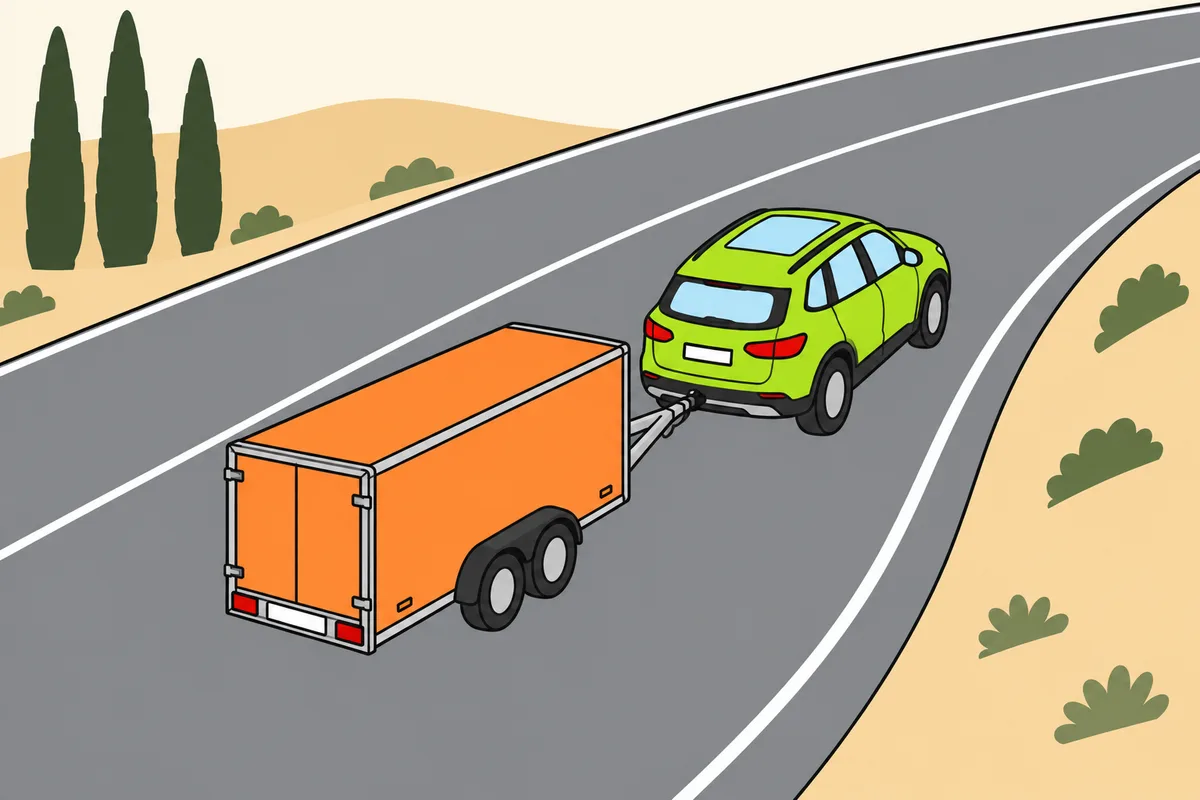
Technique with a trailer is based on coupling correctly, driving smoothly, opening up your lines more and understanding the reversal of movements when manoeuvring in reverse. In B+E it's not enough to know how to move the car: you must anticipate how the whole combination responds.
What you'll cover
Step 2. The syllabus
2.1Safe coupling
The hitch head or coupling system must be locked and secured before driving, with connections and auxiliary elements correctly fitted.
- Check the support, the safety cable or system, the lights, the trailer's brakes where fitted, and the closing of access points or tailgates before setting off.
- Without a correct prior check, no technique afterwards can make up for the risk created by a faulty coupling or connection.
- Do the check calmly and in order. The typical mistake is coupling up, getting into the vehicle and forgetting a detail visible from outside.
2.2Load control
The load must be distributed and secured so it doesn't shift when braking, turning or passing over irregularities in the road.
- Poor distribution changes stability, favours swaying and can lengthen the combination's response even if the hitch is correctly fitted.
- Before setting off, also check catches, tarpaulins, doors and any elements that could open. Losing the load affects you and other road users.
- In the exam, if an answer ignores the load and focuses only on the steering wheel, it's usually incomplete. The technique begins before you move.
2.3Smooth driving
Accelerate, brake and turn smoothly. Sudden changes favour swaying and greatly lengthen the distances the whole combination needs.
- The higher the speed, wind or gradient, the more caution and safety distance you must keep with the whole combination while driving.
- Avoid sudden steering corrections. The trailer responds with a delay and can amplify movements that would be minor in a solo car.
- When you notice oscillation, think about recovering stability, not about saving time. Reducing risk requires smoothness, margin and reading the road.
2.4Bends and turns
Open bends wider so as not to cut kerbs or hit obstacles with the trailer's wheels on tight, slow turns.
- The trailer doesn't follow exactly the same track as the tractor vehicle. In tight turns, roundabouts and narrow entrances you must allow more lateral space.
- Opening up your line doesn't mean occupying any lane without looking. Signal, observe and respect priority before widening the turn.
- Practise looking far ahead and checking your mirrors. Watching only the front of the car makes you forget where the trailer's wheels pass.
2.5Reversing
When reversing, the trailer reacts to the steering wheel in a way that's counter-intuitive at first for a learner; that's why a slow manoeuvre, small corrections and constant visual reference are needed.
- If you lose control of the line, stop, correct and start again; persisting with large turns usually worsens the combination's angle.
- Use mirrors and outside reference points without rushing. Reversing with a trailer rewards small, steady anticipation, not big turns once you're already jack-knifed.
- The exam may value knowing when to stop and reset the manoeuvre. Correcting in time is safer than forcing an angle that's closing in.
2.6Parking and stopping
When parking, remember the combination's total length and the trailer's path when entering or leaving the chosen space.
- Choose spaces where you can manoeuvre without unduly blocking traffic or mounting kerbs. Ease of exit is also part of the manoeuvre.
- Secure the combination when leaving it stationary. If the trailer has supports, catches or specific systems, check that they're correctly in place.
- Don't improvise parking on gradients, bends or areas with poor visibility. If the rule or the signalling prevents it, no technique can fix that.
2.7Practice for the exam
The B+E specific theory test asks about combination scenarios: coupling, load, stability, lighting, manoeuvres and response to oscillation of a loaded trailer.
- Study each technique with its reason. Opening bends avoids cutting the corner; going slowly in reverse allows you to correct; checking connections makes the trailer visible.
- Build cause-and-effect diagrams: abruptness produces swaying, a poor load reduces stability, missing lights hides manoeuvres, and a poor reference point ruins reversing.
- With 20 questions and a maximum of 2 errors, don't give away conceptual mistakes. Repeat the prior checks until they become a mental routine.
Step 3. Key points
If you only have a minute before the exam, revise this.
- 1.Lock and check the coupling before setting off.
- 2.Check lights, connections, brakes and the auxiliary safety system.
- 3.Distribute and secure the load before moving the combination.
- 4.Drive with smooth movements and open lines.
- 5.Increase distance with speed, wind, gradient or load.
- 6.Practise reversing with small corrections.
- 7.Stop and restart the manoeuvre if you lose your line.
Step 4. Exam traps
Mistakes the DGT uses again and again on this topic.
- Assuming a sudden manoeuvre will fix a poor trailer line.
- Forgetting lights, connections or the coupling's safety in the prior check.
- Opening up a bend without observing or signalling because the trailer needs space.
- Believing reversing is corrected with big, fast turns.
- Ignoring the load when explaining swaying or lack of stability.
- Parking while thinking only about the tractor vehicle and not the total length.
Step 5. Quick check
Four real exam questions on what you have just read.
On a long downhill stretch with a trailer combination, it is advisable to:
Step 6. Frequently asked questions about trailer techniques
- With a side wind, if you are driving a trailer combination, you must:
- Hold firmly and reduce speed. Hold the steering firmly and reduce speed, avoiding abrupt movements. Side winds can destabilise a long or tall combination and increase trailer movement. Do not accelerate to cross the area sooner or release a hand to try to balance it. Take particular care with gusts, exposed sections and changes in wind shelter.See full question
- On a long downhill section with a trailer, the correct action is to:
- Control speed and use a suitable gear. On long descents you should anticipate, control speed, and use a suitable gear to avoid overloading the brakes.See full question
- On a long downhill stretch with a B+E combination, it is advisable to:
- Control speed with a suitable gear. On long descents you should control speed with a suitable gear and avoid overloading the brakes.See full question
- With a B+E combination, when approaching congestion it is advisable to leave more margin because:
- The distance needed to stop the combination is usually greater. The trailer means the combination needs more space and anticipation to stop safely.See full question
- When overtaking with a B+E combination, you should remember that:
- It needs more space and time to complete the maneuver. A trailer combination usually needs more length and more time to complete an overtaking maneuver safely.See full question
Official sources
Test what you've studied on trailer techniques
Exam-style questions on this topic, with an explanation after every answer.
Now, practise it
Test what you have read with exam-style questions and an explanation after each answer.
Related lessons
- B+ESafety devices
The combination's safety devices prevent uncoupling, improve visibility and allow the trailer to keep its stability and braking capacity within the law. In B+E you must check them before driving and understand exactly what failure each one prevents.
- B+EMechanics and maintenance
Preventive maintenance of towing-vehicle-and-trailer combinations is part of road safety: it avoids breakdowns, reduces braking distance, improves stability and cuts down on errors in the exam and in real driving. In B+E you must check both the car and the trailer.
- B+ERegulations for combinations
In B+E you must study authorised masses, coupling, load distribution, the stability of the combination and specific signalling for driving with a trailer or semi-trailer within the framework allowed by this class. The key is always to think of the towing vehicle and trailer as a single unit that is longer, heavier and slower to react.
- B+ESigns
Master the hierarchy between officers, circumstantial signalling, traffic lights, vertical signs and road markings, and study the current official catalogue paying attention to how combinations with a trailer behave. In B+E you must read every sign thinking about mass, length, lane, stability and the section affected.