Step 1. The big picture
In one sentence…
Road safety combines prevention, occupant protection and the correct reaction to an emergency. The theory exam usually mixes active safety, passive safety and the PAS response within the same question, so always study cause, consequence and safe conduct together.
Step 2. The syllabus
2.1Active safety
Active safety helps to avoid the accident: brakes, steering, tyres, suspension, lighting and electronic aids all work before the impact.
- These elements only work well if the driver maintains the vehicle and adapts their driving. A poor tyre or badly used light reduces your margin before danger strikes.
- In the exam, a question may mention rain, a bend or braking to check whether you know active safety also depends on grip and anticipation.
- Don't confuse electronic aids with permission to take risks. Their role is to support, not to compensate for inadequate speed or insufficient distance.
2.2Passive safety
Passive safety reduces injuries once the accident can no longer be avoided: seatbelt, headrest, airbags, the vehicle's structure and child restraint systems.
- A badly adjusted headrest or a loose seatbelt can turn an apparently minor rear-end collision into a serious injury for any occupant.
- The airbag does not replace the seatbelt. In questions about occupants, the correct answer usually requires both systems to work together.
- Passive protection starts before you set off: seat, backrest, headrest, seatbelts and loose objects must all be under control so as not to increase harm.
2.3Seatbelt and posture
The seatbelt must be used whenever the vehicle is fitted with one, and it must be well adjusted, without slack or twists.
- Correct posture lets you control the pedals, steering wheel, mirrors and controls without stretching. It also helps the seatbelt, headrest and airbag protect you as they should.
- Don't fit clips, cushions or thick clothing that leave dangerous slack. In an impact, these details change how effective the system really is.
- In tests, be wary of answers that accept wearing the seatbelt any old way for short trips, low speed or rear seats.
2.4Child restraint systems
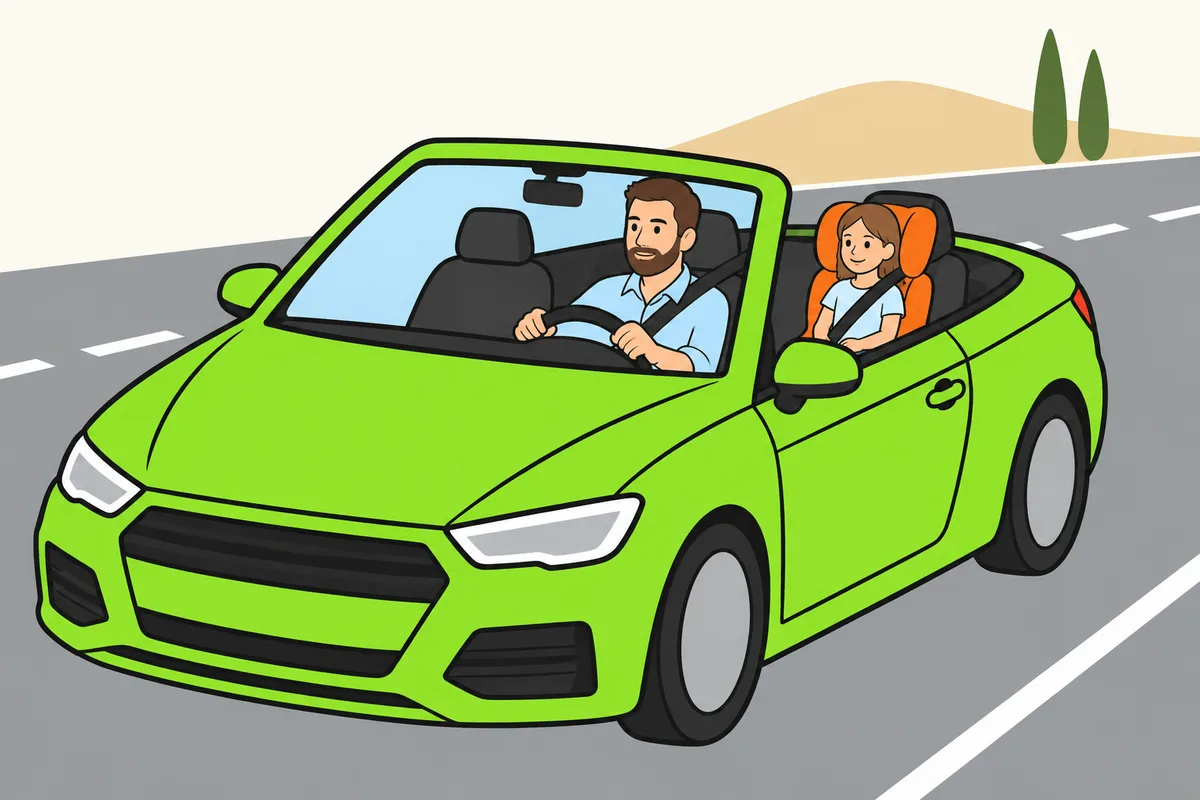
Minors must travel in the child restraint system suited to their height, weight and type approval, following the seating positions and conditions set out in law.
- The driver must make sure the system is installed and used correctly. It's not enough for the minor to be sitting in just any device.
- The question may not ask for a figure: it may ask for the principle. A minor travels protected when the system matches their characteristics and is fitted correctly.
- If in doubt between comfort and safety, choose safety. The rule aims to reduce injuries even if the trip is short or the minor complains.
2.5The PAS response
The safe sequence follows the PAS principle: protect the area, alert the emergency services and assist without worsening injuries or creating another danger.
- Protecting means preventing further collisions before helping. Park safely, make yourself visible and assess the traffic so you don't become another victim.
- Alerting requires clearly conveying where you are and what has happened. Don't improvise rescue manoeuvres that could worsen injuries unless they are essential.
- Assisting doesn't always mean moving the injured person. In the exam, the cautious answer is usually to stay with them, avoid additional risks and wait for qualified help when appropriate.
2.6Breakdown and immobilisation
Since 1 January 2026, the connected V16 light is the official reference for pre-signalling an immobilised vehicle for those vehicles required to carry the device.
- Before helping, avoid becoming a new victim: park safely, use visibility items and don't step onto the carriageway without controlling the risk.
- In a breakdown, the priority is not to get the vehicle moving quickly again, but to reduce your own exposure and that of other road users.
- Questions often pit haste against safety. Always choose the orderly response: protect first, alert next, and only assist if you don't worsen the danger.
2.7Exam preparation
Classify each element as active or passive and say what risk it reduces. This method stops you learning lists without understanding why they appear together in a question.
- Practise cases: rear-end collision, rollover, rain, a night-time breakdown and a child occupant. In each one, decide which system prevents and which protects.
- The B theory test is 30 questions with a maximum of 3 errors in 30 minutes. It pays to master these topics because they tend to appear with very everyday scenarios.
- When an answer plays down a measure because the trip is short, it's usually suspect. Road safety applies whenever you're driving.
Step 3. Key points
If you only have a minute before the exam, revise this.
- 1.Tell active and passive safety apart with real examples.
- 2.Adjust the seat, seatbelt and headrest before setting off.
- 3.Use the seatbelt, airbag and child restraint systems correctly.
- 4.Apply PAS without putting yourself in danger or worsening injuries.
- 5.Know the official reference for the connected V16 light in 2026.
- 6.Link basic maintenance to the effectiveness of brakes, lights and tyres.
- 7.Be wary of answers that justify skipping measures on short trips.
Step 4. Exam traps
Mistakes the DGT uses again and again on this topic.
- Thinking that wearing the seatbelt any old way is enough.
- Confusing an active safety element with a passive one.
- Getting out of the vehicle without assessing the road's risk during a breakdown or accident.
- Believing the airbag replaces the seatbelt.
- Moving an injured person unnecessarily and without assessing whether you might worsen their injuries.
- Forgetting that the connected V16 is the official reference from 1 January 2026.
Step 5. Quick check
Four real exam questions on what you have just read.
When distracted, the driver takes...
Step 6. Frequently asked questions about road safety
- Which of these is NOT a lighting device on the vehicle?
- Rear demisting light. A 'rear demisting light' does not exist among a vehicle's lighting devices — it should not be confused with the rear fog lamp, which is a genuine lighting device. That is why it is not one of the vehicle's lighting devices.See full question
- A row of fixed or flashing amber lights…
- Prohibits passage through the imaginary line connecting them. If we find a row of fixed or flashing amber lights on the road we are travelling on, placed as a barrier device, their function is to prohibit the passage of all types of vehicle through the imaginary line connecting them. This means that wherever we find these amber lights, passage is prohibited across the entire width they cover.See full question
- A breakdown in a tunnel requires the vehicle to stop, and an accessible emergency area is nearby in the direction of travel. If it can be reached safely, where should the vehicle be immobilised?
- In that emergency area, if it can be reached safely. Use the nearby designated emergency area in the direction of travel. If the breakdown allows safe continuation to the exit, continue to it; if an emergency area cannot be reached, move close to the right edge. Once immobilised, switch off the engine, activate hazard warning lights and retain position lights. Request assistance and follow instructions; do not improvise a tow with another driver.See full question
- To avoid excessive and unnecessary noise, the driver of a motorcycle must…
- avoid sudden accelerations. Avoid strong, unnecessary acceleration and keep the exhaust and silencer in good condition. An open exhaust is prohibited. Choose a gear suited to speed and conditions without unnecessarily high engine revs; always using the lowest gear increases noise and is not a correct rule.See full question
- A passenger car travels at night. Must its rear registration plate be illuminated?
- Yes, on all types of roads. Yes, on urban and interurban roads. Its required lamp makes the rear plate readable and must operate with the relevant lighting. This concerns a passenger car: the same requirement must not be extended without checking each vehicle category and its prescribed equipment. Repair a failed lamp; other lights do not replace plate illumination.See full question
Official sources
Test what you've studied on road safety
Exam-style questions on this topic, with an explanation after every answer.
Now, practise it
Test what you have read with exam-style questions and an explanation after each answer.
Related lessons
- BRisk factors
Risk factors are studied as a real cause of error: alcohol, drugs, speed, distraction, fatigue, adverse weather and overconfidence. In passenger cars on roads open to general traffic their effects tend to multiply, which is why the exam insists on anticipating and correcting before you lose control.
- BDriving and the environment
Efficient, environmentally sound driving reduces fuel consumption, emissions, wear and risk. The DGT studies it as a way of driving better, not just as a financial saving, and it must always be compatible with safety and the rules in force.
- BTraffic rules
Core topic for licence B: general rules of circulation, priority, speed, road position, manoeuvres, essential documentation and the punishable conduct most often asked about in the exam. Study it as practical decisions: who goes first, where you position yourself, when you must give way and how you reduce risk.
- BSigns
Master the hierarchy between officers, temporary signage, traffic lights, vertical signs and road markings. In the exam you must recognise which order prevails, what conduct each sign requires, and when a temporary indication changes what you would normally expect to see on the road.
- BVulnerable road users
Licence B requires you to drive with preventive priority towards pedestrians, cyclists, motorcyclists and road users with less physical protection. A small driver error can have serious consequences, so the exam values anticipation, distance, moderate speed and reading the surroundings.