Step 1. The big picture
In one sentence…
Licence B requires you to drive with preventive priority towards pedestrians, cyclists, motorcyclists and road users with less physical protection. A small driver error can have serious consequences, so the exam values anticipation, distance, moderate speed and reading the surroundings.
Step 2. The syllabus
2.1Who is vulnerable
Vulnerable road users are those with less physical protection against an impact: pedestrians, cyclists, motorcyclists, users of personal mobility vehicles and people with reduced mobility.
- Vulnerability doesn't depend on whether they have priority at that moment. It depends on the fact that an error or impact can cause them much greater harm.
- The exam often asks about these road users in urban scenes, crossings, turns, overtaking manoeuvres and doors of parked vehicles, because these combine little margin for error.
- Your goal as a driver is to anticipate conflicts before they appear. Reducing speed and increasing vigilance isn't courtesy, it's preventive driving.
2.2Pedestrians and designated crossings
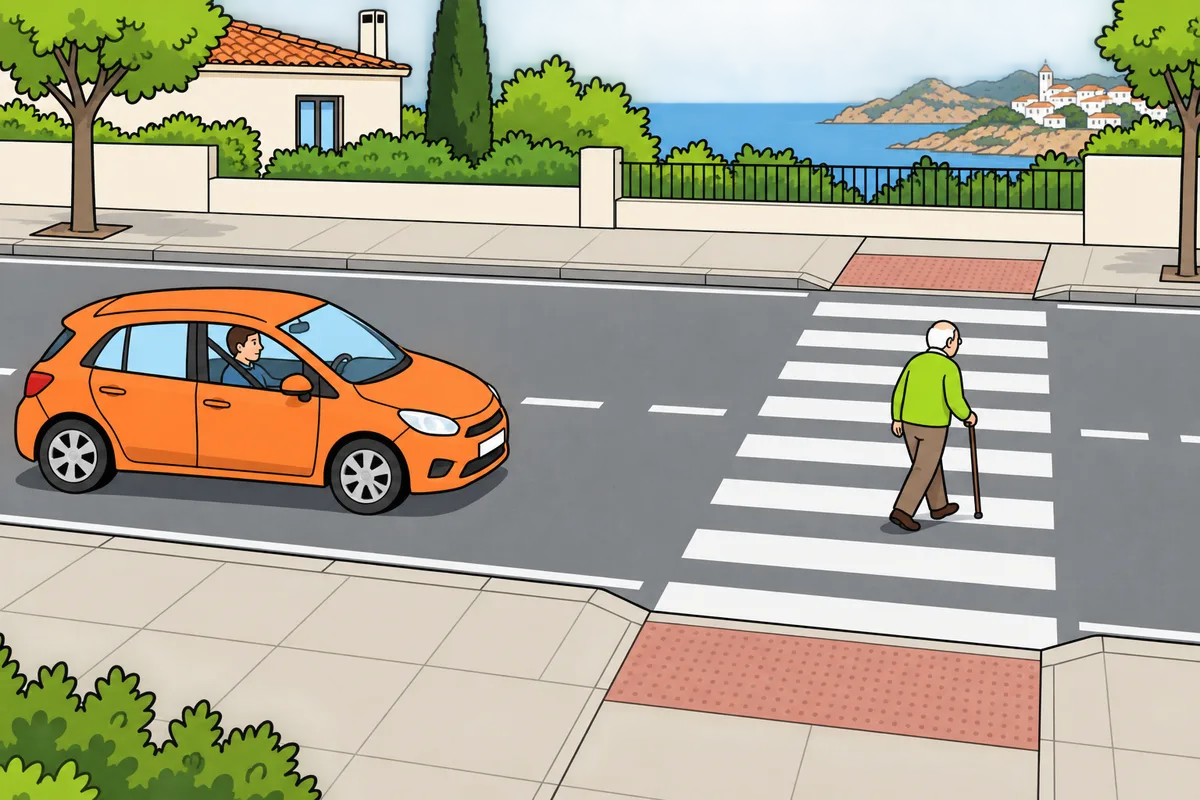
The driver must take extra care when approaching children, older people, blind people or people with mobility problems, even when they have priority.
- At pedestrian crossings, pavements, transport stops and areas with reduced visibility, you must adapt your speed and be ready to stop.
- A pedestrian doesn't stop being vulnerable because they make a mistake; your duty as a driver is to anticipate and avoid the harm.
- When a vehicle partly blocks your view of a crossing or pavement, slow down before you can see the pedestrian. Reduced visibility is already a sign of risk.
2.3Cyclists and mopeds
When overtaking bicycles or mopeds, you must leave enough lateral separation and reduce speed if circumstances require it, so as not to intimidate them.
- On roads with several lanes per direction, overtaking cycles or mopeds must be done by fully or partly occupying the adjoining lane when necessary to guarantee safety.
- Don't overtake if you can't maintain margin, visibility and control. Being in a hurry doesn't justify passing close to or intimidating someone with less stability.
- At turns, junctions and roundabouts, check mirrors and blind spots. A cyclist can be on a path you don't see if you only look straight ahead.
2.4Motorcyclists and blind spots
Motorcyclists are more visible than a bicycle in some situations, but they still have little physical protection against an impact.
- Before changing lane, opening a door or turning, check your mirrors and blind spot. The so-called dooring effect is a typical cause of collisions.
- Don't invade a motorcycle's lateral space in tailbacks or narrow lanes. Keeping a predictable course avoids scares and defensive manoeuvres.
- In the exam, a small motorcycle in the mirror can be the key to the answer. Don't treat the image as if it only contained cars.
2.5Personal mobility vehicles and urban coexistence
Personal mobility vehicles don't follow exactly the same rules as a car, but they remain vulnerable road users and may be subject to additional local bylaws.
- In urban settings, you must anticipate unexpected crossings, changes of direction and mixed traffic in low-speed zones or areas near schools.
- The best defence is to read your surroundings before a conflict appears: school zones, delivery riders, cycle lanes, shared crossings and parked vehicles.
- If a local bylaw or sign regulates a shared space, you must respect it. If you don't know the detail, apply caution and don't invent permissions.
2.6Doors, stops and obstacles
Never open a door without checking your mirrors and blind spot; the so-called dooring effect is a typical cause of collisions with cyclists and motorcyclists.
- Near stops, schools, bins or tall vehicles, expect hidden movements. The risk doesn't start when you see the road user, but when they might appear.
- When parking or setting off, signal, look and move slowly. A vulnerable road user may occupy a space you thought was clear seconds earlier.
- The DGT uses these scenes a lot because they seem simple. The decisive detail is usually who could be hidden or suffer more harm.
2.7Preventive priority
Having priority does not authorise you to maintain your speed if the other road user could enter into conflict. The duty to avoid harm still applies.
- Reducing speed, leaving space and signalling your manoeuvres also protects whoever makes a mistake. Defensive driving does not mean giving up the rules.
- At crossings, cycle lanes, turns and overtaking manoeuvres, combine the rule with technical empathy: imagine the vulnerable road user hasn't seen you.
- Practise questions by first looking for the most fragile road user. That approach makes clear when you must give way, wait, keep your distance or take extra care before moving on.
Step 3. Key points
If you only have a minute before the exam, revise this.
- 1.Reduce speed at crossings, near schools and in complex urban areas.
- 2.Overtake cycles and mopeds with enough lateral separation.
- 3.Check mirrors and blind spot before opening doors or turning.
- 4.Anticipate pedestrians hidden by vehicles, stops or obstacles.
- 5.Respect signs and local bylaws applicable to personal mobility vehicles.
- 6.Don't confuse formal priority with permission to create risk.
- 7.Read the scene looking for the road user with the least physical protection.
Step 4. Exam traps
Mistakes the DGT uses again and again on this topic.
- Believing the vehicle's priority removes the duty of caution towards pedestrians or cyclists.
- Forgetting that the other road user's vulnerability requires extra anticipation even when the manoeuvre is allowed.
- Overtaking a bicycle without margin because there's no oncoming traffic.
- Opening the door while looking only forward and not at the blind spot.
- Treating personal mobility vehicles like cars or ignoring possible local bylaws.
- Not slowing down at a partly hidden crossing until you see the pedestrian.
Step 5. Quick check
Four real exam questions on what you have just read.
Pedestrians have priority…
Step 6. Frequently asked questions about vulnerable road users
- In addition to other required warning devices, which of the vehicle’s own lights should you switch on, if fitted, to warn of a breakdown stop on a motorway?
- Hazard warning lights. The hazard warning lights: the direction indicators flashing together. A single indicator or the end-outline marker lamps alone are insufficient. Article 130 also requires the prescribed danger-warning device and, when appropriate, position and end-outline marker lights. A Spanish-registered passenger car uses the current certified connected V-16; place the warning without exposing yourself to traffic and follow the rules for safely remaining in or leaving the vehicle.See full question
- What colour are the reverse lights?
- White. Reversing lamps emit white light. They illuminate the road behind the vehicle and warn that it is about to reverse or is reversing.See full question
- You are forced to transport an injured person in your car. Must you comply with the rules of the road?
- Yes, and ensure that you do not endanger other road users. Even if you are forced to transport an injured person in your car, you must comply with all the rules of the road and ensure that you do not endanger other road users. The regulations establish that, even in particularly serious circumstances, drivers of non-priority vehicles must comply with traffic rules to guarantee the safety of everyone on the road. If necessary, the driver can alert other road users to their presence and situation by using the horn intermittently, switching on the hazard warning lights, or flashing the headlights. These methods are useful for alerting other drivers to the emergency, but they do not exempt the driver from following traffic rules.See full question
- Are novice drivers more likely to be affected by fatigue?
- Yes, because they need more concentration when driving. Yes, they may tire more easily because many processes are not yet automatic and require more concentration. This does not mean every novice is always more tired: rest, journey duration and driving conditions also matter.See full question
- Before making a U-turn, what should you check when choosing the location?
- That it is permitted and can be done without danger or obstruction. That the manoeuvre is permitted and can be performed without endangering or obstructing others, occupying the road for the shortest possible time. Article 78 requires a suitable location, advance signalling and a safety check. Looking for pedestrians and other vehicles is part of that check, not an action to disregard. If those conditions cannot be met, wait or find another lawful location.See full question
Official sources
Test what you've studied on vulnerable road users
Exam-style questions on this topic, with an explanation after every answer.
Now, practise it
Test what you have read with exam-style questions and an explanation after each answer.
Related lessons
- LCMVulnerable road users
In LCM two realities coincide: the driver themselves is very vulnerable, and they also share the road with pedestrians and other vulnerable users who require extra care. The exam wants you to understand that formal priority does not remove the risk and that visibility is everyone's responsibility.
- BRisk factors
Risk factors are studied as a real cause of error: alcohol, drugs, speed, distraction, fatigue, adverse weather and overconfidence. In passenger cars on roads open to general traffic their effects tend to multiply, which is why the exam insists on anticipating and correcting before you lose control.
- BDriving and the environment
Efficient, environmentally sound driving reduces fuel consumption, emissions, wear and risk. The DGT studies it as a way of driving better, not just as a financial saving, and it must always be compatible with safety and the rules in force.
- BTraffic rules
Core topic for licence B: general rules of circulation, priority, speed, road position, manoeuvres, essential documentation and the punishable conduct most often asked about in the exam. Study it as practical decisions: who goes first, where you position yourself, when you must give way and how you reduce risk.
- BRoad safety
Road safety combines prevention, occupant protection and the correct reaction to an emergency. The theory exam usually mixes active safety, passive safety and the PAS response within the same question, so always study cause, consequence and safe conduct together.
- BSigns
Master the hierarchy between officers, temporary signage, traffic lights, vertical signs and road markings. In the exam you must recognise which order prevails, what conduct each sign requires, and when a temporary indication changes what you would normally expect to see on the road.