Step 1. The big picture
In one sentence…
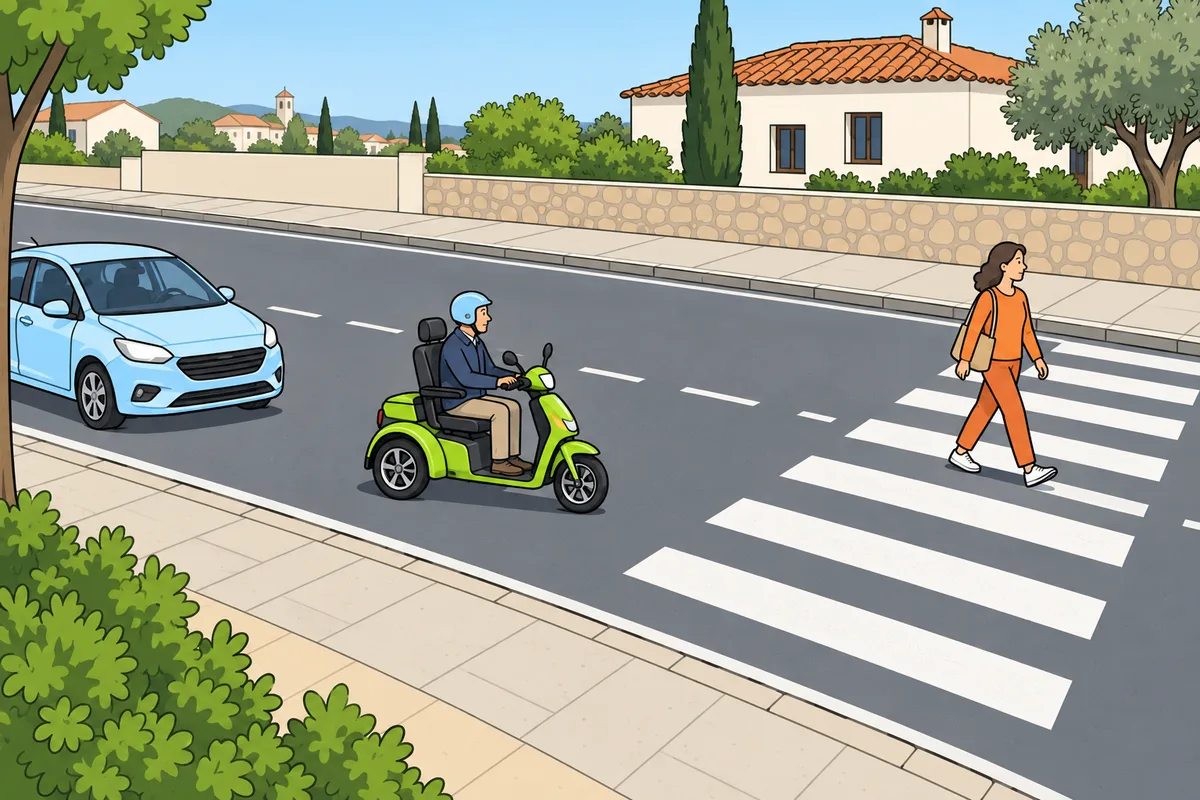
In LCM two realities coincide: the driver themselves is very vulnerable, and they also share the road with pedestrians and other vulnerable users who require extra care. The exam wants you to understand that formal priority does not remove the risk and that visibility is everyone's responsibility.
Step 2. The syllabus
2.1Coexisting with pedestrians
Being close to pedestrians requires you to slow down a great deal and avoid sudden paths that do not give them time to react.
- In areas with high pedestrian density, the preventive priority is to avoid the conflict before it can happen.
- Pedestrians can change direction unexpectedly, especially children and older people, so leave a wide margin.
- Driving slowly near pedestrians lets you stop in time and shows prudent, predictable driving.
2.2Relationship with motor vehicles
You must anticipate that other vehicles may notice your presence late or misjudge your speed because you are in a slow vehicle.
- Visibility and prudent positioning on the road are key to avoiding being hidden or trapped between larger vehicles.
- Do not rely on others adjusting their driving to you: keep your safety margin as if they might not have seen you.
- Make it easy for faster vehicles to overtake you safely rather than contesting space with them.
2.3Shared vulnerability
Being a vulnerable road user does not exempt you from following the rules, but it does require other drivers to take extra care around you.
- The best defence is to drive visibly, predictably and without being unnecessarily exposed in conflict zones.
- Understanding that both you and pedestrians are vulnerable helps you keep consistent care at all times.
- Extra care is not just a legal duty; it is the most effective way to reduce your own risk.
2.4Formal priority versus real risk
Having priority does not mean being safe: the real risk only disappears once you check that the other person has seen you and is going to respect it.
- Before exercising a priority, make sure the person who should give way to you is actually doing so.
- Many incidents happen because of relying on formal priority without checking the other road user's conduct.
- When in doubt, it is better to give way and avoid the conflict than to claim a priority that does not guarantee safety.
2.5Visibility as an active responsibility
Your own visibility remains an active responsibility of the driver, not something that depends only on others.
- Check the lights and reflective elements so other road users detect you as early as possible.
- Position yourself where you can be seen and avoid staying in the blind spot of larger vehicles.
- In poor light or bad weather, reinforce as much as possible anything that helps others see you.
2.6Conflict zones and situations
Pay extra attention at pedestrian crossings, junctions, garage exits and school areas, where vulnerable road users tend to gather.
- In these areas, reduce your speed and increase your observation so you can stop for any unexpected movement.
- Anticipate that a pedestrian hidden behind a parked vehicle may suddenly appear in your path.
- Leaving a conflict zone without rushing and with margin is always safer than forcing your way through.
2.7Predictable conduct
Driving predictably lets pedestrians and drivers anticipate your movements and adjust their own in time.
- Avoid sudden changes of direction or speed that could surprise those sharing the road with you.
- Signal your manoeuvres in advance and keep a consistent position within the available space.
- Predictability, combined with visibility, is the combination that best protects a vulnerable road user.
Step 3. Key points
If you only have a minute before the exam, revise this.
- 1.Reduce speed when coexisting with pedestrians.
- 2.Leave a wide margin for pedestrians who may change direction.
- 3.Increase visibility in relation to faster vehicles.
- 4.Check that the other person has seen you before exercising a priority.
- 5.Take extra care at junctions, crossings and school areas.
- 6.Drive visibly and predictably at all times.
- 7.Take on extra care because of both your own and others' vulnerability.
Step 4. Exam traps
Mistakes the DGT uses again and again on this topic.
- Thinking formal priority is enough to remove the real risk.
- Forgetting that your own visibility remains an active responsibility of the driver.
- Trusting that pedestrians will always keep a predictable path.
- Believing other drivers correctly judge your speed and will give way to you.
- Reducing observation in areas with high pedestrian density.
Step 5. Quick check
Four real exam questions on what you have just read.
When driving a mobility-impaired-person vehicle authorised by LCM near pedestrians, you should...
Step 6. Frequently asked questions about vulnerable road users
- With a vehicle for persons with reduced mobility, in areas with pedestrians you must act:
- With maximum caution and adapted speed. In pedestrian environments you must use extreme caution and adapt speed so as not to endanger other vulnerable users.See full question
- With a vehicle for persons with reduced mobility, when traveling through areas with pedestrians you must:
- Reduce speed and pay extra attention. In areas with pedestrians, the driver must take extra care and clearly adapt speed to avoid risks to vulnerable road users.See full question
- In shared areas with pedestrians, an LCM holder must:
- Take extra care and adapt speed. In areas with pedestrians you must take extra care and adapt your movement to the surroundings.See full question
- On a road where your vehicle for persons with reduced mobility is legally allowed, you encounter nearby pedestrians. How should you drive?
- With special caution and adapted speed. With extra caution and speed adapted to their presence, so you can react and respect their priority where applicable. LCM is the licence authorising this type of vehicle, not the vehicle’s name. This precaution does not authorise entering any pavement or pedestrian-only area.See full question
Official sources
Test what you've studied on vulnerable road users
Exam-style questions on this topic, with an explanation after every answer.
Now, practise it
Test what you have read with exam-style questions and an explanation after each answer.
Related lessons
- BVulnerable road users
Licence B requires you to drive with preventive priority towards pedestrians, cyclists, motorcyclists and road users with less physical protection. A small driver error can have serious consequences, so the exam values anticipation, distance, moderate speed and reading the surroundings.
- LCMRules and road signs
The LCM licence relies on general rules and signs applied to vehicles for people with reduced mobility: priority, position on the road and correct reading of signs. The exam tests your ability to apply that order of priority to a slow and especially vulnerable vehicle.
- LCMDriver safety
In LCM, driver safety depends on visibility, stability, adapted speed and prudent reading of the surroundings, because it is an especially exposed vehicle. The exam insists that low speed does not remove the risk and that being seen is an active responsibility.
- LCMVehicle and manoeuvres
The vehicle and manoeuvres topic in LCM requires knowing the basic controls, stability control, correctly occupying space and manoeuvring at low speed with full safety. The exam tests your ability to check beforehand, observe fully and use the available space prudently.