Step 1. The big picture
In one sentence…
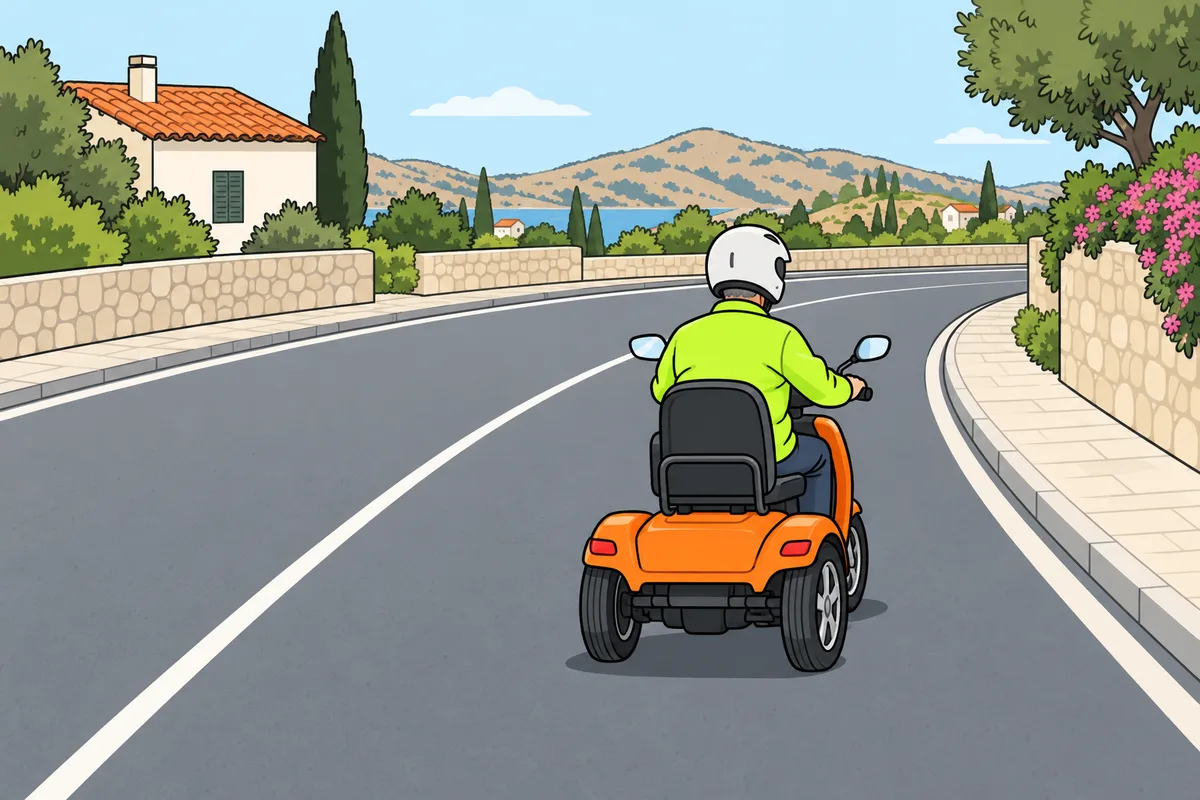
In LCM, driver safety depends on visibility, stability, adapted speed and prudent reading of the surroundings, because it is an especially exposed vehicle. The exam insists that low speed does not remove the risk and that being seen is an active responsibility.
Step 2. The syllabus
2.1Driver and surroundings
You must drive with maximum attention to pedestrians, kerbs, gradients, an uneven road surface and the proximity of vehicles faster than yours.
- The rule requires you to take extra care and not occupy more space than necessary when the road does not have a part specifically set aside for you.
- Observe the surroundings constantly to anticipate obstacles and changes in the road surface before having to react to them.
- Treating every trip as a journey that requires full attention reduces the carelessness that causes most scares.
2.2Visibility and being seen
Being seen is part of safety: check the lights, reflectors and any element that improves your detection by other road users.
- In a slow vehicle, other users perceiving you in good time stops them misjudging your speed and getting too close.
- In poor light or bad weather, reinforce as much as possible everything that helps others see you well in advance.
- Your own visibility is not optional: it is an active responsibility of the driver on every trip.
2.3Adapted speed and real risk
A modest speed does not remove the risk: a collision with larger vehicles is still very harmful because of the difference in mass.
- Adapt your speed to the road surface, the gradient and the presence of pedestrians, without assuming that going slowly already makes you safe.
- Keeping a prudent speed gives you time to observe, decide and stop within the space you can see is clear.
- The risk does not depend only on your speed, but also on the speed of those around you and on how little visible you are.
2.4Physical and mental condition
Fatigue, medication or distraction also have an effect on short trips, even though the journey seems simple and familiar.
- Do not underestimate tiredness because the trip is short: a few seconds of distraction is enough to cause an incident.
- Check whether any medication you take can reduce your reflexes, your vision or your attention before driving.
- Driving requires full physical and mental fitness whatever the distance you are going to travel.
2.5Safe manoeuvring
Safe manoeuvring in LCM requires anticipation and avoiding improvised turns or changes of trajectory that surprise others.
- Signal your intentions in advance and check your surroundings before changing direction or position on the road.
- Carry out manoeuvres at a speed that lets you correct smoothly if something unexpected happens.
- Planning the manoeuvre before starting it avoids abruptness, which is a clear source of risk in an exposed vehicle.
2.6Coexisting with traffic
Anticipate that other drivers may notice your presence late or underestimate how slowly you are travelling.
- Position yourself prudently so you do not end up hidden or trapped between bigger, faster vehicles.
- Let faster traffic overtake you safely rather than contesting space that is not yours.
- Driving predictably helps other road users know what you are going to do and adjust their own driving.
2.7Care on short trips
The confidence of a familiar route must not lower your attention: most LCM trips are short and routine.
- Keep the same routine of checking and care on both a long journey and one of just a few minutes.
- Overconfidence is an added risk because it lowers your guard exactly where you think nothing can happen.
- Treating every trip with the same seriousness keeps your safety margin stable over time.
Step 3. Key points
If you only have a minute before the exam, revise this.
- 1.Drive with maximum care and full attention to your surroundings.
- 2.Check the lights and reflectors to be seen in good time.
- 3.Adjust speed to the surroundings and to how vulnerable the vehicle is.
- 4.Do not underestimate fatigue, medication or distraction on short trips.
- 5.Anticipate and signal every manoeuvre without abruptness.
- 6.Position yourself so you are not hidden among larger vehicles.
- 7.Keep up your care on familiar routes too.
Step 4. Exam traps
Mistakes the DGT uses again and again on this topic.
- Believing that because it is a slow vehicle the risk is always small.
- Forgetting the need to be seen and predictable.
- Assuming a short trip does not require full physical fitness.
- Making improvised turns or changes of trajectory without warning.
- Assuming other drivers correctly judge your speed.
Step 5. Quick check
Four real exam questions on what you have just read.
In rain, when driving a vehicle for persons with reduced mobility, it is advisable to:
Step 6. Frequently asked questions about driver safety
- Handling a mobile phone while driving a vehicle for persons with reduced mobility:
- It is prohibited and increases distraction. Handling a phone manually while driving is prohibited and distracts from the road and vehicle control. This also applies to a vehicle for people with reduced mobility, even in slow traffic. To use it manually, stop and park somewhere lawful and safe; do not do so during a temporary traffic stop.See full question
- To drive a vehicle for people with reduced mobility, must a holder of a valid category B licence additionally obtain an LCM licence?
- No, a valid B licence authorises it, subject to its restrictions. No. Article 6.1.a does not require an LCM licence for a holder of a valid A1 or B licence. A2 and A include A1 through category grants; Article 4 also authorises these vehicles with AM. A valid B holder does not need an additional LCM licence and must observe any licence adaptations or restrictions.See full question
- The general minimum age to obtain an LCM licence is:
- 14 years. As a general rule, the licence for vehicles for people with reduced mobility may be obtained from 14 years of age.See full question
- The general minimum age to obtain the LCM licence is:
- 14 years. The licence for vehicles for persons with reduced mobility may generally be obtained from age 14.See full question
- In congestion, with a vehicle for persons with reduced mobility, keeping space from the vehicle ahead helps to:
- Have room to react and maneuver. In traffic jams it is still important to leave space to react and maneuver safely.See full question
Official sources
- BOE - Law on Traffic, Motor Vehicle Circulation and Road Safety (Ley sobre Tráfico, Circulación de Vehículos a Motor y Seguridad Vial, RDL 6/2015)
- BOE - General Traffic Regulations (Reglamento General de Circulación, RD 1428/2003)
- BOE - General Drivers Regulations (Reglamento General de Conductores, RD 818/2009)
Test what you've studied on driver safety
Exam-style questions on this topic, with an explanation after every answer.
Now, practise it
Test what you have read with exam-style questions and an explanation after each answer.
Related lessons
- LVADriver safety
The agricultural vehicle driver must manage width, visibility, moderate speed and coexistence with faster traffic, without losing control of the implement or combination. The exam insists that low speed does not reduce the need to be seen and to take extra care when joining traffic and turning.
- LCMRules and road signs
The LCM licence relies on general rules and signs applied to vehicles for people with reduced mobility: priority, position on the road and correct reading of signs. The exam tests your ability to apply that order of priority to a slow and especially vulnerable vehicle.
- LCMVulnerable road users
In LCM two realities coincide: the driver themselves is very vulnerable, and they also share the road with pedestrians and other vulnerable users who require extra care. The exam wants you to understand that formal priority does not remove the risk and that visibility is everyone's responsibility.
- LCMVehicle and manoeuvres
The vehicle and manoeuvres topic in LCM requires knowing the basic controls, stability control, correctly occupying space and manoeuvring at low speed with full safety. The exam tests your ability to check beforehand, observe fully and use the available space prudently.