Step 1. The big picture
In one sentence…
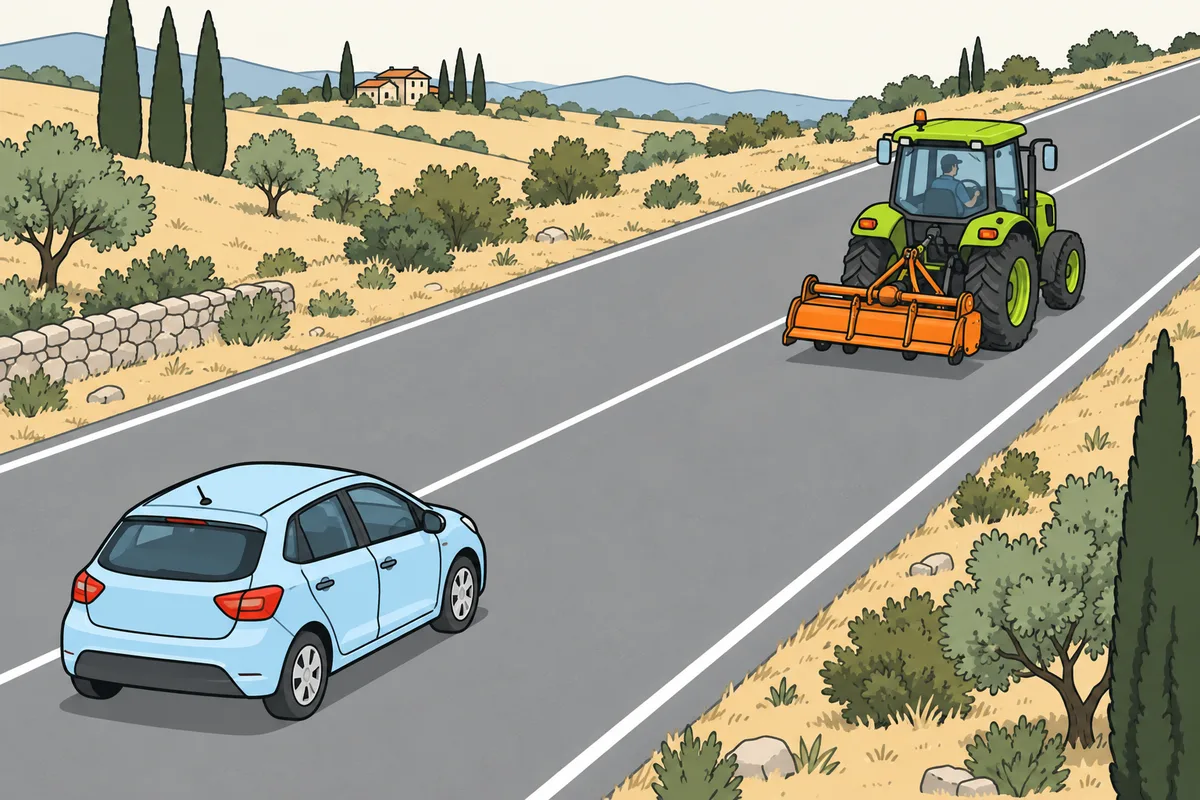
The agricultural vehicle driver must manage width, visibility, moderate speed and coexistence with faster traffic, without losing control of the implement or combination. The exam insists that low speed does not reduce the need to be seen and to take extra care when joining traffic and turning.
Step 2. The syllabus
2.1Risks of the agricultural vehicle
Lower speed and greater relative bulk increase the risk of being hit from behind and of other drivers misjudging your presence.
- Implements and protruding parts require you to assess the usable width, the turning radius and stability before entering the public road.
- An agricultural combination responds and turns differently from a car, so you must know its limitations before driving.
- Recognising these particular risks is the first step towards driving defensively and prudently.
2.2Visibility and being detected
It is essential to check the lights, reflective elements and the cleanliness of the devices so you are detected in good time.
- A slow vehicle must be very visible so that fast traffic correctly judges the speed difference and prepares for it.
- Mud or dirt can cover lights and reflectors, so clean them before going out onto the public road.
- In poor light or fog, reinforce as much as possible anything that helps others see you as early as possible.
2.3Care when joining traffic and turning
Extra care is needed when joining traffic, changing direction, turning onto a farm, and driving at night or in mud.
- Joining points are critical because they connect a slow, wide vehicle to much faster traffic.
- Anticipate the combination's wide turns so as not to enter the opposite lane or surprise the vehicle behind you.
- Signal in advance and check that others have seen you before starting the manoeuvre.
2.4Width and turning radius
The agricultural vehicle takes up more functional width than it appears to, so leave enough margin at crossings and narrow points.
- The combination's turning radius is wide; plan the turn in good time and from a position that lets you complete it.
- Assess the width of the road and the presence of side obstacles before committing to a manoeuvre.
- Recognising your real size avoids getting trapped or having to correct halfway through a junction.
2.5Coexisting with fast traffic
Make it easy for faster vehicles to overtake you safely when the road allows it, rather than contesting space with them.
- Occupy only the part of the carriageway necessary so as not to obstruct the rest of the traffic more than unavoidable.
- Anticipate that other drivers may become impatient and overtake dangerously, and leave margin for that.
- Driving predictably helps fast traffic adjust its driving to your speed.
2.6The driver's condition
Fatigue from farm work must not carry over into driving; even a short trip requires full attention.
- Do not rely on familiarity with the route to reduce your observation at joining points or junctions.
- Check whether any medication or accumulated tiredness could reduce your reflexes before driving.
- Driving requires full physical and mental fitness even on a short, familiar trip.
2.7Driving at night and in mud
At night, make full and correct use of the lights and check that reflectors and signalling are clean and visible.
- Mud on the wheels or the carriageway reduces grip and can affect both you and other vehicles.
- With reduced visibility or a dirty road surface, reduce your speed and increase your anticipation of every manoeuvre.
- Adapting your driving to the time of day and the state of the road surface is as important as the condition of the vehicle itself.
Step 3. Key points
If you only have a minute before the exam, revise this.
- 1.Recognise bulk, implements and reduced speed as your own risks.
- 2.Take the utmost care with visibility and signalling.
- 3.Take extra care at joining points, junctions and turns onto farms.
- 4.Plan turns taking into account width and turning radius.
- 5.Make it easy for faster traffic to overtake.
- 6.Do not drive with accumulated fatigue or reduce observation out of habit.
- 7.Adapt your driving to night driving and to mud.
Step 4. Exam traps
Mistakes the DGT uses again and again on this topic.
- Believing the tractor's low speed removes the need for extra visibility.
- Relying on familiarity with the route and reducing observation at joining points or junctions.
- Forgetting that the combination's real width is greater than it appears.
- Starting a wide turn without signalling or checking the traffic behind.
- Carrying fatigue from farm work over into your driving.
Step 5. Quick check
Four real exam questions on what you have just read.
If visibility is reduced while driving an agricultural vehicle requiring an LVA licence, you must:
Step 6. Frequently asked questions about driver safety
- Near pedestrians or cyclists, with an agricultural vehicle requiring an LVA licence, you must:
- Take extra care and adapt your speed. Pedestrians and cyclists are vulnerable road users, so extra care and an adapted speed are required.See full question
- Before driving an agricultural vehicle on a public road, it is advisable to check especially:
- Lights, signaling devices, and brakes. For an agricultural vehicle entering a public road, it is essential to verify the basic safety and signaling elements so you can see and be seen properly.See full question
- If fatigue appears while driving an agricultural vehicle requiring an LVA licence, the safest action is to:
- Stop in a safe place and rest. Fatigue reduces attention and increases reaction time: you may take longer to detect a hazard and respond. Stop in a permitted, safe place to rest and do not resume driving until fit to do so. Continuing or speeding up does not remove fatigue; if you are sleepy, you need sleep.See full question
- If you are not in a suitable condition to drive an agricultural vehicle requiring an LVA licence, you must:
- Do not start the trip or interrupt it if necessary. Driving requires adequate physical and mental fitness, so it should not be started or continued if you are not fit.See full question
Official sources
Test what you've studied on driver safety
Exam-style questions on this topic, with an explanation after every answer.
Now, practise it
Test what you have read with exam-style questions and an explanation after each answer.
Related lessons
- LCMDriver safety
In LCM, driver safety depends on visibility, stability, adapted speed and prudent reading of the surroundings, because it is an especially exposed vehicle. The exam insists that low speed does not remove the risk and that being seen is an active responsibility.
- LVALoad and the road
Load and the road in LVA means securing produce, implements or trailers, not dirtying or unduly encroaching on the carriageway, and adapting to coexist with the rest of the traffic. The exam tests your ability to secure the load, use the hard shoulder or carriageway correctly, and keep the road clean.
- LVARules and road signs
The LVA licence requires mastering general rules and signs applied to self-propelled special agricultural vehicles and their combinations within the permitted limits. The exam tests your ability to apply the hierarchy of signs to a wide, slow vehicle with wide manoeuvres.
- LVAAgricultural vehicle
The agricultural vehicle topic focuses on types of special vehicles, controls, implements, dimensions, couplings and safe preparation for driving outside the work site. The exam tests your ability to check beforehand, understand the scope of the licence and adapt your driving to a wide, slow vehicle.