Step 1. The big picture
In one sentence…
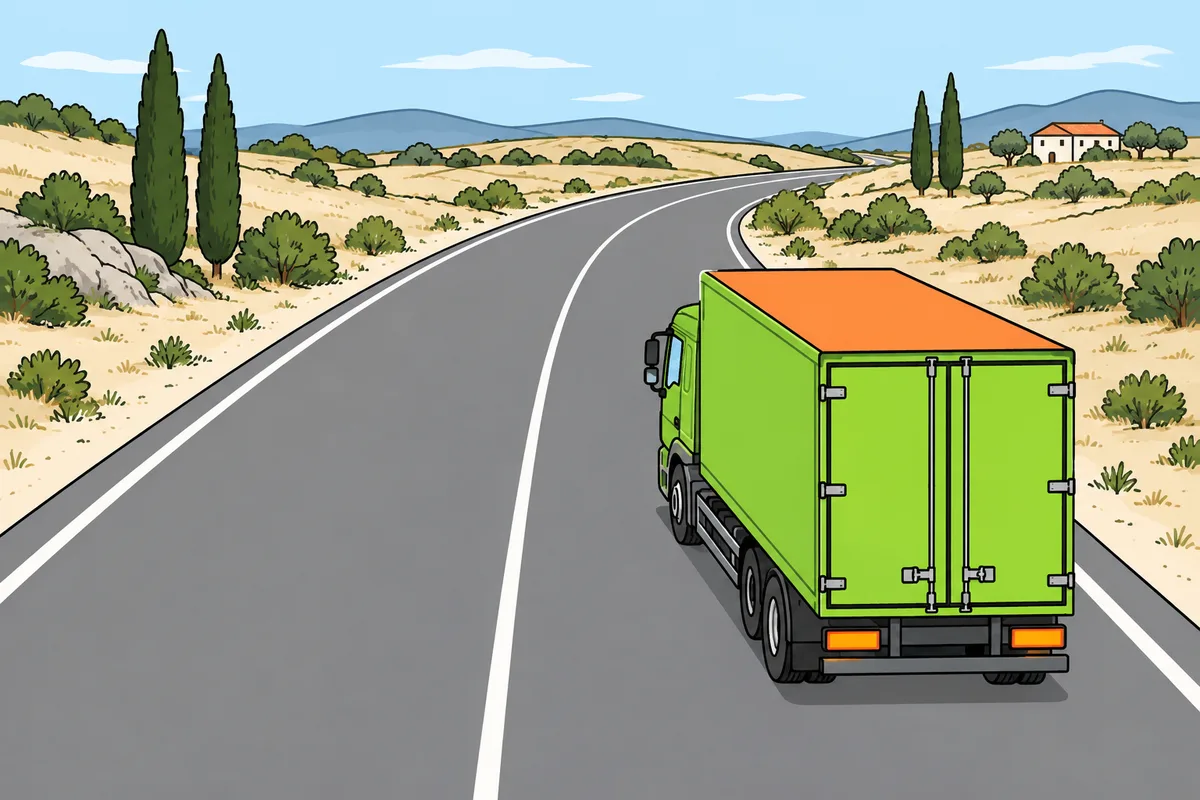
Technique with a truck demands looking well ahead, managing the blind spot, using the brakes smoothly and changing pace well in advance. The heavier the vehicle, the less margin there is to improvise, especially with a load or in narrow environments.
Step 2. The syllabus
2.1Observation and position
Adjust the mirrors and seat position to keep the front, sides and the area close to the vehicle under control before any demanding driving.
- The blind spot is structural on a truck; that's why looking once before turning or changing lane is not enough.
- Your position within the lane must anticipate the turning radius, lateral obstacles and the possible presence of pedestrians, cyclists or other vulnerable road users.
- Look far ahead to prepare the manoeuvre with time; if you spot a problem late, the mass and length reduce your options for correcting it.
2.2Blind spots and vulnerable road users
Before turning, changing lane or approaching a roundabout, check several times because a road user can enter a zone you can't see.
- In an urban environment, the sides of the truck are especially sensitive; an open line must be paired with constant watch over the interior and exterior space.
- If you can't clearly see the risk area, stop and check again; forcing a manoeuvre without visibility is a serious error.
- The exam may present an apparently slow situation; even so, the correct answer requires control of blind spots and lateral space.
2.3Braking and use of momentum
The stopping distance is longer because of mass and inertia; if you anticipate late, the margin to correct disappears sooner than in a passenger car.
- Efficient professional driving uses progressive braking, appropriate engine braking and early reading of traffic to avoid sudden, unstable interventions.
- On downhill stretches, bends and slippery surfaces you must multiply your caution and not rely solely on the service brake to correct late.
- With a load, braking also depends on distribution and securing; a sudden manoeuvre can affect stability and stowage at the same time.
2.4Turns, roundabouts and lateral space
Turns and roundabouts require calculating the turning radius, the vehicle's length and the possible lateral sweep before starting the manoeuvre.
- Don't invade a space without having checked that other road users understand your manoeuvre and that no one is trapped next to the vehicle.
- In narrow streets or service accesses, slow down and use visual reference points; hurrying tends to turn a simple manoeuvre into a risk.
- If the scenario mentions lateral obstacles, loading bays or parked vehicles, think about real space, not only right of way.
2.5Slow manoeuvres and reversing
Loading bays, parking and reversing manoeuvres require visual reference points, minimum speed and control of the lateral and rear space throughout the movement.
- A slow manoeuvre isn't automatically safe; the risk appears when you lose visibility, reference points or control of blind spots.
- Stopping to look again is the correct technical decision when the rear or lateral area isn't clearly under control.
- Practise answering what you must check before moving, during the manoeuvre and before correcting your line, not only at the end.
2.6Exam practice
In the C-specific test you have 20 questions, a maximum of 2 errors and 20 minutes; answer quickly, but always from the rule and the case described.
- In each question, first identify the factor that changes compared with a passenger car: mass, length, blind spot, load, braking or turning radius.
- Be wary of answers that propose deciding at the last second; truck technique is based on preparing early and executing smoothly.
- Relate this lesson to signs, load and mechanics, because a correct manoeuvre depends on the vehicle, the road and the condition of its components.
Step 3. Key points
If you only have a minute before the exam, revise this.
- 1.Adjust mirrors, seat and seatbelt before setting off.
- 2.Check blind spots several times before manoeuvring.
- 3.Anticipate braking, engine braking and changes of pace.
- 4.Increase your margin on downhill stretches, bends and slippery surfaces.
- 5.Calculate turning radius and lateral sweep.
- 6.Don't force manoeuvres without sufficient visibility.
- 7.Use visual reference points when reversing and at loading bays.
- 8.Relate technique to load, signs and maintenance.
Step 4. Exam traps
Mistakes the DGT uses again and again on this topic.
- Relying on experience and leaving the final check for the last second.
- Treating a truck's braking as if it were that of a loaded passenger car.
- Checking a mirror only once before turning or changing lane.
- Forgetting the lateral sweep at roundabouts, turns and narrow streets.
- Thinking a slow manoeuvre can't be dangerous.
- Separating truck technique from load, mechanics and signalling.
Step 5. Quick check
Four real exam questions on what you have just read.
Why should a high-visibility vest be stored away from prolonged sunlight, following its instructions?
Step 6. Frequently asked questions about truck driving techniques
- In a truck, why must you take extra care with nearby road users during turns and merging?
- Because they have larger blind spots. Lorries have nearby areas with limited visibility that can conceal pedestrians, cyclists and other road users. Before and during a turn or when joining traffic, check the surroundings, mirrors and available aids, without assuming they reveal everyone. Do not start or continue a manoeuvre unless it is safe. Blind spots require greater care; they do not make mirrors unnecessary or mean the lorry turns faster.See full question
- You drive a lorry at night on main beam and realise it may dazzle pedestrians walking on the shoulder. Must you switch to dipped headlights?
- Yes, to avoid dazzling. Yes, as soon as you recognise the possibility of dazzling. This duty protects all road users, including pedestrians, and applies on straights and bends. Do not wait for a person to show discomfort or retain main beam simply because you exceed 40 km/h: preventing dazzle takes precedence. Also adjust speed to the illuminated distance, visibility and pedestrians so you can stop safely.See full question
- You are driving a heavy vehicle of large dimensions and the width of the carriageway does not allow you to be overtaken easily. Are you obliged to facilitate overtaking?
- Yes, by slowing down or moving to a practicable shoulder as conditions require. Yes. Drivers of heavy or large vehicles, or those subject to a specific speed limit, must slow down or move to a practicable shoulder as soon as possible when opposing traffic density, carriageway width, profile or condition prevents easy, safe overtaking. These circumstances need not all occur together. Entering an unusable shoulder or leaving the road dangerously is not required.See full question
- What precaution should you take before and during a permitted reversing manoeuvre to avoid striking a pedestrian?
- Check the surroundings and reverse slowly, stopping for any danger. Check that the required space is clear, signal the manoeuvre and reverse slowly with utmost care. If necessary, get out or follow another person’s guidance to check that there is no danger. Stop immediately if a pedestrian approaches or any risk arises. Reversing is allowed only in the cases specified in Article 80; it is not a general authorisation to make a U-turn. Pedestrians can also be struck at night: these circumstances are not mutually exclusive.See full question
- To reduce aerodynamic drag while keeping frontal area, speed and air conditions equal, what is desirable for the drag coefficient Cx?
- The lower it is, the less drag under those same conditions. A lower value: under those equal conditions, lower Cx produces less drag and reduces the energy needed to overcome it. The coefficient is not itself the drag force. It also does not guarantee greater stability or less deviation in crosswinds; those properties depend on other factors and aerodynamic forces. Drag, lift and side forces are distinct.See full question
Official sources
Test what you've studied on truck driving techniques
Exam-style questions on this topic, with an explanation after every answer.
Now, practise it
Test what you have read with exam-style questions and an explanation after each answer.
Related lessons
- C1Truck driving techniques
Truck technique demands observing far ahead, managing the blind spot, using the brakes smoothly and changing pace well in advance. The heavier the vehicle, the less room there is to improvise, especially with a load or in tight environments.
- CSafe loading
Safe loading isn't just a logistics matter: incorrect stowage shifts the centre of gravity, lengthens braking distance and can cause a rollover or objects to fall onto the road. In the C licence - Truck, study it as a matter of safety, responsibility and anticipation.
- CMechanics and maintenance
Preventive maintenance of trucks and goods vehicles is part of road safety: it avoids breakdowns, reduces braking distance, improves stability and cuts down on errors in the exam and in real driving. In the C licence - Truck, basic checks are part of driving with anticipation.
- CGoods transport regulations
A C licence - Truck driver must master the goods-transport framework: authorised category, visibility, the vehicle's masses and dimensions, stowage, route and the prudence obligations of driving a heavy vehicle. This topic brings together licence, load, signs and daily responsibility.
- CSigns
Master the hierarchy between officers, circumstantial signalling, traffic lights, vertical signs and road markings, and study the current official catalogue paying attention to the most recent updates. For the C licence - Truck, always add the restrictions specific to goods and heavy vehicles.
- CDriving and rest times
Driving and rest times are road-safety and labour regulations. For professional licences you must memorise the base limits of Regulation (EC) 561/2006 and understand their preventive logic, because the aim is to avoid fatigue and unsafe decisions.