Step 1. The big picture
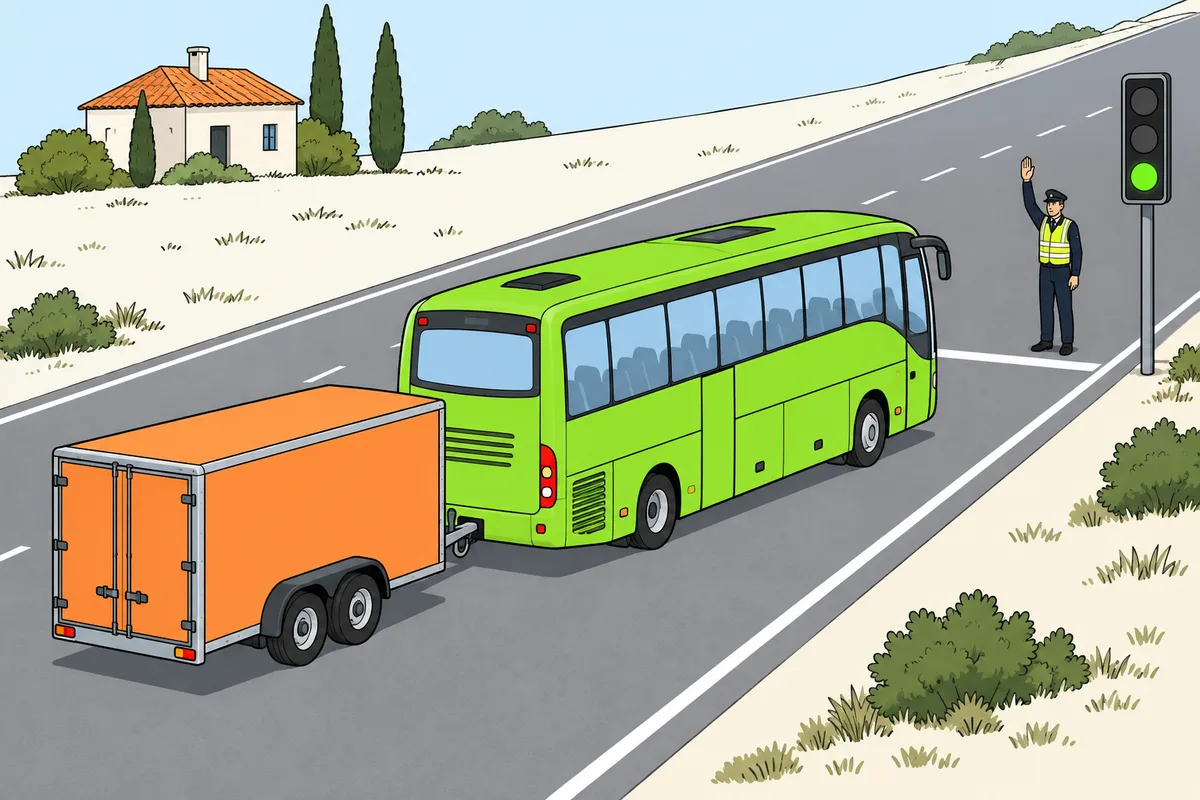
In one sentence…
Master the hierarchy between officers, temporary signalling, traffic lights, vertical signs and road markings, and apply each sign to the D+E combination. On passenger vehicles with a trailer, reading late reduces your margin for correcting.
Step 2. The syllabus
2.1Hierarchy of signalling
First you obey officers, then temporary signalling, then traffic lights, then vertical signs and finally road markings. This order resolves conflicts.
- If two signs appear to contradict each other, the higher-ranking one prevails. In the exam, apply the hierarchy before looking at shape or colour.
- Signs apply from where they are placed, unless they indicate a distance, the length of a stretch of road or an end point. Always read where the obligation begins.
- With a bus and trailer, obeying late has bigger consequences because you need more space to correct. Anticipating is also about reading well.
2.2Officers and temporary signs
Officers' orders take precedence over everything else. Do not resolve first by a road marking if an officer is regulating the situation.
- Temporary and roadworks signalling can change the usual regime. Words like roadworks, diversion or temporary signage are exam clues.
- If roadworks change lanes or the route, adapt the combination with a margin. The trailer requires avoiding abrupt decisions and improvised routes.
- Do not just memorise the order; apply it to specific conflicts. A higher-ranking temporary sign can restrict what a marking would otherwise allow.
2.3Traffic lights and lanes
Traffic lights regulate right of way with priority over an incompatible vertical sign. They may apply to everyone, to one lane or to one manoeuvre.
- In reversible, additional or diverted lanes, look at arrows, lights and panels. The key is usually the affected lane.
- An operating traffic light changes the outcome at a junction. Do not automatically apply the general priority rule if there is light regulation.
- With D+E, choosing the wrong lane can force a late correction. Study lane signs while thinking about your trajectory.
2.4Families of vertical signs
Hazard signs warn you; regulatory signs prohibit or require; information signs give directions or information. Identify their function first.
- A priority sign counts for more than the general priority-to-the-right rule. At a junction, look for signs before deciding.
- In passenger combinations, watch for restrictions on length, height, radius, gradients and access whenever they appear in current signage.
- Translate each sign into conduct: give way, stop, do not enter, keep direction, take extra care or confirm destination. This helps you avoid studying loose pictures.
2.5Road markings and temporary signage
Road markings delimit lanes, excluded areas, crossings, stop lines, parking and priority. They are binding within their scope.
- Do not read a marking in isolation if there are other signs over the same space. An arrow, a lane traffic light and a vertical sign may work together.
- Temporary signage may guide you along a different route. With a trailer, follow it at a suitable speed and without entering excluded areas.
- Transverse markings usually require you to stop, give way or protect vulnerable road users. Prepare to stop so you do not end up occupying a conflict area.
2.6Catalogue and exam method
The official catalogue was updated in 2025 with new representations and pictograms. Use current material to avoid incomplete meanings.
- If a new sign appears alongside a classic one, identify hazard, prohibition, obligation or information and apply the correct conduct.
- Before choosing your answer, work out who is regulating the situation and which stretch or lane is affected. This step removes common traps.
- Then think about how the bus with trailer would behave: anticipating, positioning correctly in the lane and avoiding abrupt manoeuvres.
Step 3. Key points
If you only have a minute before the exam, revise this.
- 1.Always apply the full hierarchy before answering.
- 2.Give priority to officers and temporary signalling when they appear.
- 3.Link traffic lights and lane lights to the affected space.
- 4.Distinguish hazard, regulatory, information, markings and temporary signage.
- 5.Translate each sign into a specific conduct.
- 6.Study the updated official catalogue and avoid old diagrams.
- 7.Think about the extra margin needed for the combination with a trailer.
Step 4. Exam traps
Mistakes the DGT uses again and again on this topic.
- Applying the general priority rule even when a sign, traffic light or officer is present.
- Forgetting that temporary signalling can change the permanent signalling.
- Reading a road marking without linking it to a lane, traffic light or vertical sign.
- Confusing an information sign with an obligation or a prohibition.
- Not checking whether the sign affects only one lane or the whole stretch.
Step 5. Quick check
Four real exam questions on what you have just read.
At a STOP sign with a D1+E or D+E combination, you must:
Step 6. Frequently asked questions about signs
- If a traffic officer is directing traffic while you drive a D1+E or D+E combination, you must:
- Follow the officer's instructions. When traffic officers direct traffic, their instructions take precedence over fixed signs.See full question
- At a yield sign with a D1+E or D+E combination, you must:
- Yield to whoever has priority. At a yield sign, you must let traffic with priority pass and stop only when necessary.See full question
- If you are driving a bus with a trailer and you encounter a STOP sign, you must:
- Come to a complete stop and yield if needed. At a STOP sign you must bring the vehicle to a complete stop and yield when required.See full question
Official sources
Test what you've studied on signs
Exam-style questions on this topic, with an explanation after every answer.
Now, practise it
Test what you have read with exam-style questions and an explanation after each answer.
Related lessons
- A1Signs
Master the hierarchy between officers, temporary signage, traffic lights, vertical signs and road markings, and study the current official catalogue with attention to the most recent updates. Don't memorise isolated pictures: link each sign to the conduct it requires.
- A2Signs
Master the hierarchy between officers, circumstantial signalling, traffic lights, vertical signs and road markings, and study the current official catalogue paying attention to the most recent updates. Don't memorise loose drawings; relate each sign to the conduct it requires.
- AMSigns
Master the hierarchy between officers, temporary signage, traffic lights, vertical signs and road markings, and study the current official catalogue with attention to the most recent updates. In the moped exam, many questions are solved by correctly applying that priority order.
- BSigns
Master the hierarchy between officers, temporary signage, traffic lights, vertical signs and road markings. In the exam you must recognise which order prevails, what conduct each sign requires, and when a temporary indication changes what you would normally expect to see on the road.
- B+ESigns
Master the hierarchy between officers, circumstantial signalling, traffic lights, vertical signs and road markings, and study the current official catalogue paying attention to how combinations with a trailer behave. In B+E you must read every sign thinking about mass, length, lane, stability and the section affected.
- CSigns
Master the hierarchy between officers, circumstantial signalling, traffic lights, vertical signs and road markings, and study the current official catalogue paying attention to the most recent updates. For the C licence - Truck, always add the restrictions specific to goods and heavy vehicles.