Step 1. The big picture
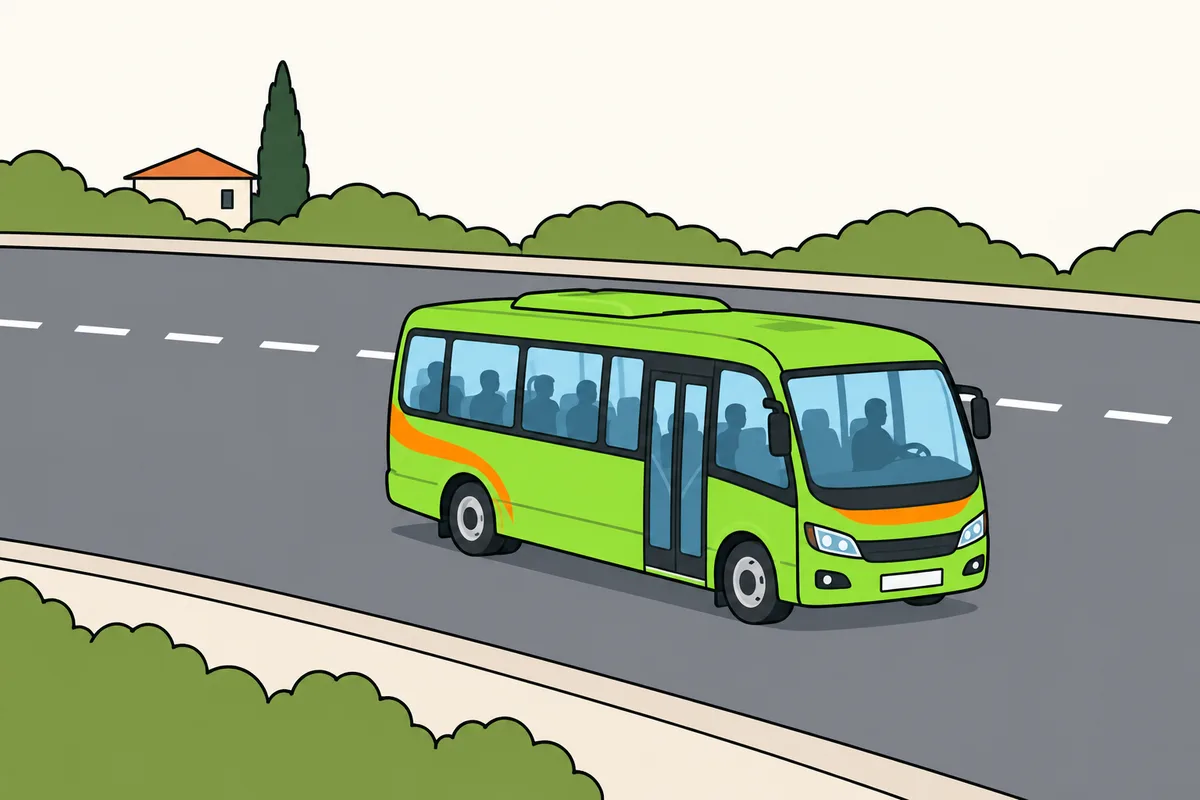
In one sentence…
Driving a minibus requires smoothness, wide observation, control of body roll and respect for the swept path in turns. Passengers feel every mistake even before the external hazard appears, which is why correct technique combines anticipation, precision and calm.
Step 2. The syllabus
2.1Position, mirrors and surroundings
Adjust the mirrors to control the sides, the near front and tracking of the bodywork in turns before setting off and throughout the exam manoeuvre.
- The driving position must let you manoeuvre without stretching, observe without losing your reference points and keep fine control of the wheel and pedals.
- In an urban environment, anticipate pedestrians, cyclists, motorcyclists and users who run towards the stop or appear close to the sides.
- The exam tests whether you understand the mirrors as a continuous tool, not as a one-off check at the start of the manoeuvre.
2.2Wide observation and anticipation
Because of the vehicle's size and the passengers on board, you need to read far and near at the same time: oncoming traffic, the sides, pavements, stops, lanes and vulnerable road users.
- Anticipation avoids sudden braking and abrupt changes that could put seated or standing passengers at risk if the service allows standing.
- Look ahead before you need the manoeuvre; on a minibus, deciding late reduces your options and increases the swept path throughout the exam manoeuvre.
- When a situation is not clear, stopping and checking again is usually safer than improvising a correction with poor visibility.
2.3Comfortable and safe driving
Accelerating, braking or changing direction smoothly protects seated passengers and especially those standing, if the service allows standing.
- Smoothness does not mean unjustified slowness: it means controlling inertia so the minibus responds predictably throughout the exam manoeuvre.
- Keeping your driving progressive helps preserve stability, avoids unnecessary body roll and gives other road users time to interpret your intentions.
- In technique questions, be wary of answers that confuse speed with professionalism; the correct criterion is usually control and anticipation.
2.4Turns and the swept path
The turning radius and the path swept by the rear of the vehicle mean you must widen the manoeuvre and watch for obstacles on the sides and vulnerable road users.
- Before turning, check the mirrors and your surroundings to prevent the rear of the vehicle from invading a space occupied by pedestrians, cyclists or other vehicles.
- Do not close the turn too early: a rushed line can bring the sides or wheels too close to kerbs, signs, vehicles or street furniture.
- The exam often asks about the rear of the vehicle because many candidates only watch the path of the front axle throughout the exam manoeuvre.
2.5Roundabouts and lane changes
At roundabouts, plan the entry, circulation and exit well in advance to avoid abrupt lane changes or unnecessary encroachment throughout the exam manoeuvre.
- Side observation must be maintained throughout the whole path, because other road users may be positioned in areas that are hard to see throughout the exam manoeuvre.
- Signal in good time and only carry out the manoeuvre when the available space allows you to do so without endangering passengers or nearby road users.
- If you take the wrong lane or exit, it is better to continue safely than to correct late with a large vehicle.
2.6Manoeuvres and approaching stops
In reversing manoeuvres or when approaching a platform, if you lack sufficient visibility you must stop and check again throughout the exam manoeuvre.
- Approaching a stop requires smoothness, side control and attention to people who are waiting, moving or crossing near the vehicle.
- Do not open the doors or move off again until the position is safe and you can control the immediate surroundings throughout the exam manoeuvre.
- Practical questions often mix manoeuvring with passengers; answer thinking about visibility, stability, doors and vulnerable road users throughout the exam manoeuvre.
2.7Common mistakes when practising
Looking only ahead is not enough: on a minibus, risk also appears on the sides, at the rear, on pavements and around stops.
- Braking late forces you to correct with force and conveys a lack of security to passengers, even if the vehicle stops before the obstacle.
- Practise turns slowly at first to understand your reference points, but remember that the final goal is safe fluency, not rigidity, throughout the exam manoeuvre.
- When reviewing practice questions, identify whether the mistake comes from a lack of observation, overconfidence, poor inertia management or not knowing the swept path.
Step 3. Key points
If you only have a minute before the exam, revise this.
- 1.Adjust the driving position, mirrors and reference points before setting off.
- 2.Read the far and near environment paying attention to the sides and pavements.
- 3.Drive with genuine smoothness, not just low speed.
- 4.Control body roll, braking and acceleration for passenger safety.
- 5.Watch the turning radius and the swept path of the rear of the vehicle.
- 6.Plan roundabouts and lane changes without late corrections.
- 7.Stop and check again if visibility is insufficient during a manoeuvre.
- 8.Approach stops protecting pedestrians, passengers and vulnerable road users.
Step 4. Exam traps
Mistakes the DGT uses again and again on this topic.
- Forgetting that a minibus can swing the rear of the vehicle sideways in turns.
- Braking or pulling away harshly as if only the road mattered and not the passengers.
- Confusing smooth driving with unjustified slowness or lack of decisiveness.
- Looking only at the front and not controlling the sides, the rear and the stop area.
- Correcting late at roundabouts or in lanes for not planning the exit.
- Continuing a manoeuvre with poor visibility instead of stopping and checking.
Step 5. Quick check
Four real exam questions on what you have just read.
Before a trip with a D1 or D bus, planning it while taking its characteristics into account:
Step 6. Frequently asked questions about bus driving techniques
- Before starting a manoeuvre with a D1 or D bus, it is essential to:
- Check surroundings and signal in advance. Checking mirrors and surroundings, and signaling in advance, helps you maneuver safely.See full question
- Near pedestrians or cyclists, with a D1 or D bus, you must:
- Take extra care and adapt your speed. Pedestrians and cyclists are vulnerable road users, so extra care and an adapted speed are required.See full question
- On a long downhill stretch with a D1 or D bus, it is advisable to:
- Control speed with a suitable gear. Control speed with a suitable gear and the vehicle’s available retardation, following the manufacturer’s instructions. This avoids relying continuously on the service brake and reduces the risk of overheating and reduced braking effectiveness. Do not descend in neutral, which removes engine braking, or wait until the end to brake sharply.See full question
- With a side wind and a D1 or D bus, the prudent action is to:
- Reduce speed and keep firm control. A side wind can destabilize the vehicle, so speed should be reduced and control maintained.See full question
Official sources
Test what you've studied on bus driving techniques
Exam-style questions on this topic, with an explanation after every answer.
Now, practise it
Test what you have read with exam-style questions and an explanation after each answer.
Related lessons
- DBus driving techniques
Driving a bus requires smoothness, wide observation, control of body roll and respect for the swept path in turns. Passengers feel every mistake even before the external hazard appears, which is why correct technique combines anticipation, precision and calm.
- D1Mechanics and maintenance
Preventive maintenance of buses and minibuses is part of road safety: it prevents breakdowns, reduces braking distance, improves stability and cuts down on exam and real-driving errors. On the D1 licence you must treat it as part of your routine as a driver, not as a task left to the garage.
- D1Passenger-transport regulations
On the D1 licence you must master passenger-transport regulations: the scope of the licence, passenger safety, stops, doors, luggage and the extra margin of caution required by the vehicle's size and responsibility. The exam does not separate the regulation from conduct: it asks you to decide how to protect passengers in specific situations.
- D1Signs
Master the hierarchy between officers, temporary signalling, traffic lights, vertical signs and road markings, and study the current official catalogue with attention to the most recent updates. On passenger-transport licences, reading a sign late can compromise turns, stops, reserved lanes and access restrictions.
- D1Driving and rest times
Driving and rest times for passenger transport are based on Regulation (EC) 561/2006. The aim is to limit driver fatigue and protect passengers and other road users; in the exam you must know both the figures and the purpose of each break or rest period.
- D1Passenger transport
Passenger transport requires technique, regulatory knowledge and safe treatment of passengers: access, luggage, information, attention to vulnerable groups and the correct response to incidents. On the D1 licence, driving is always studied together with the service received by the people being transported.